
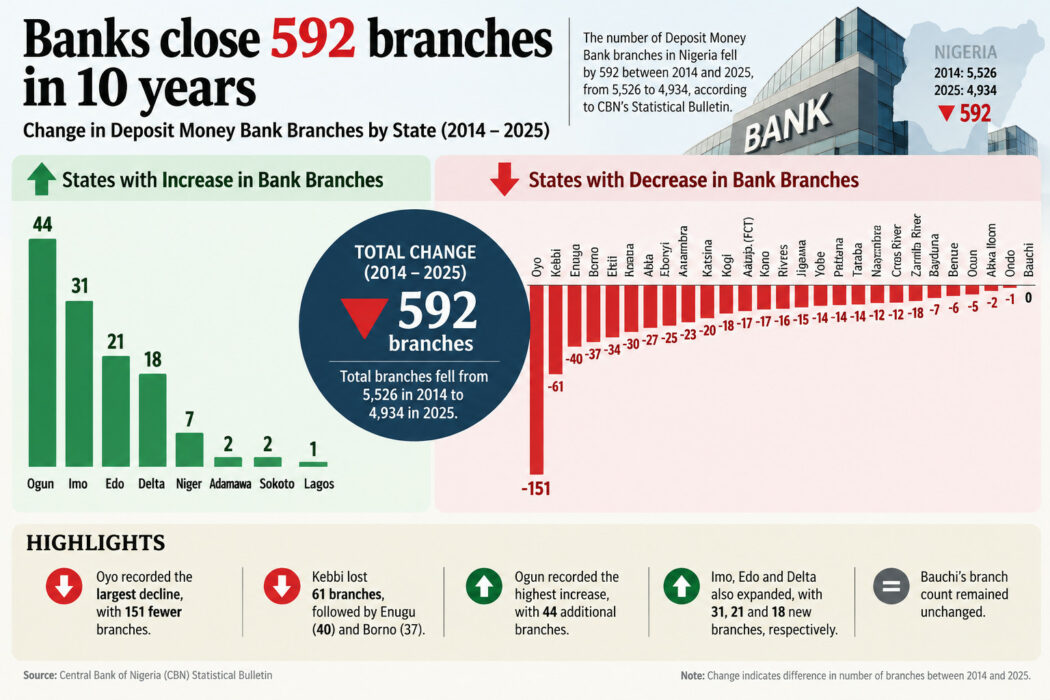
Deposit Money Banks (DMBs) reduced their branch network across Nigeria by 592 between 2014 and 2025, with crisis prone states bearing the costs of shutdowns data from the Central Bank of Nigeria’s Statistical Bulletin for the financial sector has shown.
The CBN data showed that the number of DMB branches declined from 5,526 in 2014 to 4,934 in 2025. The contraction was reflected across a majority of the states, with 27 states recording fewer bank branches over the period, while nine states recorded increases, except for Bauchi which remained unchanged.
The South West recorded some of the sharpest movements, with Oyo State recording the largest decline, with bank branches falling from 347 in 2014 to 196 in 2025, representing a reduction of 151 branches.
Lagos, however, recorded a marginal increase from 1,442 branches in 2014 to 1,444 in 2025, while Ogun recorded an increase of 44 branches, rising from 137 to 181.
In the South East, Enugu recorded a decline from 158 branches in 2014 to 118 in 2025, a reduction of 40 branches. Abia fell from 144 to 117, while Anambra declined from 219 to 196. Ebonyi also recorded a reduction from 59 to 32 branches.
Imo declined from 106 branches to 96, while the number of branches in the South East increased only in none of the states within the region covered by the data.
In the South South, Cross River recorded a decline of 32 branches, from 79 in 2014 to 47 in 2025. Rivers fell from 292 to 275, while Edo declined from 174 to 168. Delta, however, recorded an increase from 178 branches to 196, while Bayelsa declined from 38 to 31.
In the North Central, Abuja recorded a decline from 380 branches in 2014 to 362 in 2025. Kogi dropped from 84 to 68, while Kwara declined from 104 to 74.
Benue was among the states that recorded an expansion, increasing from 47 branches to 61. Nasarawa also rose from 47 to 55, while Niger increased from 67 to 74. Plateau, however, fell from 75 to 61.
In the North East, Borno recorded a decline from 80 branches in 2014 to 56 in 2025, while Gombe fell from 42 to 31. Taraba declined from 39 to 26. Adamawa was one of the states that expanded its branch network, increasing from 47 to 59.
In the North West, Kano recorded a decline from 174 branches to 157, while Kaduna fell from 157 to 146. Katsina dropped from 73 to 50, Kebbi from 38 to 34, Jigawa from 43 to 37 and Zamfara from 33 to 28.
Sokoto was among the few states to record an increase, with its branch network rising from 43 in 2014 to 45 in 2025. Akwa Ibom also expanded from 72 branches in 2014 to 90 in 2025, representing an increase of 18 branches.
We’ve got the edge. Get real-time reports, breaking scoops, and exclusive angles delivered straight to your phone. Don’t settle for stale news. Join LEADERSHIP NEWS on WhatsApp for 24/7 updates →
Join Our WhatsApp Channel