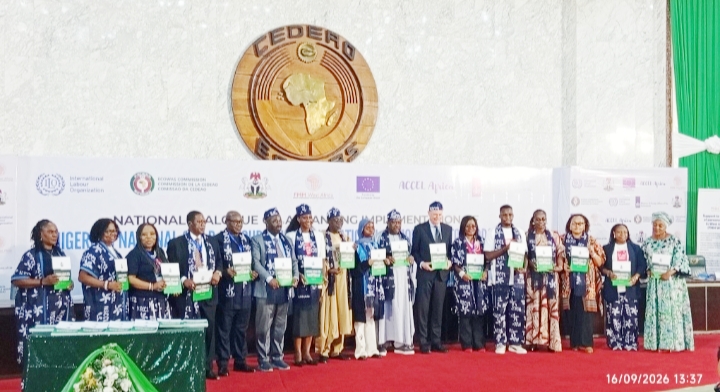
President Bola Tinubu and the International Labour Organisation (ILO), including stakeholders have called for coordinated action by government, employers, workers, civil society and development partners to eliminate child labour in Nigeria, stressing that the problem requires interventions beyond the labour sector.
The call was made on Wednesday in Abuja at the National Dialogue on Advancing the Implementation of Nigeria’s National Policy on Child Labour and National Action Plan for the Elimination of Child Labour (2026–2030), held as part of activities marking the 2026 World Day Against Child Labour.
Tinubu, represented by the Secretary to the Government of the Federation (SGF), George Akume, said the federal government viewed child labour as a national development challenge linked to education, social protection, economic growth, poverty reduction, food security, human capital development and national security.
He said children forced into labour lost opportunities to acquire education, develop confidence and health, and fully contribute to national development.
The President said government would continue to strengthen labour administration, improve labour inspection systems and enhance child protection mechanisms while addressing poverty, unemployment, inadequate access to quality education and social exclusion, which he identified as major drivers of child labour.
He said, “The federal government considers the elimination of child labour not merely as a labour issue, but as a national development priority.
Every child belongs in school, not in hazardous workplaces. Every child deserves protection, not exploitation.”
“Our collective success will depend on partnership, accountability, and sustained commitment.
Together, let us build a Nigeria where every child learns, every family thrives, and every workplace holds dignity, fairness, and justice.”
The President said Nigeria’s participation in the sixth Global Conference on the Elimination of Child Labour in Marrakech, Morocco, earlier this year had further strengthened its commitment to Sustainable Development Goal Target 8.7 and the Marrakech Global Framework for Action.
As an Alliance 8.7 Pathfinder country, Tinubu said Nigeria had the responsibility and opportunity to lead by example by translating international commitments into measurable national action.
He called on state governments to fully support implementation of the National Action Plan, while urging the Nigeria Governors’ Forum and Nigeria Governors’ Spouses Forum to champion child protection initiatives across the states.
Employers, he said, must ensure that Nigerian businesses and supply chains were free from child labour, while workers’ organisations, development partners, traditional and religious institutions, community leaders and parents should contribute to efforts to end the practice.
Speaking at the dialogue, ILO Country Director for Nigeria and ECOWAS, Vanessa Phala, said child labour continued to have damaging consequences for children’s rights, education, health and safety, while limiting their potential contribution to their communities and the country.
Phala said the issue should be treated not only as a child protection matter but also as a labour market and social justice challenge.
She identified four key areas requiring attention in implementing the policy and action plan: national accountability and commitment; decent work and economic empowerment for adults; stronger institutions and systems; and improved coordination and participation.
She said poverty, vulnerability, lack of quality education and social protection, and limited livelihood opportunities were among the major drivers of child labour.
Phala called for greater involvement of the private sector in creating decent work opportunities for parents, saying improved household incomes would help families keep children in school rather than relying on their labour.
She said, “Child labour is not merely a child protection issue, but it is a pervasive and fundamental challenge.
Policies can be as good as they are sitting there gathering dust, but what is actually required is an intentional commitment towards their implementation.”
We cannot make policy without data. Let us transform the strategies into actions and really make measurable progress that we will all be proud of.”
Earlier, the Minister of Labour and Employment, Muhammad Maigari Dingyadi, said child labour remained a major obstacle to human dignity, social justice and sustainable development.
Dingyadi said findings from the National Child Labour Survey showed that millions of children continued to engage in child labour, with many exposed to hazardous work in agriculture, mining, domestic service, street trading and construction.
He said the reviewed National Policy on Child Labour and National Action Plan 2026–2030 provided a roadmap for prevention, protection, enforcement, rehabilitation, institutional coordination and accountability.
The minister said Nigeria remained committed to implementing the Labour Act, Child Rights Act, Trafficking in Persons legislation and relevant international labour standards, particularly ILO Conventions 138 on Minimum Age for Work and 182 on the Worst Forms of Child Labour.
Dingyadi urged stakeholders to move beyond discussions and make concrete commitments to strengthen enforcement of labour laws, expand social protection, improve access to quality education and promote responsible business conduct.
“Child labour remains one of the greatest obstacles to human dignity, social justice and sustainable development.
The statistics generated are not merely numbers; they represent children whose dreams are interrupted and whose rights are denied.”
“Ending child labour cannot be achieved by government alone. It requires a whole-of-government and whole-of-society approach.
I urge every participant to move beyond discussions and make concrete commitments,” Dingyadi said.
We’ve got the edge. Get real-time reports, breaking scoops, and exclusive angles delivered straight to your phone. Don’t settle for stale news. Join LEADERSHIP NEWS on WhatsApp for 24/7 updates →
Join Our WhatsApp Channel