
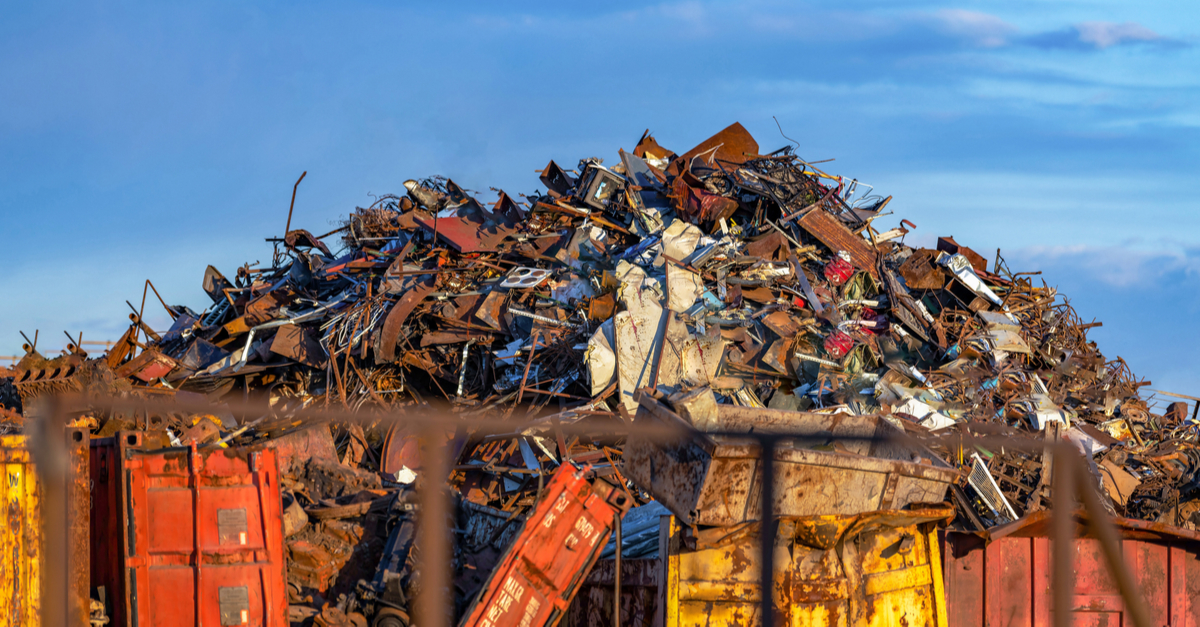
The crisis between scrap-metal dealers and iron and steel companies may have moved beyond a dispute over prices and weighing methods, with the 15-day nationwide strike by dealers threatening to expose a major vulnerability in Nigeria’s steel value chain, the industry’s dependence on scrap as a key raw material.
The chief executive Officer of the Centre for the Promotion of Private Enterprise (CPPE), Dr Muda Yusuf, has identified the weakness of Nigeria’s steel industry as a major obstacle to the construction sector and industrial development, warning that the country’s failure to develop a functional domestic steel ecosystem has resulted in huge capital flight and weakened backward integration.
Yusuf argued that Nigeria’s steel industry must be revived if the country is to become a serious manufacturing economy.
He noted that billets and flat sheets are still imported to produce iron rods, inputs that he said a functional domestic steel industry should be able to supply.
According to him, the failure of the steel sector has implications far beyond steel manufacturing because heavy industries are expected to provide inputs for lighter industries.
“Every single steel used in Nigeria today is imported; it is a sad situation,” Yusuf was quoted as saying, stressing that the construction industry uses substantial quantities of steel annually.
That structural weakness makes the current scrap dispute particularly significant.
Yusuf’s revelation is coming on the backdrop of the 15-day strike by scrap-metal dealers which may have exposed another weak link in Nigeria’s troubled steel value chain, with industry stakeholders warning that a prolonged disruption in the supply of scrap could squeeze steel production, worsen the country’s dependence on imported inputs and ultimately increase construction costs.
For Yusuf, the larger issue is the failure to establish a properly integrated steel industry capable of supplying the inputs required by Nigeria’s expanding construction and manufacturing sectors.
He has argued that the country’s dependence on imported steel represents lost opportunities for jobs, industrial growth and investment.
Speaking further, Yusuf lamented that Nigeria was still importing billets and flat sheets for iron rod production despite the country’s longstanding investments in steel development.
He said the absence of functioning heavy industries had defeated the principle of backward integration.
The present scrap dispute, therefore, comes against the backdrop of Nigeriais efforts to attract fresh investment into the steel industry.
LEADERSHIP also gathered that in September, about $2.7 billion in private capital was being lined up for steel projects, including efforts involving Ajaokuta, Delta Steel and new rolling mills, with the broader objective of increasing domestic steel production and reducing import dependence.
Yusuf, who commented on the investment push, said private investors must have conducted their due diligence and noted that gas infrastructure and tariff protection could support the competitiveness of local producers.
But a functioning steel industry requires more than investment in furnaces and rolling mills. It also requires a reliable supply of raw materials.
That is where the scrap dealers become strategically important.
The dealers form the link between thousands of individual collectors, dumpsites, workshops, construction sites and other sources of discarded metal and the large volumes required by industrial steel producers.
When that link is disrupted, the mills may face a raw-material squeeze.
The immediate effect may not necessarily be a sharp increase in reinforcement-rod prices. Steel manufacturers could draw from existing inventories, source scrap from alternative channels or increase purchases from other suppliers.
However, if the disruption persists and available scrap becomes more expensive, steel producers could face higher production costs.
Those costs could eventually filter through to distributors, building-material merchants, contractors and property developers.
And reinforcement bars are not an insignificant construction input.
Yusuf warned that policies that increase the cost of iron and steel can have serious consequences for construction, manufacturing, and housing, as steel is a major component of building projects.
He also cautioned that rising steel costs could encourage the circulation of inferior products as consumers seek cheaper alternatives.
That concern adds an additional dimension to the current scrap dispute.
If steel production becomes more expensive while purchasing power remains weak, some consumers may seek cheaper reinforcement bars, potentially creating room for substandard products to penetrate the market.
This is particularly sensitive because reinforcement bars are structural materials whose quality directly affects the strength and safety of buildings
For these reasons and more, the National Association of Scrap and Waste Dealers Employers of Nigeria (NASWDEN) commenced the warning strike on October 1, suspending supplies of scrap metals to iron-smelting companies over what it described as arbitrary price reductions, disputed weighing procedures and other practices that have allegedly inflicted heavy losses on its members.
But beyond the immediate disagreement between scrap dealers and steel companies lies a broader economic concern: Nigeria’s steel industry remains heavily constrained by weak domestic production capacity and reliance on imported steel inputs.
Scrap remains an important feedstock for Nigeria’s existing electric arc furnace and melting operations.
A steel expert, Anthony Madagua, said in July that scrap availability was already a major challenge to sustainable steel production and the manufacture of affordable, quality steel products.
“Scrap availability continues to be a major challenge to sustainable steel production and affordable quality steel products,” Madagua said,
He added that scrap aggregation should be regulated and that the government should accelerate efforts to increase scrap generation.
The warning strike therefore comes at a sensitive point for an industry that is already struggling with energy costs, logistics, inadequate infrastructure and competition from imported steel.
Speaking on the development, NASWDEN Deputy National President, Aminu Hassan Soja, said the dealers had been pushed into the industrial action after suffering what they described as repeated financial losses from sudden reductions in scrap prices.
According to him, dealers sometimes buy and transport scrap at an agreed price, only to discover that the purchasing company has reduced the price when the material is delivered.
He said such adjustments could result in losses of between N3 million and N4 million per truckload. The association had earlier put the possible losses at between N3 million and N6 million per truckload.
The dealers have also alleged discrepancies in weighing procedures and deductions of between one and five per cent, which they say further erode their margins.
The allegations remain claims by the association and have not been independently established. The affected steel companies would need to respond to the accusations.
For the dealers, however, the consequences had already become severe enough to warrant a complete suspension of supplies.
The crisis could now shift the pressure from the scrap market to steel mills.
If the stoppage remains within the 15-day warning period, companies with sufficient scrap stocks or alternative raw materials may be able to absorb the disruption. But an extension of the strike could begin to affect production schedules, particularly for companies whose furnaces depend substantially on locally collected scrap.
That possibility is significant because Nigeria’s steel deficit remains enormous.
A recent analysis estimated Nigeria’s annual steel requirement at about 10 million metric tonnes, against domestic production of roughly 1.2 million tonnes, most of it from recycled scrap rather than primary steel production.
This means that even relatively small disruptions within the scrap-to-steel chain can have consequences beyond the companies directly involved.
We’ve got the edge. Get real-time reports, breaking scoops, and exclusive angles delivered straight to your phone. Don’t settle for stale news. Join LEADERSHIP NEWS on WhatsApp for 24/7 updates →
Join Our WhatsApp Channel