
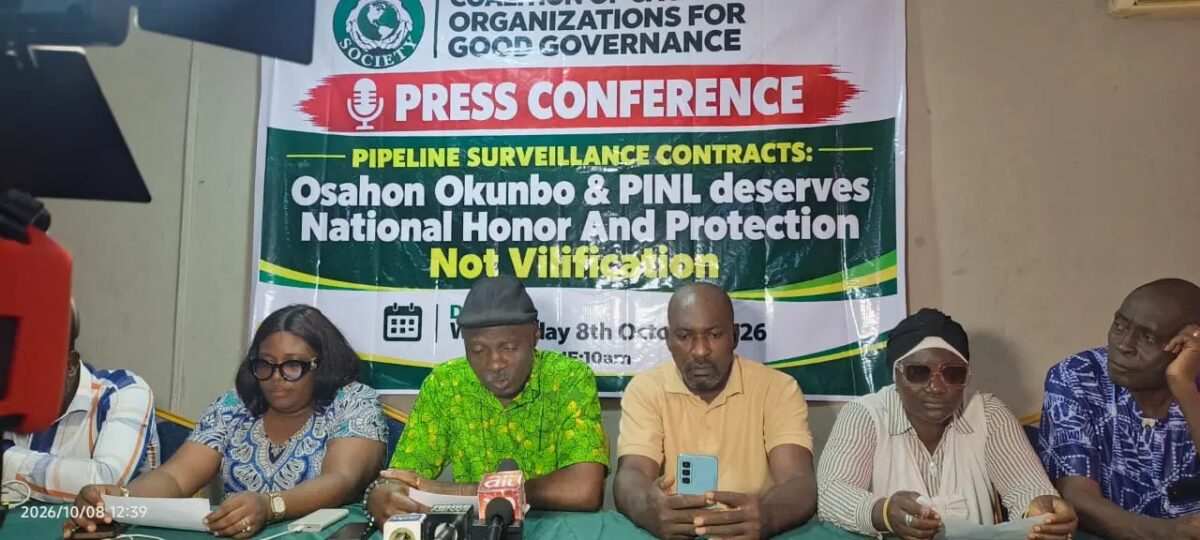
The Coalition of Civil Society Organisations for Good Governance (CCSOGG) has challenged those alleging that Pipeline Infrastructure Nigeria Limited (PINL) receives ₦2.7 trillion for pipeline surveillance in the Niger Delta to produce documentary evidence or retract the claim.
The coalition also defended PINL and its project director, Osahon Okunbo against allegations surrounding the company’s pipeline surveillance contract, warning that unverified claims could undermine critical national security operations and expose personnel to security risks.
Recall that the Olu of Warri, Ogiame Atuwatse III, had rejected a claim by Niger Delta activist Asari Dokubo that he receives N2.7trn annually from pipeline surveillance contracts.
The monarch, through his Sole Representative to NNPC Limited and its joint venture partners, Collins Edema, described the allegation as false and challenged Dokubo to produce evidence to support it.
Speaking at a press briefing the coalition’s spokesman, Comrade Declan Ihekaire, said public accountability must be anchored on verifiable facts rather than sensational allegations.
The group expressed concern over allegations reportedly circulated by former militant leader Asari Dokubo, insisting that no credible documentary evidence had been publicly presented to establish that PINL receives ₦2.7 trillion annually.
CCSOGG argued that the figure had been irresponsibly associated with the company and its leadership, urging those making the allegation to substantiate it with contracts, payment records or other verifiable documents.
“If the allegation is true, let the document be produced. If it is not true, those responsible for spreading it must have the courage and responsibility to correct the record,” the coalition said.
It put the value of PINL’s contract at about ₦150 billion, insisting that the figure should not be confused with the ₦2.7 trillion being circulated.
The coalition, however, did not present the underlying contract documents at the briefing, instead challenging anyone with contrary evidence to make it public.
It also stressed that the value of a corporate contract does not represent the personal income of the individual managing the company, noting that pipeline surveillance involves expenditure on personnel, equipment, logistics, technology, security operations and community engagement.
CCSOGG urged the federal government and the Nigerian National Petroleum Company Limited (NNPCL) to publish sufficient information on pipeline surveillance contracts to promote transparency and address public concerns over government spending.
The group said PINL was responsible for surveillance along the Eastern Corridor of the Trans Niger Pipeline, covering parts of Rivers, Bayelsa, Abia and Imo states.
It cited figures attributed to the company indicating a reduction in pipeline vandalism and infractions, as well as reports of improved protection of sections of the pipeline.
The coalition also referenced PINL’s reported claim that there had been no pipeline vandalism on sections of the Trans Niger Pipeline in Bayelsa and the wider corridor during a period under review.
It acknowledged, however, the need for relevant government authorities to independently verify such performance claims.
According to the group, PINL’s operations cover about 215 communities, with traditional rulers, youth leaders, women and other stakeholders reportedly participating in surveillance activities.
It added that the company’s reported engagement of thousands of youths, alongside the deployment of drones, surveillance stations, security vessels and mobile response units, underscored the importance of combining community intelligence with technology to protect critical oil infrastructure.
The coalition called for an independent assessment of all pipeline surveillance contractors, insisting that decisions to retain, review or expand their contracts should be based on measurable results, competence and value for money.
It said the assessment should consider reductions in pipeline vandalism, protection of crude oil production, community relations, technology deployment and operational effectiveness.
CCSOGG maintained that contractors meeting established performance benchmarks should not be disadvantaged by unverified allegations, while emphasising that all operators must remain accountable under the same standards.
It urged anyone with evidence of wrongdoing to submit it to the appropriate government and anti-corruption agencies rather than resort to public accusations.
The coalition also called for adequate protection for pipeline surveillance personnel, warning that inflammatory allegations surrounding sensitive security assignments could expose workers, their families and host communities to unnecessary risks.
“Nigeria needs more protection of its pipelines, not more politics around pipeline protection,” the coalition said.
We’ve got the edge. Get real-time reports, breaking scoops, and exclusive angles delivered straight to your phone. Don’t settle for stale news. Join LEADERSHIP NEWS on WhatsApp for 24/7 updates →
Join Our WhatsApp Channel