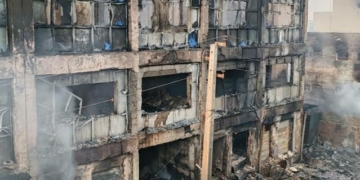
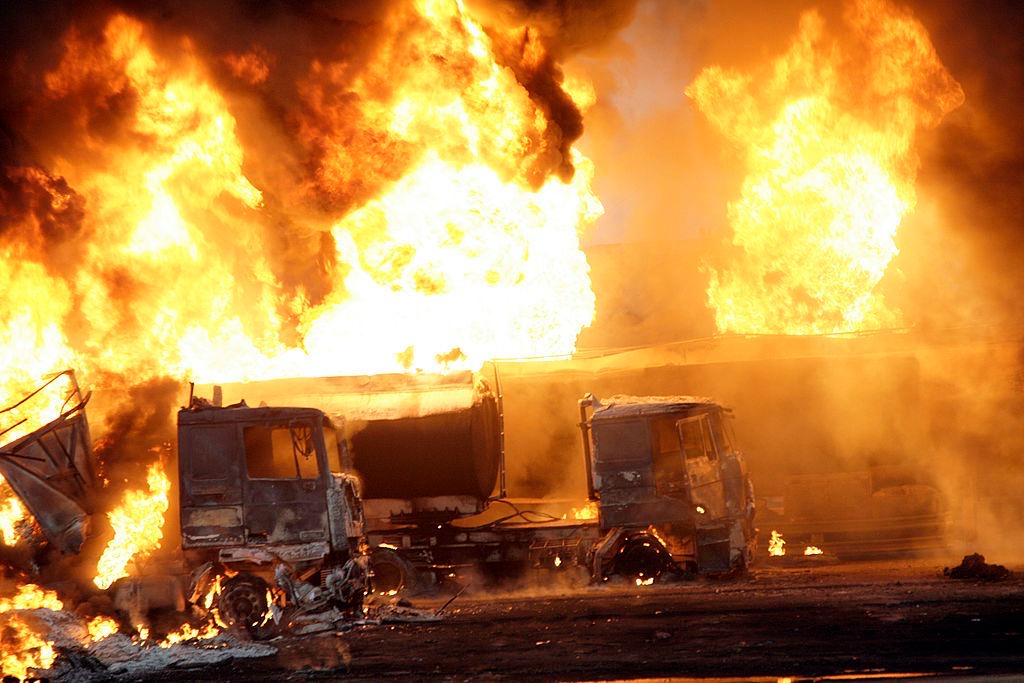
From tanker explosions to burning homes, filling stations, markets and shopping malls, recurring fires across Nigeria continue to claim lives and destroy property worth billions of naira.
Despite a ₦45.11 billion allocation to the Federal Fire Service in the 2025 budget and another substantial allocation proposed for 2026, questions persist over its preparedness, operational capacity and accountability.
In this report, CHRISTIANA NWAOGU examines the funding, challenges, and whether Nigerians are getting value for money.
Every major fire outbreak leaves behind more than charred vehicles, gutted buildings and grieving families. It exposes weaknesses in Nigeria’s emergency response system and raises questions about whether firefighters have the equipment, personnel, and resources needed to save lives when disaster strikes.
From highways and filling stations to crowded markets, warehouses, homes and shopping malls, fire outbreaks continue to threaten lives, livelihoods and investments. Traders lose their businesses, families lose their sources of income, and communities bear the economic and emotional costs long after the flames have been extinguished.
In some incidents, frustrated residents have reportedly pelted firefighters with stones, while property owners have accused emergency responders of arriving late. The Federal Fire Service (FFS) has attributed some delays to late distress calls and other operational challenges, explanations that grieving and angry victims may find difficult to accept.
Across Nigeria’s 36 states and the Federal Capital Territory (FCT), the aftermath of uncontrolled infernos is often marked by panic, anguished cries and a painful sense of helplessness.
The scale of the challenge is reflected in figures attributed to the FFS for 2025, which reportedly recorded 1,866 fire incidents, 114 deaths and estimated property losses of ₦74.75 billion. These figures underscore the need for human resources, facilities, and technology to respond to fuel-related fires, building collapses, and floods.
But with substantial public funds allocated to the Service, questions remain about whether government spending is translating into functional equipment, improved response times and better protection for Nigerians.
Recent incidents across the country illustrate the scale of the challenge confronting emergency responders, particularly the Federal Fire Service ( FFS)
In Cross River State, Calabar recorded several major incidents in 2026. A reported explosion at the Fonex/Fomex facility in Edibe Edibe in March injured dozens of people and damaged nearby property. The Akim Timber Market fire subsequently destroyed more than 100 shops, while a fire at SPAR Mall in August damaged sections of the shopping complex. On October 15, a reported fire at Scanobo Filling Station in Ikot Ekpo, 8 Miles, affected vehicles and nearby shops.
Tanker-related incidents have also continued to claim lives. In March, a collision involving a gas tanker and a tipper at Sango-Tedo along the Lekki–Epe Expressway in Lagos reportedly killed one person and injured two. In June, a tanker-related collision at Ugwu Onyeama on the Enugu–Onitsha Expressway claimed three lives.
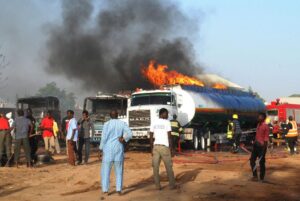
October brought further incidents. On October 4, a diesel tanker fire in Odukpani, Cross River State, reportedly destroyed shops, buildings and vehicles. Published reports differed on the casualty figures.
On October 13, a fire at Itire, Lagos, spread from an eight-room bungalow to an adjoining two-storey residential building. Two men were rescued, including one who sustained burns.
Two days later, a petrol tanker overturned and caught fire near Oluku Market along the Benin–Lagos Road in Edo State, damaging market stalls and several vehicles. Reports indicated that at least eight people sustained burn injuries.
Also on October 15, fire engulfed parts of the Folashade Tinubu Ojo Ebute-Ero Market on Lagos Island, spreading from storage shops to an upper floor of a multi-storey building.
On October 17, a diesel tanker reportedly carrying 45,000 litres of fuel suffered brake failure and crashed into four vehicles near Aduloju Bus Stop along the Ojoo–Iwo Road in Ibadan, Oyo State. Five people were reported dead, while 10 others were rescued alive.
The following day, another tanker crash near Okoh Junction in Agbor, Delta State, triggered a fire that engulfed vehicles and destroyed property worth millions of naira.
Market fires have similarly destroyed shops, goods and livelihoods in Nnewi, Kano, Yobe, Offa, Jos, Onitsha, Lagos, Ilorin and Ibadan, among other locations. Other reported incidents have affected Mandate Ultra-Modern Market in Ilorin, Sabo Market in Ikorodu, Oranyan Market in Ibadan and Eda Plaza in Abuja.
Beyond the immediate destruction, these incidents raise questions about fire prevention, emergency access, the availability of specialised equipment and the ability of responders to reach affected locations quickly.
Funding Versus Performance
Established in 1963, the Federal Fire Service is the federal government’s principal agency for fire prevention, mitigation and suppression, as well as rescue and other emergency services. It operates under the supervision of the Federal Ministry of Interior.
Its responsibilities include controlling and preventing fires, protecting lives and property, and undertaking other authorised humanitarian duties. However, recurring disasters and complaints about delayed responses have raised questions about its operational capacity.
Figures obtained by LEADERSHIP show that the FFS received an allocation of ₦9.6 billion in 2019, rising to ₦11.9 billion in 2020 and ₦16.5 billion in 2021. More than ₦10.4 billion was reportedly invested in 2022, while an allocation of ₦51.74 billion was cited for 2023.
The 2025 Executive Budget proposal earmarked approximately ₦45.11 billion for the Service, covering personnel, overhead and capital expenditure. Another substantial allocation was proposed for 2026.
These figures raise a fundamental question: how much of the money budgeted is actually released and spent, and what improvements does the expenditure deliver?
For firefighters confronting emergencies under difficult conditions, functional vehicles, reliable water supplies, adequate staffing, accessible roads and strategically located stations can make the difference between containing a blaze and watching it spread.
Fire consultant Engr. Nevolom Ibeku said the scale of reported fire incidents raised important questions about emergency-response capacity.
He questioned whether enough fire engines were operational and whether firefighters had adequate protective equipment, water supplies, specialised foam for petroleum-related emergencies and regular training.
These concerns are particularly significant during tanker fires, industrial emergencies and blazes in congested markets, where the nature of the fire and availability of appropriate equipment can determine the outcome.
A retired firefighter who identified himself only as Nnaji said budget allocations alone could not establish the Service’s effectiveness without evidence of implementation and operational results.
He cautioned against automatically blaming firefighters whenever a disaster caused extensive damage, noting that traffic congestion, inaccessible locations, inadequate water supplies, equipment shortages and the scale of an outbreak could affect response times.
However, Nnaji stressed the need for greater transparency in public expenditure and operational performance. He said fire-service authorities should provide reliable information on functional vehicles, staffing, response times and equipment availability, while governments should disclose how funds were released and utilised.
Providing examples of operational challenges at state level, Nnaji said only three of nine firefighting vehicles in Kebbi State were functional. He explained that before his retirement, the state’s Director of Fire Service had submitted several memos seeking repairs to the vehicles or the procurement of replacements.
He further disclosed that Delta State had 18 functional fire trucks serving 12 fire stations, adding that new stations had been constructed at Owa Oyibu and Koko. He said the state government had also procured equipment and firefighting chemicals to strengthen operations.
In the FCT, Nnaji said there were 25 firefighting vehicles, including water, foam, and emergency tenders, distributed across 15 fire stations. According to him, the service had the facilities and technology to respond to fuel-related fires, building collapses, floods, and road accidents.
The claims highlight differences in operational capacity across jurisdictions and the need for verifiable data on the condition, distribution and utilisation of firefighting resources.
FFS Explains Challenges, Defends Response Times
Responding to concerns about recurring fires, emergency-response delays, and operational capacity, the FFS, the national public relations officer, deputy controller of Fire, DCF Paul O. Abraham, said the adequacy of firefighting resources must be assessed against Nigeria’s population, geographical size, expanding cities, and growing economic activities.
He noted that the country’s 36 states, the FCT, and 774 local government areas contain commercial centres, industrial facilities, petroleum depots, refineries, filling stations, gas installations, ports, markets, and highways that require different levels of firefighting capacity.
According to Abraham, the Service’s responsibilities extend beyond extinguishing fires to include prevention, rescue operations, public enlightenment, regulatory functions and professional training.
He put the FFS fleet at 84 fire trucks, 20 water tankers and 20 Rapid Intervention Vehicles. He also cited an operational structure comprising 18 zones, 32 state commands, 94 fire stations, area commands, and outposts.
Abraham argued that the adequacy of these resources should not be judged by vehicle numbers alone, but by their condition, distribution, suitability and ability to meet the risks in different locations.
A tanker fire involving large quantities of petrol, for instance, may require specialised firefighting foam, substantial water supplies, protective equipment, trained personnel and the coordinated deployment of several appliances. Industrial fires and outbreaks in congested markets may similarly demand specialised equipment and vehicles capable of navigating narrow streets.
On efforts to improve operational capacity, Abraham said the Service was pursuing the rehabilitation and modernisation of firefighting appliances, personnel development, fire-safety inspections, public education, inter-agency collaboration and expansion of fire-station infrastructure.
He disclosed that, at a stakeholders’ summit in August 2026, the controller-general reported that 40 firefighting appliances had been rehabilitated and revamped, while two modern appliances were ready for commissioning and deployment.
Abraham added that the Service was pursuing partnerships with public tertiary institutions, local government stakeholders, private organisations and communities to support fire-station development. The proposed National Fire Academy project, he said, was also part of efforts to strengthen professional training and national firefighting capacity.
The objective, according to him, was not merely to acquire more vehicles but to ensure that functional equipment, trained personnel and appropriate emergency facilities were available where they were most needed.
Who Is Accountable When Firefighters Arrive Late?
On the question of accountability when emergency responders arrive late, or extensive damage occurs, Abraham said responsibility must be determined by investigating the circumstances of each incident rather than automatically blaming a particular agency or individual.
He explained that emergency response involves multiple agencies, including federal and state fire services, the Federal Road Safety Corps, the Nigeria Police Force, the National Emergency Management Agency and other relevant authorities.
While firefighters undertake suppression and rescue operations, other agencies may be required to manage traffic, secure incident scenes, facilitate evacuation and provide medical assistance.
Abraham identified several factors that could delay responses, including late distress calls, inaccurate location information, heavy traffic, poor road access, distance from the nearest operational station, equipment limitations and response units already attending other emergencies. Communication and coordination difficulties among agencies could also affect operations.
However, he stressed that where investigations establish negligence, misconduct or failure to discharge assigned responsibilities, appropriate administrative, disciplinary or legal procedures should follow. Where delays result from systemic weaknesses, the relevant authorities must take corrective action.
He also highlighted the responsibilities of tanker owners, operators and drivers, noting that roadworthiness, proper vehicle maintenance, compliance with safety regulations and responsible driving were essential to preventing accidents and reducing their consequences.
Abraham cited a joint response by the Federal Fire Service and Rivers State Fire Service in February 2026 after a tanker overturned and spilt fuel near Nkpogu Roundabout along Elekahia Road in Port Harcourt. He said the intervention helped prevent ignition and avert what could have become a major fire disaster.
He also referred to an August 2026 incident at AYM Shafa Filling Station in Area 3, Garki, Abuja, involving a tanker carrying approximately 60,000 litres of petrol. According to him, the incident demonstrated the importance of appropriate firefighting appliances, specialised suppression methods and coordinated emergency operations.
To improve response times, Abraham called for strategically located fire stations and emergency outposts, functional, well-maintained appliances, reliable emergency communication systems, improved traffic management, and regular joint exercises among relevant agencies.
He also urged motorists to give way to emergency vehicles, and members of the public to keep away from tanker accident scenes and avoid scooping up spilt fuel.
He maintained that a swift response depends not only on the speed of a fire truck but also on appropriate equipment, accurate information, accessible roads, strategic deployment, inter-agency coordination and public cooperation.
Beyond Budgetary Allocations
Nigeria’s recurring fire disasters raise questions that cannot be answered by budget figures alone. The country needs functional firefighting equipment, trained personnel, strategically located stations, reliable emergency communication systems and effective coordination among federal and state agencies.
Just as importantly, Nigerians need reliable information showing how public funds are released, what they purchase and whether they improve emergency-response performance.
The Federal Fire Service outlined measures it says are being taken to rehabilitate equipment, improve training and strengthen operational capacity. Assessing their impact, however, requires verifiable information on the condition of its fleet, staffing, station coverage, response times and the outcomes of fire incidents.
Clear performance targets, regular public reporting and credible investigations into emergency-response failures would help Nigerians determine whether public investment is translating into better protection for lives and property.
For a country where a single tanker explosion or market inferno can destroy livelihoods and devastate communities, preparedness cannot remain a budgetary promise. It must be demonstrated through operational readiness, measurable results and accountability.
The question on the lips of many Nigerians is this:
When the next tanker overturns, or a market goes up in flames, will the Federal Fire Service and other emergency responders have what they need to save lives?
Or will Nigerians once again be left asking the painful question: Where is the fire service when it is needed most?
We’ve got the edge. Get real-time reports, breaking scoops, and exclusive angles delivered straight to your phone. Don’t settle for stale news. Join LEADERSHIP NEWS on WhatsApp for 24/7 updates →
Join Our WhatsApp Channel