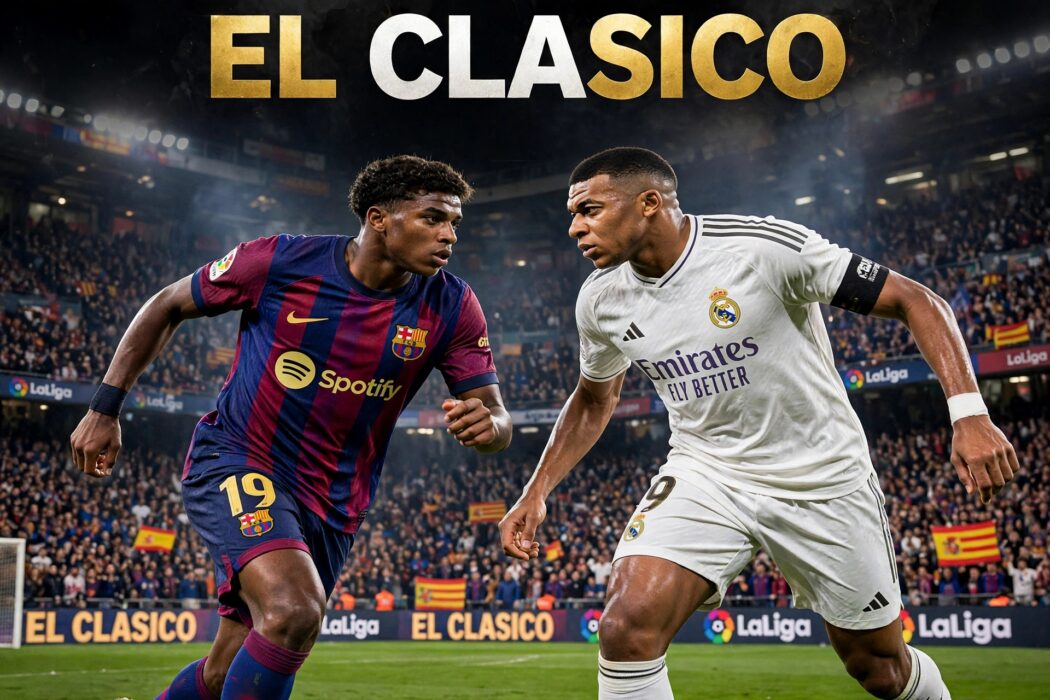
It is the game that stops Spain and captivates the football world. Ahead of the 265th competitive El Clásico, here are the ten essential facts that explain why Barcelona vs. Real Madrid is more than just a match.
1. The head-to-head is perfectly level
After 264 official meetings, neither club can claim superiority. Barcelona and Real Madrid have each won 106 times, with 52 draws—a balance that has taken 124 years to reach. A win on Sunday would put one club ahead in the all-time record for the first time in recent memory.
2. The goals are almost as tight as the wins
Real Madrid hold a narrow advantage in goals scored, but the margin is just three: 444 for Madrid compared to 441 for Barcelona across all competitive fixtures. In La Liga alone, the two sides have met 192 times, with Madrid winning 80, Barcelona 77, and 35 draws.
3. Lionel Messi owns the scoring record
No player has scored more in this fixture than Lionel Messi, who found the net 26 times in 45 Clásicos. Cristiano Ronaldo and Alfredo Di Stéfano are joint-second with 18 goals each, followed by Karim Benzema on 16. Messi also leads the assist charts with 14.
4. The biggest win was an 11-1 thrashing
The largest margin of victory in El Clásico history came in June 1943, when Real Madrid beat Barcelona 11-1 in the second leg of the Copa del Generalísimo semi-final. Madrid also hold the record for the biggest La Liga win in the fixture: an 8-2 victory at Chamartín in the 1934/35 season.
5. Real Madrid own the longest winning streak
Between April 1962 and February 1965, Real Madrid won seven consecutive Clásicos—the longest run of dominance by either side in the fixture’s history. Barcelona’s best streak is five, achieved between 2008 and 2011 under Pep Guardiola.
6. It is Spain’s first televised football match
El Clásico made history on 15 February 1959, when it became the first football match ever broadcast on Spanish television. TV sets sold out across both cities as fans scrambled to watch Real Madrid, featuring Di Stéfano and Puskás, win 1-0 at the Bernabéu.
7. Cruyff’s 0-5 at the Bernabéu changed Barcelona
Johan Cruyff’s arrival in 1974 tilted the balance toward Barcelona, and his performance in a 5-0 win at the Santiago Bernabéu remains one of the greatest individual displays in Clásico history. That result helped Barcelona win the league and instilled a footballing philosophy that still defines the club today.
8. It is watched by more than 600 million people
El Clásico is a truly global event, with a potential worldwide audience of over 600 million viewers across more than 180 countries. Estimates suggest the global audience has at times reached 650 million to 800 million, dwarfing even major events like the IPL final.
9. The stadiums are among the largest in world football
A Clásico at the Camp Nou has drawn 99,264 spectators, while the Bernabéu has hosted 81,044 for the same fixture—more than 30,000 more fans than any other major football rivalry. Both clubs are also among the top three most valuable sports teams in the world, alongside the Dallas Cowboys.
10. Sunday’s game could decide the title race
Barcelona lead La Liga with 27 points from nine wins, six clear of Real Madrid in third on 21 points. A Barcelona victory would open a nine-point gap—a margin that, even at this stage, would leave Madrid’s title hopes hanging by a thread. With José Mourinho returning to the Clásico and Hansi Flick’s Barcelona chasing a historic tenth straight league win, the stakes could hardly be higher.
Bottom line
El Clásico is a fixture where history, identity, and footballing excellence collide. The records are level, the goals are tight, and the global audience is immense. On Sunday, one of those 106 wins will become 107—and the balance of Spanish football may shift with it.
We’ve got the edge. Get real-time reports, breaking scoops, and exclusive angles delivered straight to your phone. Don’t settle for stale news. Join LEADERSHIP NEWS on WhatsApp for 24/7 updates →
Join Our WhatsApp Channel