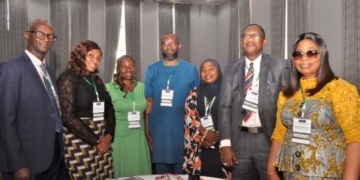
The minister of finance and coordinating minister of the economy, Taiwo Oyedele, has urged Nigerian startups to grow into large companies, saying the country’s economic future depends on it.
Oyedele spoke on Saturday at the final Demo 4.0 Day of the fourth edition of the NSIA Prize for Innovation (NPI), where the Nigeria Sovereign Investment Authority (NSIA) and its partners awarded $277,000 to seven startups.
In his keynote address, the minister, represented by his special adviser on Investments, Marie Ukpere, described small and medium-sized enterprises (SMEs) as the backbone of the Nigerian economy.
He said they sustain millions of livelihoods, provide jobs across the country and support local economic activity in virtually every sector.
He said the ability of businesses to innovate, expand production and reach new markets would be critical to Nigeria’s long-term economic development.
“Our ambition in view of the trillion-dollar economy would depend in no small measure on our abilities to help small businesses become medium-sized enterprises, medium-sized enterprises become large companies, and Nigerian companies become competitive players across Africa and the world,” he said.
Oyedele told the winners and finalists that the true measure of their success would not be the prizes and exposure they received at the event, but the businesses they go on to build in the years ahead.
He expressed the hope that within five to 10 years, the businesses would employ thousands of Nigerians, attract significant investments and develop solutions that could serve markets across Africa.
Seven winners share $277,000
The combined prize value of $277,000 comprises $220,000 from the NSIA, $45,000 from Cascador and $12,000 from Wema Bank.
Twelve startups pitched their innovations at the event after emerging from more than 6,000 initial applicants. This year’s edition focused on startups in manufacturing, climate and food security, and healthcare.
Come Again Foods, a food manufacturer that produces packaged snacks from locally sourced agricultural commodities, emerged as the overall winner. Its products include Tapiokies.
The company received a combined prize of $105,000, made up of $100,000 from the NSIA and a $5,000 Cascador Impact Prize.
Protein Kapital, an insect-farming company, came second and received $70,000 from the NSIA. The company uses Black Soldier Fly larvae to process organic waste into protein and biofertiliser. It processes about 5,000 tonnes of waste across three countries.
InstantRad Inc., an AI-enabled teleradiology platform, took third place and received $50,000 from the NSIA. The platform connects hospitals and diagnostic centres with radiologists across Africa.
Eight Medical, an emergency medical services company, won the $15,000 Cascador Impact Prize and $4,000 from Wema Bank. The company gives people access to ambulances, hospitals and trained emergency personnel through WhatsApp, USSD, IVR and telephone channels.
Uwana Energy, a clean energy marketplace that helps businesses source and deploy solar energy systems, won a $5,000 PIVAC Healthcare Innovation Prize.
Tryctor, which makes tractors and farm implements for smallholder farmers, and Smartei Agri Tech, a climate-tech firm building AI-enabled hydroponic farming systems, each received $4,000. Smartei’s systems use controlled growing environments to improve productivity while using less water and land.
According to the NSIA, the awards comprise both cash and equity components. The top three winners received a combined $220,000 in cash and equity.
The nine other NSIA award finalists, all classified as fourth-place finalists, will join the top three winners for a six-week, all-expenses-paid learning programme at Lagos Business School.
The prize also offers winners potential access to up to $1.5 million through the Pula Xcelerator, and a chance to compete for N100 million in equity-free grants at the grand finale of Wema Bank’s Hackaholics programme.
How the winners were picked
Each of the 12 finalists pitched to a live audience and a panel of judges drawn from the business and technology ecosystems, and answered questions from them. Deloitte Consultancy vetted the process from the application stage to the final.
The managing director and chief executive officer of the NSIA, Aminu Umar-Sadiq, told the press that the 12 innovators went through a rigorous and transparent selection process. It involved more than 6,000 applications, five rounds of interviews, accelerator programmes and meetings.
He said providing education, equity and exposure to talented Nigerian innovators was a key part of the NSIA’s strategy for supporting SMEs.
Umar-Sadiq added that the NSIA and its partners, Wema Bank, Cascador and Pula, would support the businesses to advance their ideas, generate cash flow and possibly attain unicorn status.
Partners speak
The founder of Cascador, Dave DeLucia, said Nigeria has huge unmet needs, many business opportunities and a strong culture of entrepreneurship and resourcefulness.
He said tapping these opportunities would require entrepreneurial training and support to help startups become investment-ready, secure initial funding, attract more capital and build sustainable businesses.
DeLucia said identifying the best innovators early was a valuable initiative, and that the NSIA Prize for Innovation embodied it. He added that innovators would need substantial training and support to scale their ideas.
The national coordinator of the Presidential Initiative for Unlocking the Healthcare Value Chain (PVAC), Dr Abdu Mukhtar, urged the innovators to see challenges as opportunities to make an impact in the healthcare, agriculture and climate change sectors.
About the NSIA
The NSIA was established under the Nigeria Sovereign Investment Authority Act, 2011, to manage and invest in a diversified portfolio of medium- and long-term funds.
The NSIA Prize for Innovation is its multi-year initiative to identify and nurture early-stage innovative businesses in the technology ecosystem, with the aim of creating a sustainable positive impact.
Earlier, founder and chief executive officer of ReelFruit, Affiong Williams, advised entrepreneurs to understand their customers, build strong professional networks and remain resilient to succeed in business.
Mrs Williams, one of the Judges, gave the advice while sharing lessons from her entrepreneurial journey with finalists at the event.
She urged entrepreneurs to prioritise understanding their target customers and ensuring that their products meet market needs, rather than concentrating solely on product innovation.
The ReelFruit founder also urged entrepreneurs to build strong networks and establish a reputation for commitment, preparedness and credibility to attract investors.
Drawing from her experience, she said that her business had raised more than seven million dollars in funding from individuals and institutions.
Mrs Williams further encouraged entrepreneurs to remain resilient amidst Nigeria’s economic challenges, including currency fluctuations, policy changes and macroeconomic instability.
She urged the finalists to see the competition as a stepping stone to greater opportunities and remain focused on building sustainable businesses that create jobs, wealth and economic impact.
We’ve got the edge. Get real-time reports, breaking scoops, and exclusive angles delivered straight to your phone. Don’t settle for stale news. Join LEADERSHIP NEWS on WhatsApp for 24/7 updates →
Join Our WhatsApp Channel