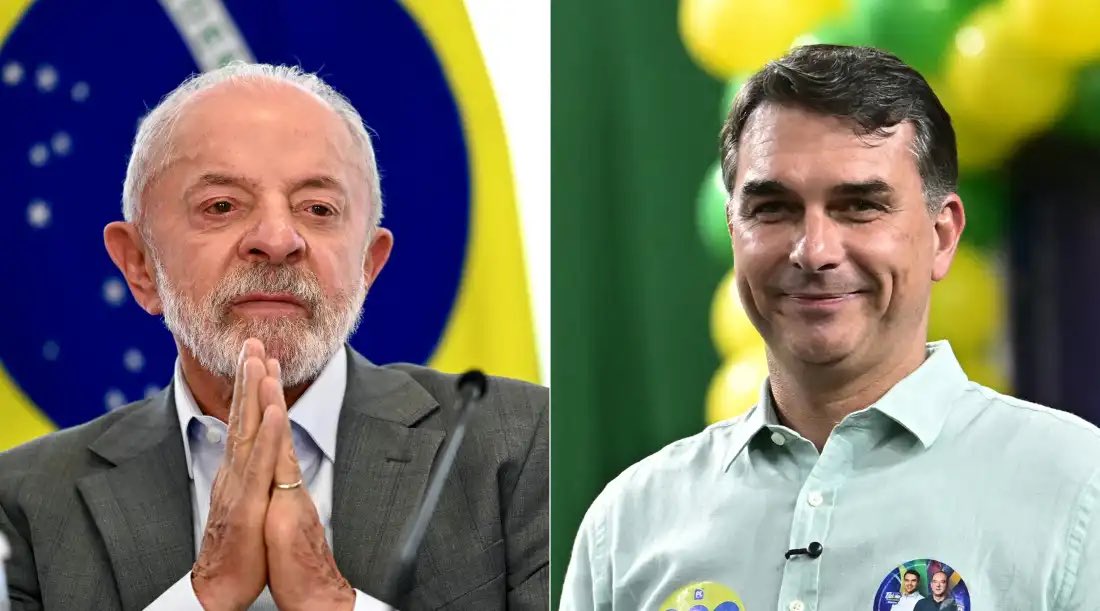
Right-wing Brazilian Senator Flavio Bolsonaro has followed his imprisoned father’s lead by refusing to concede defeat to leftist President Luiz Inácio Lula da Silva, who won a historic fourth term in Sunday’s presidential election.
Bolsonaro, the son of former President Jair Bolsonaro, called into question a late-Sunday decision by a Lula-appointed Supreme Court justice that extended voting by two hours over alleged public transport irregularities. The senator said he would ask for the result to be annulled.
“It is impossible to recognize the election results, given the circumstances under which things unfolded,” Bolsonaro told journalists.
While the candidate moved to contest the result, world leaders quickly rallied behind Lula’s victory, with congratulations pouring in from the EU, Mexico, France, Canada, India and Russia.
Recently elected right-wing presidents in Colombia, Peru and Chile joined the ranks of leaders recognizing Sunday’s results, but the Trump administration remained silent.
Investors stunned by Lula’s comeback, which defied private polling, hammered Brazil’s stock market, exchange rate and public debt, as markets reassessed the country’s fiscal outlook under Lula.
The scale of Bolsonaro’s loss, with the senator trailing Lula by over 4 million votes, makes it unlikely his efforts to annul the vote will succeed, analysts said.
Less than 35,000 votes, or some 0.03% of the total, were cast in the extra two hours of voting ordered by the Supreme Court, according to an analysis of electoral records by Insper professor Pedro Burgos.
Bolsonaro’s petition is also undermined by the fact that his campaign also sought a voting extension due to heavy rains in the conservative-leaning south.
Still, the senator’s refusal to concede could spark protests in a country where faith in the electoral system, and judicial independence, has been strained in recent years, observers say.
Jair Bolsonaro plunged Brazil into a deep democratic crisis after the election in 2022, when his supporters stormed government buildings in protest against the result. He later received a 27-year sentence for plotting a coup.
As Bolsonaro challenged the result at home, foreign leaders were quick to recognize Lula’s victory.
French President Emmanuel Macron said France and Brazil had “much to build together,” while European Commission President Ursula von der Leyen said “democracy and multilateralism have won in Brazil.”
The Kremlin welcomed Lula’s re-election and praised him for his contribution to bilateral ties and to BRICS. Ukrainian President Volodymyr Zelenskiy congratulated the leftist leader on “remarkable election results” and said he looked forward to expanding cooperation.
Notable absences were the White House and the US State Department, which did not immediately comment, and President Javier Milei of neighboring Argentina.
The result is likely to disappoint the administration of US President Donald Trump, whose State Department led a campaign to return the Bolsonaros to power.
Lula’s victory defied polls, precedent and global anti-incumbent sentiment to put the brakes on a wave of right-wing election victories across Latin America. He trailed Bolsonaro in the first round, but managed to convince voters to come out for him in the runoff.
Rampant selling tore through financial markets at the shock result, as investors reversed positions that had largely been built around expectations of a Bolsonaro victory.
Brazil’s currency tumbled over 11% against the US dollar in early spot trading, one of its biggest daily declines on record, while the benchmark Bovespa stock index was down more than 15% in its largest daily percentage drop since 1998.
“The initial selloff could moderate as election-related positions are unwound, but investors will demand convincing fiscal commitments before rebuilding exposure,” said Pantheon Macroeconomics’ Chief Latin America Economist Andres Abadia.
Speaking at a hotel in Sao Paulo late on Sunday, Lula took a conciliatory tone.
“I won’t speak of national unity, because that doesn’t always fit the reality of this country. No one is obliged to like the elected president, but he was put in place to govern for everyone,” Lula said.
During the campaign, Lula pointed to his track record of cutting poverty and inequality while also highlighting record low unemployment, illiteracy and deforestation, but his fourth term may prove challenging.
He will face an uphill battle for his agenda in a Congress packed with Bolsonaro allies after a surge of conservative voters in the first round of the general election pushed the Brazilian legislature further to the right.
“The challenges are countless,” said Carlos Melo, a political science professor at Insper in São Paulo.
We’ve got the edge. Get real-time reports, breaking scoops, and exclusive angles delivered straight to your phone. Don’t settle for stale news. Join LEADERSHIP NEWS on WhatsApp for 24/7 updates →
Join Our WhatsApp Channel