
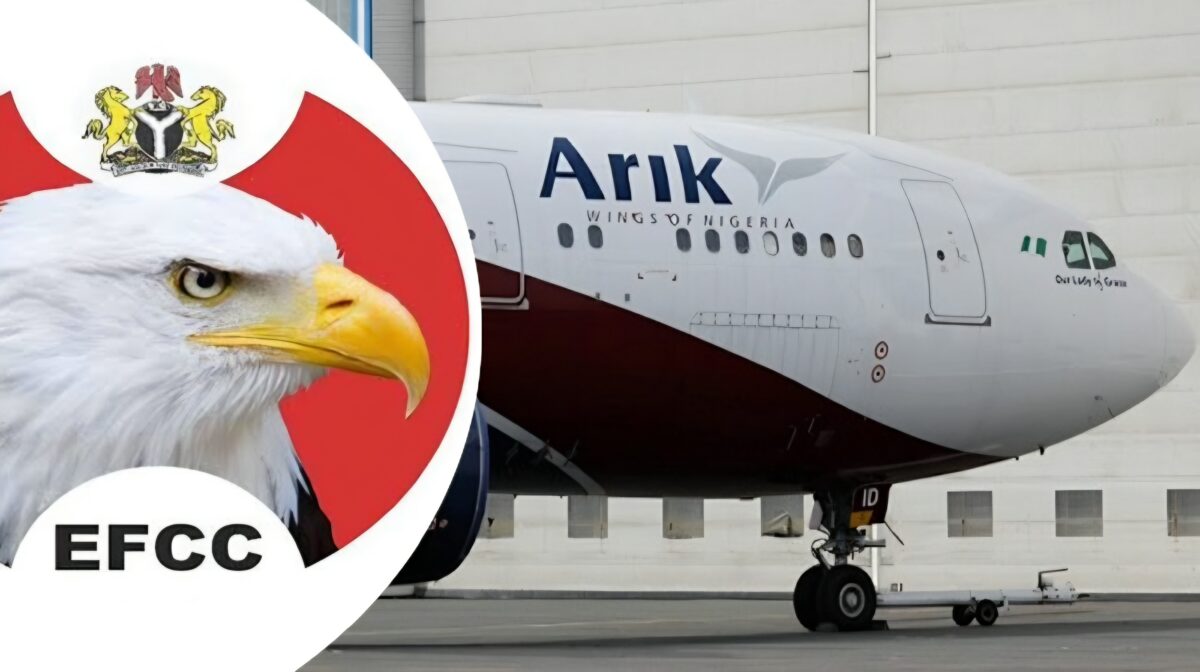
A director of the Economic and Financial Crimes Commission (EFCC), Bawa Usman Kaltungo, told a Lagos State Special Offences Court in Ikeja that Arik Air owed no money to Union Bank of Nigeria Plc, describing the airline’s receivership as fraudulent and based on a non-existent bad debt.
Kaltungo, who is the Director of the EFCC’s Lagos Zonal Directorate 2, made the claim while testifying as the fourth prosecution witness in the ongoing trial of former Managing Director of the Asset Management Corporation of Nigeria (AMCON), Ahmed Kuru, and four other defendants over alleged fraud involving N76 billion and $31.5 million.
The witness, who led the EFCC team that investigated the petition against Arik Air, testified before Justice Mojisola Dada.
Read Also: Investigation Bureau Begins Probe Into Arik Air Lagos–Port Harcourt Flight Engine Incident
During cross-examination by the counsel to the second defendant, Uyi Giwa-Osagie, Kaltungo said his investigation revealed that the purported bad debt used to appoint a receiver-manager over Arik Air did not exist.
“The foundation for the appointment of a receivership over Arik Air was fraudulent and faulty. There was no bad debt; it does not exist,” he told the court.
Kaltungo also claimed that he informed AMCON’s top management at a meeting that Arik Air was not indebted to Union Bank and that the appointment of the receiver-manager to take control of the airline was defective.
However, the witness maintained that Kuru, as AMCON’s managing director and chief executive officer, had extensive powers and unilaterally sanctioned the appointment of the receiver-manager.
The assertion prompted Giwa-Osagie to tender AMCON board resolutions to challenge the claim that Kuru alone had authorised the receivership.
The defence counsel argued that the documents were relevant to establishing the circumstances surrounding the decision and determining his client’s alleged role in the transactions.
He maintained that Kuru was not standing trial over the general propriety of AMCON’s powers to appoint a receiver-manager, but over the specific allegations contained in the charge sheet.
The prosecution opposed admitting the resolutions, arguing that the documents were too remote from the issues before the court.
Giwa-Osagie countered that the resolutions were public records emanating from AMCON’s board and could be tendered from the Bar.
In her ruling, Justice Dada admitted the documents, holding that they emanated from AMCON’s board as a corporate body and had been duly certified in accordance with Section 104 of the Evidence Act.
The admission of the resolutions gives the defence documentary material with which to challenge the prosecution witness’s account of Kuru’s role in approving the receivership.
However, the court’s decision to admit the documents does not determine the legality of the receivership or any defendant’s guilt or innocence.
The case arose from a petition by human rights lawyer Femi Falana, SAN, on behalf of Arik Air’s promoters and shareholders, concerning the airline’s receivership and related transactions.
The defendants are Kuru; Kamilu Alaba Omokide, a former receiver-manager of Arik Air; Captain Roy Ilegbodu, the airline’s chief executive officer; Union Bank of Nigeria Plc; and Super Bravo Limited.
They are facing a six-count charge bordering on conspiracy, theft, and abuse of office. They pleaded not guilty when they were arraigned on 20 January 2025.
One count alleges that, in 2011, Union Bank made false statements to AMCON about Arik Air’s performing loans and bank guarantees, resulting in the transfer of an allegedly bogus N71 billion debt exposure to the corporation.
Another count accuses Kuru, Omokide and Ilegbodu of fraudulently converting N4.9 billion belonging to Arik Air for NG Eagle Limited’s use in 2022.
The prosecution’s case also concerns how the airline handled its loan obligations, transferred its debt exposure to AMCON, and conducted transactions involving its assets.
The dispute raises questions about AMCON’s exercise of its statutory powers and the responsibilities of a receiver-manager appointed to take control of a distressed company.
Section 553(2) of the Companies and Allied Matters Act 2020 sets out obligations relating to a receiver-manager’s conduct, including acting in the company’s best interests and preserving its assets.
We’ve got the edge. Get real-time reports, breaking scoops, and exclusive angles delivered straight to your phone. Don’t settle for stale news. Join LEADERSHIP NEWS on WhatsApp for 24/7 updates →
Join Our WhatsApp Channel