
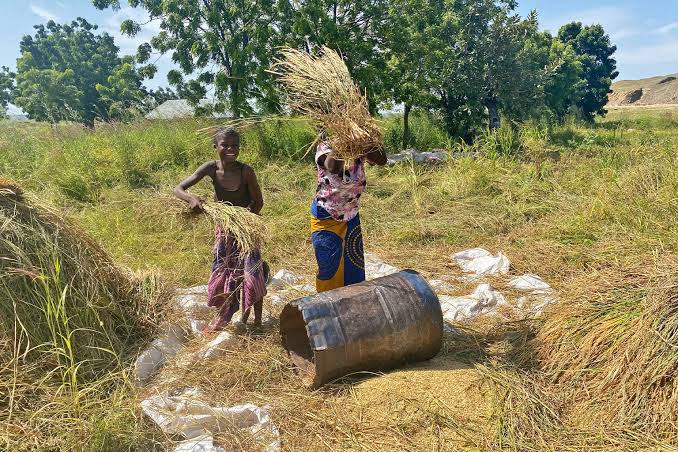
Poor harvests of maize and rice caused by inadequate and irregular rainfall could worsen food insecurity and trigger further increases in food prices across Nigeria, the Kaduna State chairman of the All Farmers Association of Nigeria (AFAN), Nuhu Aminu, has warned.
Aminu told LEADERSHIP yesterday that inadequate rainfall during the 2026 farming season affected the growth and yield of major food crops, leaving farmers with reduced harvests and raising concerns about food availability.
He explained that some maize crops withered and dried up because rainfall was insufficient to support their growth, while rice production was also affected in areas that received inadequate water.
The AFAN chairman said the poor harvests had coincided with rising food prices, noting that a bag of maize which previously sold for about N20,000 now costs between N30,000 and N40,000.
He added that the price of local rice had also increased from N48,000 to between N62,000 and N70,000.
Aminu warned that reduced crop yields could worsen hunger in the country, urging the government to intensify support for dry-season farming to bridge the shortfall in food production.
He said increased dry-season cultivation was necessary to improve food supplies, adding that farmers would struggle to make up for the production losses without adequate support.
Similarly, a farmer, Tambaya, said unpredictable weather conditions had forced him to replant several crops, including rice, beans and sorghum, thereby increasing his production costs and labour requirements.
He also lamented the lack of access to irrigation facilities, saying farmers remained heavily dependent on seasonal rainfall despite its increasing unpredictability.
The farmer warned that poor yields could further worsen food insecurity and push up market prices as reduced harvests affect the supply of staple crops.
Tambaya said he had invested about N6 million or more in cultivating eight hectares of farmland, with his expected returns of about N12 million now uncertain because of the losses recorded during the season.
A foodstuff trader, Ngozi Edeh, also lamented the sudden increase in the prices of staple food items, saying the rising cost of commodities had made it increasingly difficult for traders and consumers to cope.
She said the frequent price changes had affected customers’ purchasing power, with many now struggling to afford quantities of food they previously bought at lower prices.
An agricultural expert, Yunusa Abdullahi, called on the government to invest in the construction and rehabilitation of dams to improve access to water for irrigation and reduce farmers’ dependence on rainfall.
Abdullahi also urged the government to provide farmers with the necessary support to expand dry-season farming, saying increased irrigation-based production would help boost food supplies, improve agricultural output and reduce the risk of food shortages.
We’ve got the edge. Get real-time reports, breaking scoops, and exclusive angles delivered straight to your phone. Don’t settle for stale news. Join LEADERSHIP NEWS on WhatsApp for 24/7 updates →
Join Our WhatsApp Channel