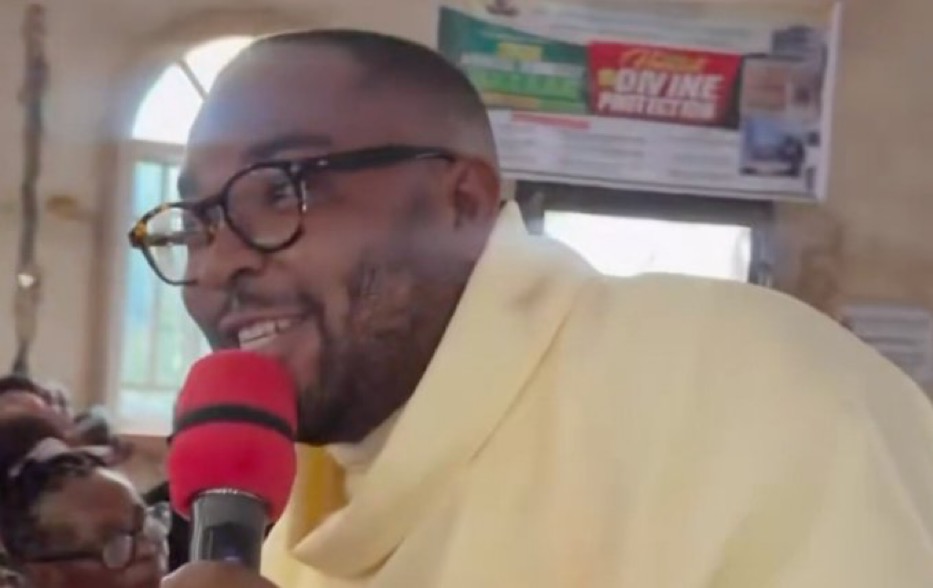
The video of a Catholic priest leading worshippers in a church service in a song endorsing the presidential candidate of the Nigeria Democratic Congress (NDC), Peter Obi and his running mate, Rabiu Musa Kwankwaso, ahead of the 2027 general elections has sparked mixed reactions on social media.
In the video circulating on X, the priest was seen leading members of the congregation in singing a song rendered in Igbo, describing the NDC as a better political platform.
The priest sang, “Party Peter Obi ka mma; Party Kwankwaso, ka mma!” meaning “Peter Obi’s party is better; Kwankwaso’s party is better.”
The development has reopened conversations about the involvement of religious leaders in partisan politics, the place of churches and mosques in Nigeria’s democracy, and whether religious institutions should publicly identify with political candidates.
Reacting to the video, an X user, Atlantic, described the priest’s action as “redeeming,” while accusing some religious leaders of compromising their positions for political and financial gains.
“Redeeming. Examples abound of his colleagues prostituting their offices for 30 pieces of silver.
“Most notorious is one Mbaka who will sell his congregation to the devil’s jingles!” Atlantic wrote.
However, another user, Whiskystan, questioned whether the same level of acceptance would be extended to an Islamic cleric who openly endorsed a different presidential candidate.
“Imagine if an imam does this for Atiku what will they say?” the user asked.
Similarly, an X user, Yoruba Angel, who identified as a supporter of Obi, expressed reservations about the priest’s action, arguing that religious leaders should be subjected to the same standards irrespective of the political candidates they support.
“I am for Obi but I don’t see this as right. If a pastor was singing a Tinubu song in church he’s seen as fake or a bad one yeah?” the user wrote.
In defence of the church’s involvement in political conversations, another X user, Iffy Prudence, argued that government policies and decisions directly affect religious institutions and their members, making it necessary for religious leaders to speak out on issues of governance.
“Those of you crying here, what do you mean that the church is not partisan?
“The government policies affect the church, the church rules affect the people and the government in turn use it against the people. The government is ruling the people and the church leaders are taking advantage of the situation making it look like our problems are spiritual. The church needs to speak out because the people believe in her,” Iffy Prudence wrote.
The debate came against the backdrop of Nigeria’s longstanding intersection of religion and politics, particularly during presidential elections, where religious identity and the composition of political tickets have frequently generated controversy.
Although Section 10 of the 1999 Constitution provides that neither the Federal Government nor any state government shall adopt a religion as its official state religion, faith remains an influential factor in the country’s political conversations.
During the 2023 presidential election, the All Progressives Congress (APC) presented a Muslim-Muslim ticket comprising President Bola Tinubu and Vice-President Kashim Shettima.
The decision generated widespread controversy, particularly among Christian groups, which argued that the arrangement failed to reflect the country’s religious diversity.
The Catholic Bishops’ Conference of Nigeria (CBCN) and the Christian Association of Nigeria (CAN) were among the Christian organisations that publicly opposed the arrangement, calling for religious balance in presidential tickets.
The opposition parties adopted different arrangements, with the Peoples Democratic Party (PDP) presenting Atiku Abubakar, a Muslim, alongside Ifeanyi Okowa, a Christian, while the Labour Party fielded Obi, a Christian, with Yusuf Datti Baba-Ahmed, a Muslim, as his running mate.
Religious leaders have also remained visible in political discussions through public endorsements, criticism of government policies and calls for particular voting choices.
In August 2026, Islamic cleric Sani Jingir reportedly urged Muslims to vote for a Muslim-Muslim presidential ticket in the 2027 election.
Jingir made the call at a mass wedding organised by the Kano State Government for 1,500 couples, where he urged Muslims to vote in a manner that would reflect their numerical strength in the country.
Kwankwaso subsequently condemned the cleric’s remarks in a post on X.
In another development, the Charismatic Bishops Conference of Nigeria (CBCN) endorsed Tinubu for a second term during its 2026 synod in Abuja.
The endorsement was announced by the conference’s President-General, Leonard Kawas, following a decision reportedly reached by representatives from the six geopolitical zones.
Kawas said the organisation had members in 52 countries, including 950 canonical bishops in Nigeria, adding that Tinubu had demonstrated an ability to accommodate the country’s religious diversity through appointments to key positions in his administration.
The conference also pledged to support the president through prayers and advocacy ahead of the 2027 elections.
Meanwhile, the Catholic Bishops’ Conference of Nigeria had, in August 2018, warned Catholic priests against publicly endorsing political candidates or using liturgical ceremonies as platforms for political campaigns.
The bishops maintained that the Catholic Church was apolitical and did not endorse or subscribe to any political party, while stressing that priests had an obligation to educate the faithful on their responsibilities in the country’s political life.
We’ve got the edge. Get real-time reports, breaking scoops, and exclusive angles delivered straight to your phone. Don’t settle for stale news. Join LEADERSHIP NEWS on WhatsApp for 24/7 updates →
Join Our WhatsApp Channel