Picture a modern metropolis that powers its high-rise towers, industrial complexes, and digital networks not through a central grid, but by pressing millions of exhausted citizens into service on stationary exercise bicycles every morning. Millions pedal furiously from dawn to dusk, sweating away their physical vitality simply to generate enough voltage to keep the streetlights flickering. When the system predictably sputters, state planners do not build modern power stations or lay high-voltage transmission lines. Instead, they organize televised ceremonies to hand out lighter pedals, offer tiny credit lines for padded bike seats, and praise the pedallers for their heroic resilience. We would rightly diagnose such a strategy as economic madness, a tragic misdirection of human capability disguised as public welfare.
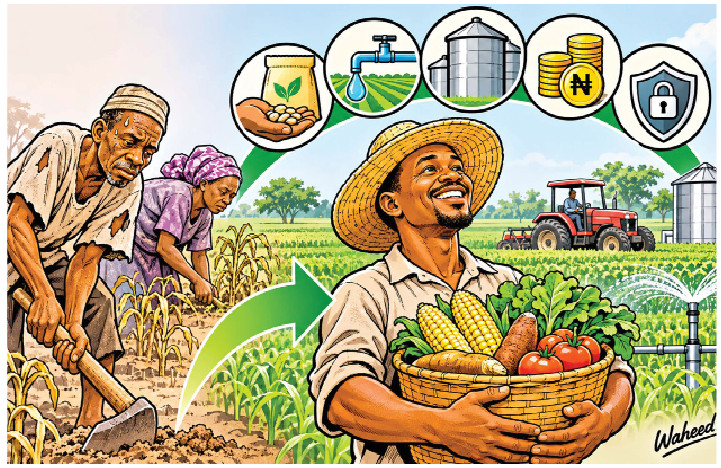
Yet, this absurd machinery accurately mirrors how Nigeria treats its smallholder farmers. We entrust national survival to millions of rural families working exhausted soils with hand tools, while expecting them to lift a nation of over two hundred million people into modern prosperity. Policymakers endlessly praise these farmers as the noble backbone of national food security, yet construct economic frameworks that treat their toil as an unchangeable social safety net rather than the primary engine of capital accumulation. We expect a tropical agricultural miracle, but we treat the cultivators like draft animals trapped in a cycle of perpetual struggle.
The Fatal Misconception of Structural Transformation
In the high halls of development planning, a dangerous illusion has long held sway: the belief that a nation can leap straight from low-productivity rural subsistence into capital-intensive industry without first mastering its fields. African policy discourse frequently frames the smallholder not as the indispensable foundation of economic transformation, but as an uncomfortable artifact of rural backwardness to be leapfrogged, ignored, or swept away by corporate interests.
This thinking completely ignores the fundamental historical lessons of economic modernization. As economic historian Joe Studwell demonstrates in his landmark work How Asia Works, every economic powerhouse in East Asia—from Japan and South Korea to Taiwan and China—anchored its historical breakthrough in a singular, disciplined strategy: radical land reform paired with intense, state-directed support for smallholder household productivity. By maximizing crop yields per hectare on small family plots through labour-intensive techniques, these nations achieved immediate domestic food independence, generated broad rural purchasing power to buy local manufactured goods, and built the national savings pool needed for industrial flight.
The Empirical Reality of Rural Neglect
Strip away the grand political speeches, and the hard data exposes the stark reality of our economic priorities. Figures from the National Bureau of Statistics and the Food and Agriculture Organization confirm that agriculture generates between twenty-one and twenty-six percent of Nigeria’s real gross domestic product, while employing roughly forty percent of our total national workforce. Within this expansive human enterprise, smallholders working plots of under two hectares grow over eighty percent of the food that feeds our cities.
Yet, these primary producers are left to battle systemic structural vulnerabilities virtually single-handed. World Bank agricultural tracking reports show that post-harvest losses for staple grains and perishables regularly hover between twenty and forty percent, wasted simply because rural communities lack basic cold storage and paved feeder roads. Less than one percent of Nigeria’s arable land enjoys functional irrigation, leaving our national breadbasket entirely at the mercy of increasingly unpredictable rain cycles. Central Bank credit figures reveal that primary smallholders receive less than five percent of commercial bank lending. We demand abundant harvests from our rural producers, yet starve them of the basic infrastructure required to succeed.
The Political Economy of Institutionalized Poverty
This persistent structural failure is neither an accident of geography nor a simple administrative oversight. It is the predictable outcome of an institutional architecture designed to extract value from the rural periphery to finance urban political centres.
This dynamic lies at the heart of the critique delivered by Professor Toyin Falola in his inaugural lecture at Bayero University Kano, in 2017, titled “The Poor We Have with Us Always”. Falola laid bare the deep structural machinery that manufactures poverty across our landscape, arguing that rural hardship is not a natural law of economics, but a policy outcome created by political structures that siphon resources from producing communities to sustain urban elites.
Connecting Falola’s structural insight with Studwell’s developmental framework exposes the tragic flaws in Nigerian agricultural policy. In How Africa Works, Studwell highlights that rapid demographic concentration makes intensive smallholder policy an urgent structural necessity, noting that Nigeria’s agrarian energy is undermined by policy elites who treat rural farming as a safety net rather than a disciplined engine of capital accumulation. Instead of establishing disciplined state mechanisms – where public support in high-yield seeds, extension knowledge, and micro-technology is tied directly to verified harvest performance – our interventions regularly dissolve into broad, discretionary subsidy schemes. These programmes frequently become political pork barrels, captured by non-farming intermediaries and urban political brokers while the actual cultivators remain trapped in low-input, low-yield subsistence.
The Illusion of Agribusiness Shortcuts
Panicked by stagnant crop yields, state planners periodically chase shiny shortcuts, convincing themselves that massive, capital-intensive corporate agribusinesses can instantly replace our fragmented rural farms. The popular belief claims that consolidating land into vast corporate estates naturally yields modern efficiency through sheer scale.
Yet, as Studwell carefully documents, this thinking misinterprets the basic microeconomics of agrarian reform in labour-rich, capital-scarce nations. Maximum yield per square meter is achieved not through massive corporate machinery, but through intensive family farming, where cultivators possess direct ownership incentives to squeeze every drop of productivity from their land. Large corporate estates in developing nations routinely struggle with heavy management costs, land speculation, and a preference for export cash crops that does nothing to fill domestic market stalls. Nigeria’s recent economic history underscores this warning: while corporate processors play an essential midstream role in refining and marketing, abandoning primary production to mega-estates displaces farming families, sparks land disputes, and ignores the millions of smallholders who manage our soil.
Strategic Policy Pathways for Agrarian Modernization
To break this cycle, we must step outside our established mental models and rethink the fundamental concepts that govern our agricultural policy, shifting our perspective from viewing agriculture as a welfare enterprise to seeing it as a precise, disciplined mechanism of value creation.
First, we must dismantle rigid intellectual categories and stop treating smallholder agriculture as a static relic of the past, recognizing it instead as a dynamic platform waiting for strategic design. Second, we must address the poverty of institutional imagination by replacing discretionary subsidies with performance-tied extension networks that deliver certified seeds and soil-specific inputs directly to verified farmer clusters. Third, we need to redefine modern scale by aggregating smallholder output through organized cooperatives, shared digital networks, and decentralized solar-powered micro-irrigation systems.
Fourth, we must prioritize maximizing yield per square meter over speculative land consolidation, establishing localized storage and cold-chain hubs to eliminate the devastating twenty to forty percent post-harvest loss margin. Fifth, we must formalize rural land tenure through streamlined titling processes to incentivize long-term soil investment and enable secure credit access. Finally, we must institute coordinated area-based security frameworks across agricultural belts, ensuring unhindered access to fields so that national food sovereignty becomes an active accomplishment of statecraft.
We’ve got the edge. Get real-time reports, breaking scoops, and exclusive angles delivered straight to your phone. Don’t settle for stale news. Join LEADERSHIP NEWS on WhatsApp for 24/7 updates →
Join Our WhatsApp Channel