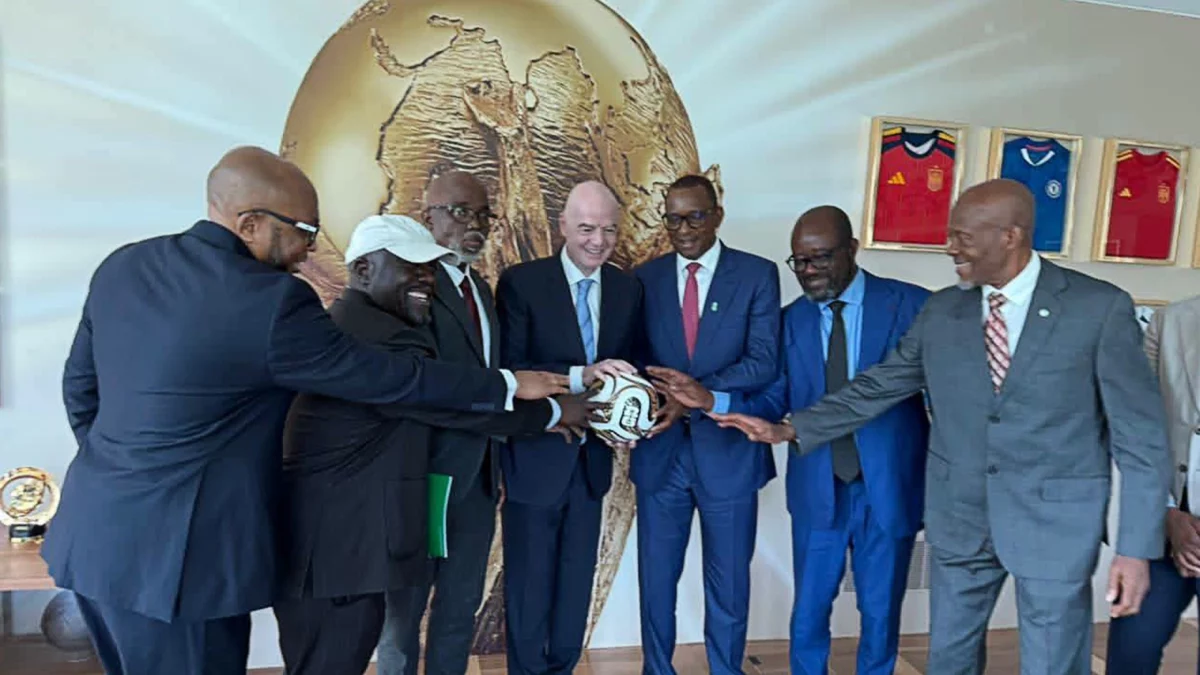
Two weeks after FIFA announced the establishment of a Normalisation Committee to oversee the affairs of the Nigeria Football Federation (NFF), the National Sports Commission (NSC) has disclosed that the proposed members are undergoing screening and integrity checks by the world football governing body.
The disclosure comes amid growing concerns among Nigerian football stakeholders over the delay in unveiling the committee, with questions lingering over its composition, selection process and commencement of operations.
FIFA announced the intervention following consultations with the Confederation of African Football (CAF) and the Nigerian government as part of efforts to resolve the leadership crisis within the NFF and restore stability to the country’s football administration.
The committee is expected to oversee the federation’s affairs, implement necessary reforms and organise elections, with its mandate scheduled to end upon completion of its responsibilities, but not later than 31 May 2027.
However, the absence of an official announcement of its members has continued to generate uncertainty over when the intervention team will be inaugurated and formally assume its responsibilities.
Speaking on the delay, Kola Daniel, Special Assistant on Media to the NSC Director-General, Bukola Olopade, disclosed that the names of prospective members had already been submitted to FIFA, which is conducting integrity checks and screening before giving final approval.
According to him, the process involves interviews and background checks to establish the suitability of those nominated to serve on the committee.
“Yes, the names of the members of the committee have been submitted to FIFA. But right now, FIFA is doing what they call a screening process and integrity test for all the people whose names have been submitted to serve as members of the Normalisation Committee.
“It is not a one-day thing. The process is ongoing, and interviews are also being conducted. As soon as they are done, they will be able to say they are satisfied with the people selected to run the affairs of Nigerian football,” Daniel said.
He explained that the exercise was taking longer because the normalisation arrangement was not solely an NSC initiative but a joint process involving FIFA and the Nigerian sports authorities.
“Because FIFA is involved, the Normalisation Committee does not only entail the National Sports Commission, but it is in conjunction with FIFA. That is why you are seeing some delay. We need to be patient, and the news will be out,” he added.
Meanwhile, the acting interim General Secretary of the NFF, Dr Ademola Olajire, also attributed the delay to FIFA and CAF, saying the responsibility for the next announcement rested with the two football governing bodies.
When contacted, Olajire simply said: “It is FIFA and CAF.”
However, Prince Harrison Jalla, chairman of Advocacy for Nigerian Football Reform, has questioned the suggestion that FIFA would independently determine the committee’s membership, insisting that the NSC would play a significant role in the selection process.
Jalla argued that FIFA’s knowledge of Nigerian football stakeholders was largely shaped by its previous dealings with the country’s football administration, making collaboration with the Nigerian authorities important in identifying suitable individuals.
“It is a cover-up to say FIFA would appoint or nominate members of the Normalisation Committee for the reform of Nigerian football. How many stakeholders does FIFA know in Nigeria? Those actually known to FIFA are those who messed up our football.
“The simple truth is that FIFA must be working with the NSC to put the committee in place,” he said.
The football reform advocate stressed that the priority should be the appointment of credible individuals capable of delivering meaningful changes rather than allowing disagreements over the selection process to prolong the uncertainty.
He, however, expressed optimism that there was still sufficient time for the committee to execute its mandate, given FIFA’s May 31, 2027 deadline.
“I think what is important and what Nigerians expect is to get the right persons appointed. It is not too late because we certainly have six months for the committee to do its job, and FIFA has sealed it for May 31, 2027.
“So, I think the committee should start working from December 1,” Jalla added.
The Normalisation Committee’s eventual composition and inauguration are expected to provide a clearer direction for the transition, particularly as Nigerian football awaits reforms to its administration and the organisation of fresh elections.
We’ve got the edge. Get real-time reports, breaking scoops, and exclusive angles delivered straight to your phone. Don’t settle for stale news. Join LEADERSHIP NEWS on WhatsApp for 24/7 updates →
Join Our WhatsApp Channel