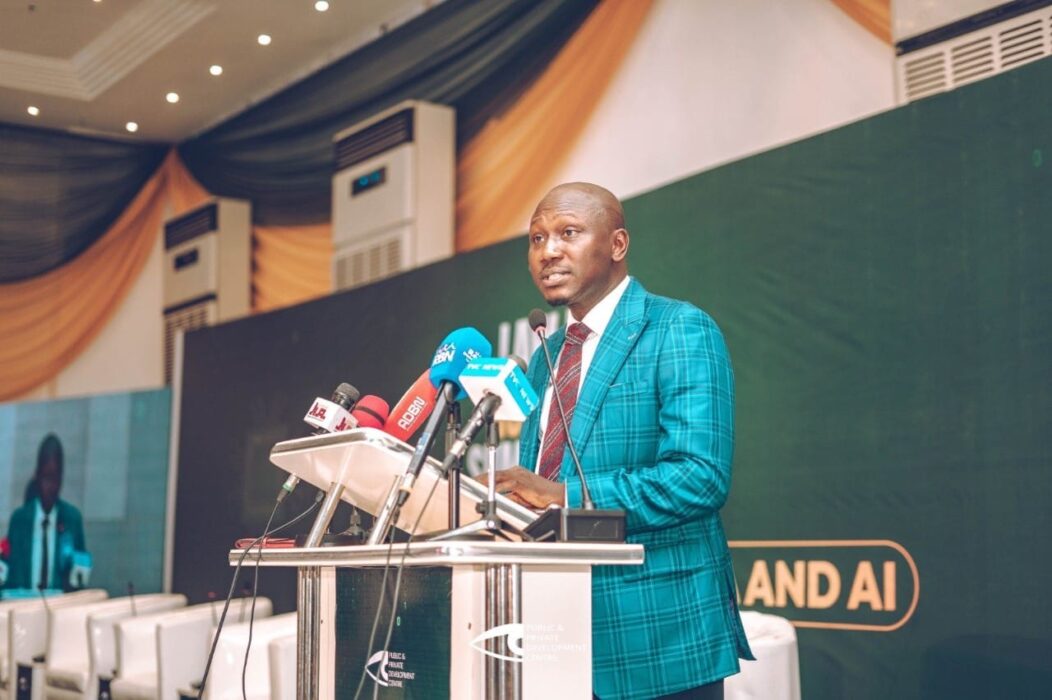
The Senior Advocate of Nigeria (SAN)Muyiwa Tola Atoyebi has warned against allowing artificial intelligence to determine decisions affecting people’s freedom, insisting that human judgment, accountability and respect for fundamental rights must remain central to the administration of justice.
He said the growing use of data and AI in the justice system must be guided by transparency, effective oversight and respect for human dignity.
He gave the warning on Tuesday at the third Law for Humanity Summit 2026 in Abuja, with the theme, “Justice in the Age of Data and AI”.
Delivering the keynote address,he said responsible deployment of AI required more than acquiring advanced technology or introducing digital systems into existing institutions.
According to him, “Clear standards, effective oversight and firm safeguards were necessary to protect the rights of people affected by technology-driven decisions.
“Technology can inform a decision, but it must never quietly become the decision,” Atoyebi said.
He warned that whenever AI was used to make recommendations affecting people’s liberty, livelihood or rights, a designated human official must review the outcome and be held accountable.
“Whenever AI is watching an outcome that affects persons’ liberty, livelihood or rights, there must be a named human being who reviewed it, who can be questioned about it, and who bears responsibility for it,” he said.
Atoyebi added, “No algorithm should be the last signature on an order that seeks to deprive somebody of freedom.”
He also called for transparency and accountability in the procurement and deployment of AI tools in courts and other justice institutions.
According to him, any technology used in the justice system must be auditable, with clear explanations available whenever its decisions or recommendations are questioned.
“If we cannot explain how a system reached a recommendation, we have no business allowing it near our courtroom, and we have to be very, very careful,” he said.
The SAN urged law schools, legal clinics and continuing legal education institutions to make data and AI literacy an essential part of legal training.
He warned that leaving the governance of AI entirely to technology professionals could result in systems that prioritised efficiency and cost reduction over fundamental rights.
“AI offers us an opportunity to improve access to justice, no doubt: strengthening legal research, reducing administrative delays and enhancing the handling of evidence.
“Yet these benefits will mean little if they come at the expense of fairness, privacy, accountability and human dignity,” he added.
Earlier, the Chief Executive Officer of the Public and Private Development Centre, Lucy James Abagi, said transforming the justice sector was not the sole responsibility of the judiciary.
She said achieving an accessible, fair and responsive justice system required collaboration among the judiciary, legal practitioners, government institutions, law enforcement agencies, correctional services, legal aid providers, civil society organisations and technology experts.
Abagi said the adoption of technology could expand access to legal services, particularly for people who had historically been excluded from the justice system.
“Technology-driven legal representation can democratise access to justice. It can help lawyers serve more people, enable legal aid institutions to manage larger caseloads, strengthen law enforcement and equip justice sector professionals with better information,” she said.
She explained that the centre’s interventions had focused on addressing prolonged detention, strengthening legal representation, improving court administration and supporting the digital transformation of justice institutions.
Abagi disclosed that through its legal aid intervention, the organisation had mobilised and supported more than 350 pro bono lawyers.
She said the intervention had resulted in 23,909 detainees receiving legal representation at police stations, more than 18,000 cases involving children and other persons in custody being handled, over 8,500 bail grants and a reported 93 per cent success rate under the PBSSK.
“Behind these figures are people whose liberty, dignity and future depend on timely access to justice,” she said.
She acknowledged the contributions of the Legal Aid Council of Nigeria, the Nigerian Bar Association, the Nigeria Police Force, the Nigerian Correctional Service, judicial institutions, civil society organisations and academic institutions.
Abagi urged stakeholders to build a justice system in which technology supported legal representation, improved case management and helped prevent unnecessary detention.
She, however, cautioned that the pursuit of efficiency must not come at the expense of fairness and human dignity.
“Our ambition must be clear, not simply for a digital justice system, but a justice system that works better for humanity,” she said.
Also speaking, the Director-General of the Legal Aid Council of Nigeria, Aliyu Bagudu Abubakar, represented by Bamidilee Ibikunle of the Technical Adviser’s Office, called for stronger collaboration in developing an equitable framework for technology-driven justice delivery.
He urged stakeholders to consider the challenges posed by digital transformation and AI collectively rather than in isolation.
Abubakar said there was a need for robust access-to-justice frameworks, effective protection mechanisms and clear ethical guidelines to ensure that AI remained a tool for serving humanity.
He stressed the need to protect the rights of individuals as justice institutions embraced technological advancement.
“Behind every data point in a database is a human life, a family waiting and a presumption of innocence that must be fiercely protected,” he said.
He urged participants to use data not merely to monitor institutions but also to improve the delivery of justice and protect human lives.
We’ve got the edge. Get real-time reports, breaking scoops, and exclusive angles delivered straight to your phone. Don’t settle for stale news. Join LEADERSHIP NEWS on WhatsApp for 24/7 updates →
Join Our WhatsApp Channel