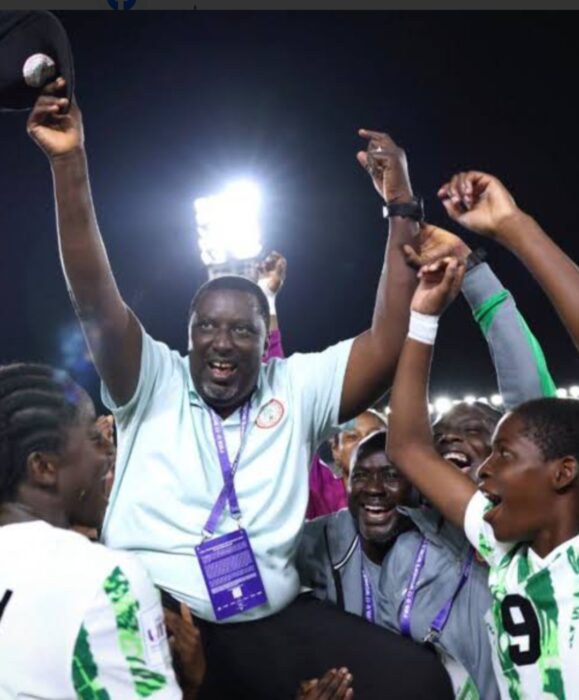
When the Nigeria Football Federation appointed Hakeem (Akeem Ishola) Busari as head coach of the Flamingos on April 2, 2026, he was in charge of Pacesetter Queens FC of Ibadan. Seven months and five days later, he became a world champion.
Busari led Nigeria’s U-17 women’s team to a 2-1 victory over Japan in the final of the 2026 FIFA U-17 Women’s World Cup in Rabat, Morocco, on Saturday, November 7, 2026 — giving Nigeria its first title in the competition and making the country the first African nation to win it.
Flamingos Make History, Beat Japan To Win Maiden U-17 Women’s World Cup Title
The appointment
Busari replaced Bankole Olowookere, who had spent several years with the Flamingos and led Nigeria to bronze at the 2022 FIFA U-17 Women’s World Cup in India. At the time, the NFF noted that Busari was head coach of Pacesetter Queens.
His immediate task was to guide Nigeria through the African qualifying campaign for the Morocco 2026 finals.
The background
According to the National Institute for Sports, Busari obtained his initial coaching qualification in Lagos in 1999. He returned for the institute’s higher programmes between 2003 and 2006, with his final coaching certificates issued in October 2006 — more than two decades before he led Nigeria to global glory.
The qualification
Busari began building his squad almost immediately, inviting 36 players to camp in April 2026. By July, Nigeria had secured their ticket to Morocco, beating Benin Republic 8-5 on aggregate — 3-2 in Ikenne and 5-3 in Lomé.
The tournament
The Flamingos lost their opening group match 2-1 to Poland, but recovered to beat Puerto Rico 2-0 and defending champions North Korea 3-1. In the knockout stage, they defeated Mexico 2-1, Venezuela 1-0 and Brazil 3-1 — becoming the first African team to reach the final.
The final
Awawu Bashiru put Nigeria ahead in the 39th minute with a shot from distance. Oluebube Umejiaku made it 2-0 in the 47th minute after a pass from Esther Stephen. Japan’s Fuki Ito pulled one back in the 80th minute, but Nigeria held on. Umejiaku was named Player of the Tournament.
The tactical call
The NFF highlighted Busari’s willingness to change personnel, particularly his decision to start Bashiru against Brazil after she had largely featured as a substitute. She responded with two goals in the semi-final.
The significance
The title surpassed the bronze medal Nigeria won under Olowookere in 2022. Busari described the win as “a turnaround for Africa” and a signal that African youth football is “really coming.”
From Pacesetter Queens to the Flamingos, from April appointment to November glory — Busari’s seven-month journey ended with Nigeria’s first FIFA U-17 Women’s World Cup title and a place in African football history.
We’ve got the edge. Get real-time reports, breaking scoops, and exclusive angles delivered straight to your phone. Don’t settle for stale news. Join LEADERSHIP NEWS on WhatsApp for 24/7 updates →
Join Our WhatsApp Channel