
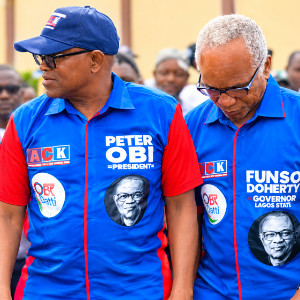
The incident, which was captured in a viral video circulating on social media, reportedly involved a group of individuals who stormed the party’s gathering, creating tension and disrupting the political activity.
During the confrontation, some vehicles parked outside the venue reportedly had their windscreens smashed, while sounds suspected to be gunshots were later heard outside the premises.
A suspected street urchin who was apprehended during the incident reportedly sustained injuries to his legs. He was said to have denied being sent by anyone to attack the party supporters, while NDC faithfuls resisted the assault and attempted to repel the suspected political thugs who stormed the venue.
 Obi, who spoke at the town hall meeting held after the incident, clarified that the gathering was not a campaign rally but an opportunity for the party to engage with Nigerians and listen to their concerns.
“Today is not our Lagos campaign. What we’re doing is a town hall meeting. Our town hall meeting is an opportunity to listen to people and their ideas,” he said.
The former Anambra State governor, however, condemned the attack on NDC supporters, insisting that political violence would not deter the party from pursuing its political ambitions.
He called for peace and fairness among supporters of all political parties, stressing the need for Nigerians to exercise their democratic rights without intimidation or fear.
Obi also used the occasion to assure Nigerians that their sacrifices for a better country would not be in vain, urging citizens not to lose hope in the nation’s future.
While outlining his policy priorities, he promised to tackle insecurity, unemployment, poverty and infrastructure deficits, with a pledge to increase electricity generation to 10,000 megawatts, make basic education compulsory and free, and establish functional primary healthcare centres in every ward across the country.
He further pledged to move Nigeria from a consumption-driven economy to a production-based economy capable of creating jobs, attracting investment and improving living standards.
Obi, while addressing security challenges, promised reforms to strengthen the police, improve officers’ welfare and recruit more graduates into the force, while calling for credible elections in 2027.
He also urged Nigerians to remain at polling units until votes were counted and transmitted, emphasising the importance of transparency and public confidence in the electoral process. He appealed to Lagos residents to support the party’s governorship candidate, Funso Doherty.

Reacting to the disruption and the spate of violence reported around political gatherings in some parts of the country, public affairs advocate, Comrade Nelson Ekujimi, condemned the use of violence in political activities, warning Nigerians against allowing themselves to be used as instruments of political intimidation.
“We do not encourage this act. Such acts must be condemned. We must follow the advice of people of good conscience who continually admonish Nigerians to remain peaceful,” he said.
Ekujimi added that political violence does not promote goodwill or peaceful coexistence but creates resentment and divisions within society.
“They should not allow themselves to become tools or instruments of violence. Violence is not good for any society. It does not promote goodwill or good feelings; rather, it creates bad blood. As everybody has said, we must not allow ourselves to be deceived, whether by the ruling party or supposedly opposing parties,” he added.
He called on security agencies to investigate the incident and establish the circumstances surrounding the disruption, stressing that allegations must be properly examined before conclusions are drawn.
“I would expect the authorities responsible for maintaining law and order to allow the police to do what they need to do in accordance with the law,” he said.
Similarly, a public affairs analyst, Ake Ayodeji, said persistent attacks, intimidation and disruption of opposition activities posed concerns for democratic participation, particularly as Nigeria approaches the 2027 general elections.
He noted that democracy depends on political competition, freedom of association and the ability of parties to mobilise supporters and communicate their policies without fear of violence.
According to him, the normalisation of political intolerance could discourage participation, weaken public confidence in electoral institutions and raise questions about the credibility of the electoral process.
Ayodeji, however, cautioned against assuming that violence against opposition groups would automatically translate into electoral advantage or disadvantage for any political party, noting that electoral outcomes depend on several factors, including voter choices, political organisation and confidence in the electoral process.
Meanwhile, attempts to obtain the reaction of the Lagos State Police Command were unsuccessful, as the Command’s Police Public Relations Officer (PPRO) did not respond to telephone calls as of the time of filing this report.
The circumstances surrounding the disruption and the identities of those responsible had yet to be independently established as of the time of filing this report.
However, public analysts have stressed that the incident has renewed concerns about the preparedness of security agencies to protect political parties, candidates and supporters exercising their constitutional rights to peaceful assembly and political participation. Even as political activities are expected to intensify ahead of the 2027 general elections, the stakeholders further called for investigations into reported attacks and stronger security measures to prevent intimidation and ensure that political disagreements are resolved through lawful and democratic means.
We’ve got the edge. Get real-time reports, breaking scoops, and exclusive angles delivered straight to your phone. Don’t settle for stale news. Join LEADERSHIP NEWS on WhatsApp for 24/7 updates →
Join Our WhatsApp Channel