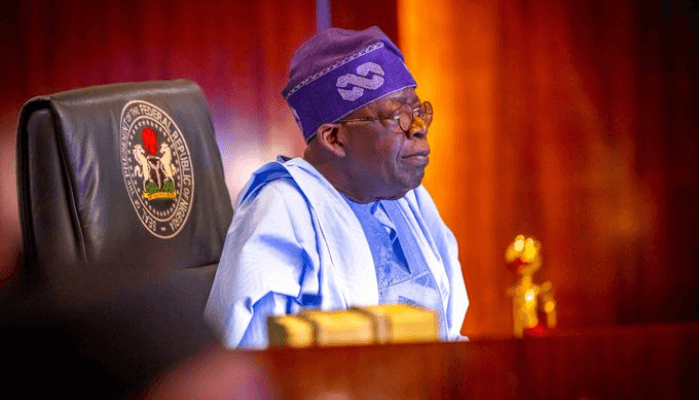
In 2025, President Bola Tinubu’s leadership was tested as decisions from Aso Rock revealed the full spectrum of his authority, the resistance he faced, and the precedents his administration set for Nigeria’s democracy,” writes JONATHAN NDA- ISAIAH
By the close of 2025, President Bola Tinubu had firmly stamped his authority on Nigeria’s political landscape. The year tested the limits of executive power, exposed the fragility of public trust, and highlighted the delicate balance between reform, control, and democratic restraint. From Aso Rock, decisions made in the name of stability, justice, and economic management repeatedly collided with public sentiment, constitutional debate, and international scrutiny.
If 2023 was about assuming office, and 2024 about early reforms, 2025 was the year Tinubu’s presidency was truly defined, not by rhetoric, but by consequence.
Power And The Rivers State Precedent
Nothing symbolised the administration’s governing philosophy more starkly than the declaration of a state of emergency in Rivers State in March 2025. By suspending the governor, deputy governor, and state legislature, the presidency deployed one of the most extreme constitutional instruments available to the executive.
The official justification was a breakdown of governance and escalating political instability in a state critical to Nigeria’s oil economy. Yet the decision immediately ignited a national debate that went far beyond Rivers. Legal scholars, opposition figures, and civil society organisations questioned not merely the necessity of the action, but its legality and precedent.
The concern was not whether Rivers faced political turmoil—it clearly did—but whether the federal executive had crossed a line by effectively dissolving an elected state government without impeachment or judicial adjudication. For critics, the move suggested a presidency increasingly comfortable with muscular interventions. For supporters, it demonstrated resolve in the face of dysfunction.
While the Supreme court has resolved the matter over the powers of the president to declare a state of emergency, what endured was a recalibration of federal–state relations and a sobering reminder that stability, when pursued through exceptional powers, often extracts a democratic cost.
Economic Messaging Meets Fiscal Reality
Equally defining was the administration’s handling of economic communication. In September, President Tinubu announced that Nigeria had met its revenue targets ahead of schedule and would not borrow for the year—an assertion framed as evidence that painful reforms were beginning to pay off.
The statement was politically significant. It came amid public fatigue over subsidy removal, inflation, and cost-of-living pressures. For a moment, it offered reassurance that sacrifice had yielded results.That reassurance proved short-lived.
Within weeks, the presidency sought legislative approval for N1.15 trillion in domestic borrowing, alongside an already-secured external loan. The contradiction was immediate and damaging. Critics seized on the inconsistency, arguing that the administration had either overstated its fiscal success or underestimated the depth of Nigeria’s budgetary challenges.
Beyond the optics, the episode revealed a deeper issue: the tension between reform narrative and fiscal reality. Nigeria’s structural revenue weaknesses, debt servicing obligations, and social spending demands left little room for rhetorical certainty. The borrowing request did not merely weaken credibility—it reinforced public scepticism about economic transparency.
For an administration that had promised clarity and discipline, the episode became a cautionary tale in the politics of premature declarations.
Justice, Clemency, And The Limits Of Executive Grace
If the economy tested credibility, the Maryam Sanda clemency controversy tested moral authority. Her inclusion on a presidential pardon list shocked many Nigerians, not because of technical legality, but because of its symbolic implications.
Here was a high-profile murder conviction, adjudicated through years of judicial process, seemingly reversed by executive fiat. Victims’ advocates, legal professionals, and ordinary citizens reacted with rare unanimity: the pardon was unjust, insensitive, and corrosive to public confidence in the justice system.
The presidency’s subsequent reversal—removing Sanda from the pardon list and commuting her sentence—did little to quell outrage. It took the intervention of the Supreme Court to restore finality by reinstating the original judgment.
The episode was damaging not merely because of the decision itself, but because it exposed institutional misjudgment. It suggested insufficient consideration of public perception, judicial boundaries, and the emotional weight of justice in a society already suspicious of elite privilege.In governance, perception often shapes legitimacy as much as law. In this case, the damage lingered.
Nigeria, The United States And Religious Freedom Claims
Internationally, 2025 forced Tinubu’s government into defensive diplomacy. The designation of Nigeria by the United States as a country of particular concern over religious freedom elevated domestic security challenges into a global human rights issue.
The implication,bthat Nigeria was either unable or unwilling to protect Christian communities ,struck at the heart of national identity. Tinubu’s response was firm, rejecting the genocide narrative and affirming Nigeria’s pluralistic character.
Yet the controversy revealed the limits of official rebuttals. International perceptions are shaped not only by statements, but by patterns of violence, reportage, and advocacy. The subsequent engagement with U.S. lawmakers underscored a recognition that diplomacy, not denial, would be required to manage the fallout.
For Aso Rock, the episode was a reminder that internal security failures increasingly carry external consequences—and that sovereignty in a globalised world is negotiated as much as asserted.
Coup Rumours And The Military Reshuffle
Perhaps the most unsettling episode of the year was the coup scare that rippled through Abuja in October. Though officially denied, reports of alleged coup plotting tapped into a regional anxiety shaped by military takeovers across West Africa.
The cancellation of Independence Day celebrations and the sweeping replacement of service chiefs sent an unmistakable signal: the presidency was taking no chances.
Officially described as routine, the timing of the shake-up suggested a leadership keenly aware of the symbolism of military loyalty. While no coup materialised, the incident revealed an uncomfortable truth—that economic hardship and political mistrust can make even rumours destabilising.
For Tinubu, the swift action projected control. For observers, it raised questions about the underlying stress points within Nigeria’s security architecture.
A Presidency Revealed, Not Rewritten
Taken together, the defining moments of 2025 did not radically alter Tinubu’s policy direction. Instead, they clarified the character of his presidency.
This was an administration inclined toward decisiveness, sometimes at the expense of consultation; confident in authority, yet occasionally inattentive to consequence; reform-minded, but constrained by structural realities; assertive internationally, but sensitive to reputation.
Supporters argue that such firmness is necessary in a country grappling with insecurity, economic transition, and institutional weakness. Critics counter that strength without restraint risks eroding democratic norms.Both views found evidence in 2025.
As Nigeria moves forward, the question is not whether Tinubu has the power to act—2025 answered that decisively—but whether future decisions will be tempered by the lessons of backlash, contradiction, and public trust.
In the annals of Aso Rock, 2025 will be remembered not as a year of calm, but as a year of definition—one in which power was tested, boundaries were stretched, and the presidency revealed itself in full view of the nation.
We’ve got the edge. Get real-time reports, breaking scoops, and exclusive angles delivered straight to your phone. Don’t settle for stale news. Join LEADERSHIP NEWS on WhatsApp for 24/7 updates →
Join Our WhatsApp Channel