Ajogbe Agro‑Allied Industries Ltd., has unveiled a total‑mixed‑ration (TMR) cattle feed, developed in partnership with the University of the West of Scotland and the Federal University of Agriculture, Abeokuta (FUNAAB).
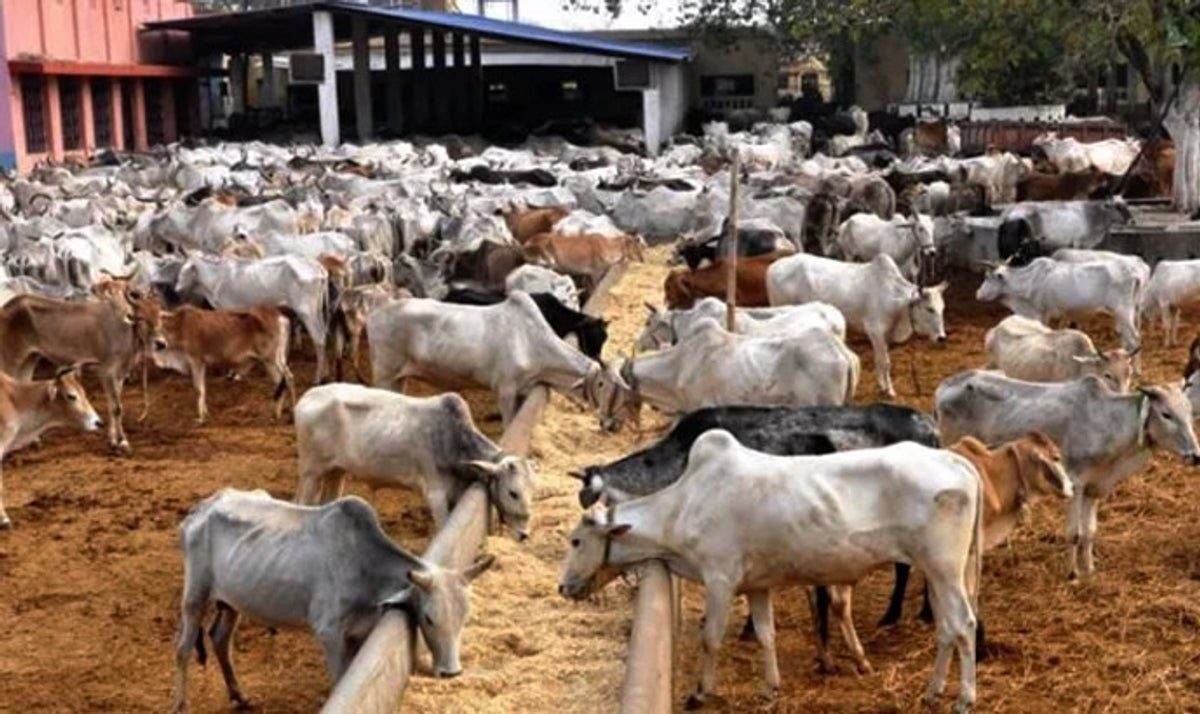
The innovation coincides even with the company, has it expanded one-time herd capacity to 5000 ruminants in Southwest Nigeria, a move projected to supply 250,000 cattle annually, even as it comes with decisive step towards modernising Nigeria’s beef ecosystem and reducing the long‑standing pressures of nomadic herding that have fueled farmer‑herder clashes across the nation.
Funded by the UK Research & Innovation (UKRI) through the African Agricultural and Land Transfer Partnership, the two‑year research project brought together FUNAAB scientists, UWS experts, and Ajogbe’s commercial arm. Joint IP rights ensure the technology remains accessible and affordable for nationwide rollout.
In a public presentation of the African Agriculture knowledge transfer project on “Developing Cost-Effctive Nutritive Feeds From Locally Crop Residues and Agro-industrial By-products for Livestock in Southwest, Nigeria.”
The executive chairman Agro‑Allied Industries Ltd., Bosoye Olalere, speaking at FUNAAB, described it as a “significant milestone in efforts to modernise the Nigerian beef ecosystem and reduce dependence on nomadic cattle rearing.”
He elaborated that the research breakthrough dovetails with the company’s feedlot expansion, positioning Ajogbe at the forefront of a scientific, value‑chain approach to cattle production.
Olalere outlined the breadth of the Nigerian beef ecosystem, noting that it comprises cattle breeders, feed mill operators, feedlot operations, the abattoir and meat processing plants, as well as the associated storage and logistics that drive every aspect of those value chains. By integrating these components, the firm aims to create a seamless, efficient system that can meet market demands while preserving animal welfare.
He further defined the feedlot concept, explaining it is “a place where you keep cattle in a fenced environment or designated area where cattle are not allowed to roam.” This controlled environment, combined with the newly formulated TMR feed, now enables the company to predict with precision the time needed to fatten a calf from 200 kg to a slaughter weight of about 350 kg.
According to Olalere, extensive testing has confirmed an average daily weight gain of one kilogramme per day, a performance level that constitutes an important milestone in the Nigerian beef ecosystem.
He stressed that this shift from traditional, culture‑driven practices to science‑based livestock management is essential for sustainability.
“What we are doing is based on the adoption of global best practices, whereby you look at the needs of the cattle and you try to meet those needs. It makes the animal healthier, and it makes the beef of superior grade. It tastes better, the flavour is better, the texture is better, and the nutritional value is also much, much better,” Olalere affirmed.
Highlighting market potential, Olalere revealed that demand for cattle across the six southwestern states stands at 2.5 million annually. Consequently, Ajogbe has set an ambitious target to capture at least 10 per cent of that market share over the next three years, equating to roughly 250,000 cattle per year.
Project lead, University of West of Scotland, Prof. Christian Harrison, described the project as an amassing initiative that solves both economic and social problems.
Harrison: “When we started the project two years ago, the intent was to solve a very big issue in Nigeria, the issue of nomadic cattle rearing.”
Harrison who is also the professor of Leadership and Enterprise, and director of the Centre for Leadership and Empowerment, University of Greater Manchester, added, “We have been able to formulate a feed and by doing that, the cattle can now grow bigger in size. So we have solved two problems. One, we can fatten cattle and provide more revenue, but also be able to solve a big societal issue about nomadic cattle rearing.”
He confirmed that there are big plans for commercialisation, while banks and investors have already shown interest.
“It’s a joint IP between the university, FUNAB, and Ajogbe. Although we’re not going to disclose the formulation, we are going to ensure that we commercialise it and make it readily available in cheap amounts.”
Also speaking, co-lead of the African Agricultural and Land Transfer Partnership project and FAO country project consultant, Prof. Adebayo Shittu, said the development represents a historic step for Nigeria.
“If you are looking for poultry feed, you can always go somewhere and get a brand. But for cattle, sheep and goat, we don’t have that, and that’s why we have been having this challenge of herder–farmer conflicts,” he said.
He, however, revealed that the project aims to provide an all-year-round feed solution. “At times, herders have access to fresh grasses. But in the dry season, they don’t, so they move down south. This project is going to help address that problem by converting what we consider as waste, like maize stover to produce what we call total mixed ration for our cattle.”
Shitu added that the innovation will ensure the farmers taking to take the feed to the cattle, and not the cattle to the feed, thereby enabling farmers in the South to raise cattle sustainably even on limited land space.
“You can have a small area, less than one hectare, where you can actually have maybe a hundred herds of cattle. It will help reduce the need to go up and down and help us produce animals within the limited area of land that we have.”
We’ve got the edge. Get real-time reports, breaking scoops, and exclusive angles delivered straight to your phone. Don’t settle for stale news. Join LEADERSHIP NEWS on WhatsApp for 24/7 updates →
Join Our WhatsApp Channel