An Australian mining company, Chariot Resources Limited, has secured approval to develop lithium assets in Nigeria after the country’s mining regulator granted six licences for its operations.
Licences include four exploration permits and two small-scale mining leases
The Nigerian Mining Cadastre Office (MCO) approved the transfer of the licences to C&C Minerals Limited, a Nigerian subsidiary of Chariot. The portfolio comprises four exploration permits and two small-scale mining leases previously held by Continental Lithium Limited.
In a statement at the weekend, the company said the approvals cover the Fonlo and Gbugbu exploration projects, as well as small-scale mining interests at the Saki project in Kwara and Oyo States.
Chariot’s Executive Chairman and Managing Director, Shanthar Pathmanathan, described the development as a major milestone while speaking to an online platform.
“These approvals are monumental for the company and, indeed, for the global lithium sector,” he said.
“They mark the first entry of an ASX-listed lithium company into Nigeria’s high-potential lithium sector, which hosts lithium pegmatites already producing spodumene for the Chinese market but remains largely underexplored.”
The six licences consolidate Chariot’s position across key exploration and mining assets in Nigeria. A further four licences — three at Saki and one at the Iganna project — are still awaiting final approval from the MCO.
Chariot currently holds a 66.6 per cent stake in C&C Minerals, while Continental Lithium retains the remaining 33.3 per cent. The company expects to complete full acquisition by May 2026, subject to outstanding conditions and shareholder approval.
High-grade lithium confirmed
The company said independent laboratory analysis by the University of British Columbia confirmed significant spodumene mineralisation across all six sampled sites at the Fonlo and Iganna projects.
Spodumene accounts for between 28.4 per cent and 75.3 per cent of crystalline content in the samples. It is considered one of the most commercially viable lithium-bearing minerals due to its relatively straightforward processing compared with alternatives such as lepidolite, which was not detected in any of the samples.
Lithium oxide grades ranged from 2.66 per cent to 5.96 per cent, indicating high-grade mineralisation. Elevated caesium levels were also recorded, with pollucite reaching as high as 9.5 per cent in one Iganna sample. This points to strong lithium–caesium–tantalum pegmatite potential across the site.
Chariot said the findings support its strategy to develop drill-ready targets and accelerate exploration across its Nigerian portfolio.
Mr Pathmanathan said the company’s objective is to deliver large-scale discoveries in Nigeria.
“We will deploy modern, systematic exploration to generate high-quality technical data and drill-ready targets across an underexplored portfolio,” he said.
“We are also in discussions with potential offtake and asset-level funding partners to accelerate drilling, as well as to restart and develop small-scale mining activities.”
Lanre Afebuameh, President and Vice-Chairman of Continental Lithium, said the approvals strengthen the company’s relationship with Nigerian regulators and will support structured exploration at Fonlo and Gbugbu.
Nigeria’s lithium potential amid rising demand
The development comes amid surging global demand for lithium, driven by the rapid expansion of electric vehicles and battery storage systems.
Nigeria, Africa’s largest oil producer, also holds significant mineral resources, including granite, limestone, gold and lithium. The government is seeking to diversify revenue sources by developing its solid minerals sector and reducing reliance on oil.
However, a parliamentary probe has found that a significant share of Nigeria’s mineral wealth is lost through unlicensed mining, costing the country billions of dollars and contributing to insecurity.
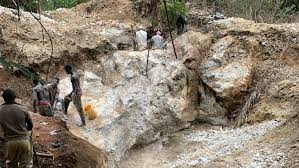
Lithium mining in Nigeria began roughly a decade ago in Pasali, once a quiet rural community that has since become a centre for small-scale and largely illegal mining activity. Dozens of unlicensed operations now operate in the area.
Mining practices are often hazardous. Workers use basic tools such as chisels and hammers, digging into unstable pits or crawling through narrow underground tunnels. In some cases, explosives are used to open new shafts.
Artisanal mining persists through informal trading networks of buyers and sellers, operating with minimal regulatory oversight and limited enforcement presence.
We’ve got the edge. Get real-time reports, breaking scoops, and exclusive angles delivered straight to your phone. Don’t settle for stale news. Join LEADERSHIP NEWS on WhatsApp for 24/7 updates →
Join Our WhatsApp Channel