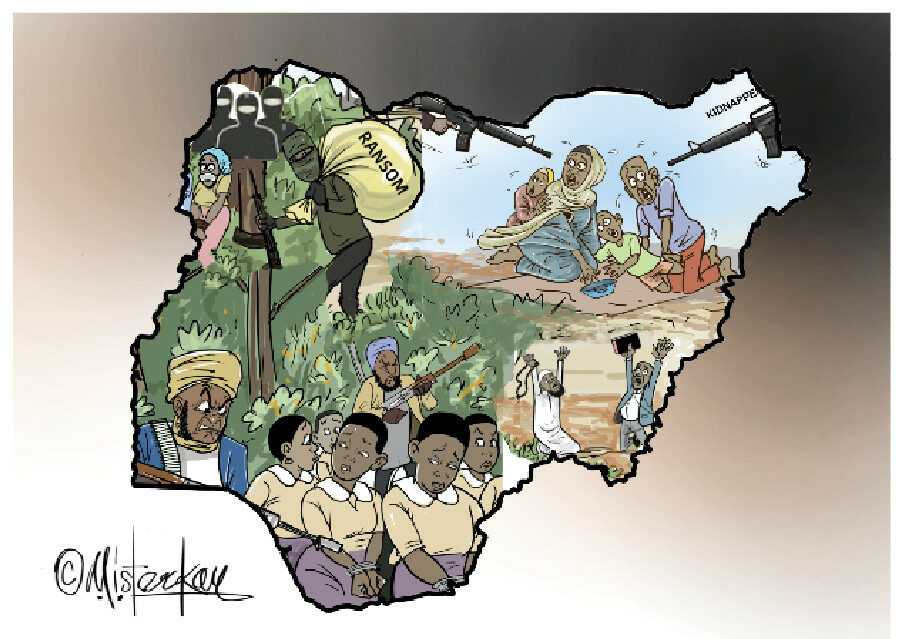
There is a kind of national tragedy that does not arrive with a single thunderclap. It seeps in until ordinary people reorganise their lives around fear. A journey becomes a calculation, a farm becomes a gamble, and a school day becomes a prayer. This is the atmosphere that has settled over Nigeria’s North-West, where banditry, kidnapping for ransom, cattle rustling, farmer–herder clashes, and gender-based violence have begun to feel less like “incidents” and more like a permanent climate.
What makes the North-West’s crisis especially corrosive is not only the bloodshed and displacement; it is the way violence has fused with an illicit economy. In many contexts, insecurity is explained as a shortage of troops or hardware. Here, that explanation is too small. The gun is not merely a weapon; it is a tool of taxation. The forest is not merely a hideout; it is a marketplace. Victims are not only targets; they are revenue streams. Illegal mining, ransom kidnapping, and rustled livestock do not sit in parallel lanes; they feed one another, and they all feed on weak governance. Once a crime becomes an industry, you cannot defeat it with rhetoric or periodic raids. You have to dislodge its structural roots.
That begins with a hard admission: the absence of effective grassroots governance is one of the most corrosive drivers of insecurity in the North-West. Where local institutions are hollowed out—where local government feels like a payroll centre, rural policing is sporadic, justice is distant, and basic services are unreliable—a vacuum opens. Armed actors do not merely terrorise; they begin to govern. They decide which roads are passable, which markets can open, which farms can be cultivated, and what a community must pay to be left alone. In that vacuum, violence becomes not only a weapon but an administrative system.
Gold, Guns, Currency Of Conflict
Gold sits close to the centre of this ecosystem. Artisanal and small-scale mining should be a ladder for rural prosperity—formalised, regulated, taxed, made safer, and linked to legitimate value chains. In the North-West’s war economy, gold becomes a currency of conflict: compact, valuable, easy to move, and easy to launder. Armed groups tax access to sites, seize output, coerce labour, and use proceeds to buy weapons, pay informants, and purchase protection. When conflict is funded by extraction, the violence does not merely “happen” around communities; it is sustained by what is taken from them.
Kidnapping for ransom completes the architecture. It has evolved into a market: targets are selected, routes are surveilled, negotiations are managed, payments are structured, and releases are staged. Families pay because they believe rescue will not come in time. Communities pay because refusal can invite retaliation. Each successful payment does not end the problem; it professionalises it. The more predictable the payoff, the more quickly the crime spreads, and the more the state’s authority is publicly mocked.
Cattle rustling has also shifted from opportunistic theft to organised asset seizure. Livestock is rural wealth in motion. When herds are stolen, households collapse; when households collapse, recruitment becomes easier. Layered on top is the protection economy—fees demanded for grazing corridors, safe passage, or access to farmlands—until fear becomes a steady line of income. A community that cannot move freely cannot trade freely, and a community that cannot trade freely becomes easier to dominate.
It would be incomplete to describe this crisis as purely domestic. Nigeria’s North is not sealed off from the cultural and economic currents of the Sahel and beyond. Across our northern borders flow long-standing transhumance routes, cross-border kinship ties, informal trade, and—too often—arms and criminal expertise. Cultural influences matter: how armed self-help is normalised, how violence is rationalised, how authority is negotiated outside formal institutions. Porous borders and shared networks allow armed groups to find sanctuary, recruit, trade, and return with renewed confidence. Ignoring these cross-border influences amounts to treating a regional ecosystem as a local nuisance.
The Political Bandits
But the darkest layer of the North-West crisis is not in the forest. It is a question many citizens whisper, but institutions rarely pursue with the seriousness it deserves: who benefits? Illicit economies on this scale do not survive without enablers—buyers, transporters, financiers, informants, and protectors. This is where the idea of “political bandits” becomes more than a metaphor: politicians and associates who divert fertiliser meant for farmers, capture allocations meant for services, shield illegal mining, or quietly profit from the disorder while commissioning press statements about security. The bandit with a rifle is dangerous; the bandit with influence and cover is more dangerous, because he turns public power into private armour.
We should also be honest about our financial culture. Our banks, our financial values, and our wealth markers are part of the crisis. When society celebrates sudden wealth without asking hard questions, illicit proceeds find social cover. When cash is king, ransom payments move easily; when suspicious inflows meet weak scrutiny, the proceeds of violence learn how to wear suits. And when “success” is measured by display rather than value creation, crime gains not only money but status. Status lowers the social shame that should restrain criminality, and it teaches the next recruit that violence can be a ladder.
This is why the security conversation must shift from capacity to incentives. Most importantly, our security apparatus has not yet made banditry unattractive. In too many places, the risk–reward equation still favours the criminal. Where arrests are rare, investigations compromised, prosecutions slow, convictions uncertain, and sentences inconsistent, violence remains a rational choice for those already inside the enterprise. A state defeats an armed industry by making participation costly and outcomes certain, not by appearing occasionally and withdrawing predictably.
Here, Nigeria faces a glaring institutional gap: we have no serious legislative hindrance against banditry, let alone a judicial strong arm that consistently delivers prohibitive justice. Deterrence cannot be improvised; it must be built. We need laws that define banditry and its financing as grave offences, close loopholes around ransom facilitation and illicit mineral trade, empower asset forfeiture and swift disruption of criminal proceeds, protect witnesses, and strengthen interagency coordination so investigations lead to convictions—not paperwork.
None of this will endure without restoring opportunity. Banditry recruits from a landscape of collapsed pathways: declining vocational centres, deteriorating education, unaffordable tertiary options, and too little digital or agricultural training that connects young people to real markets. These are not side issues. In the North-West, they are security multipliers. When a young person sees no ladder, the gun begins to look like a career path; when communities lose skills and schooling, they lose the future that competes with the armed economy.
Strategy Against Banditry
A serious strategy must therefore do several hard things at once: choke the money by disrupting mining and ransom supply chains; rebuild grassroots governance so the state is present where people actually live; redesign deterrence so banditry becomes a bad investment; strengthen financial intelligence and anti-money laundering enforcement without fear or favour; revive skills and livelihoods at scale; and treat border governance as internal security policy, not a footnote.
Nigeria must decide what it is confronting: scattered criminals, or a parallel economy with armed enforcement, cross-border linkages, and political insulation. If it is the latter—and it increasingly looks like it—then our response must rise to match the complexity of the threat. We will not win by only counting boots on the ground. We will win when we dismantle the business model, dislodge the structural roots, and build institutions that make violence a losing proposition.
– Dr Dakuku Peterside is the author of two books – Leading in a Storm and Beneath the Surface.
We’ve got the edge. Get real-time reports, breaking scoops, and exclusive angles delivered straight to your phone. Don’t settle for stale news. Join LEADERSHIP NEWS on WhatsApp for 24/7 updates →
Join Our WhatsApp Channel