

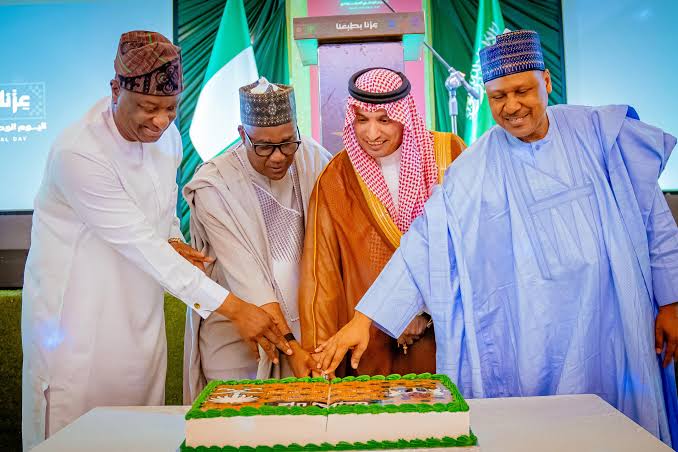
In the business of governing, signing agreements is easy. Delivering on them is considerably harder. Governments have perfected the art of celebrating diplomatic breakthroughs, often with elaborate ceremonies, flattering speeches and photographs intended to convey progress. Yet the true measure of institutional competence is rarely found in the grandeur of a signing ceremony. It lies in the unglamorous business of making promises work.
This distinction is particularly important in the administration of the Hajj, where the consequences of bureaucratic failure are measured not merely in wasted resources but in human suffering, shattered expectations and the indignity of turning a sacred obligation into a logistical ordeal.
On November 10th, at the Super Dome in Jeddah, Nigeria’s National Hajj Commission (NAHCON) and Saudi Arabia’s Ministry of Hajj and Umrah signed a memorandum of understanding governing the 2027 pilgrimage. Ambassador Ismail Abba Yusuf, NAHCON’s chairman and chief executive, represented Nigeria. Dr Abdulfattah bin Sulaiman Mashat, the Saudi vice-minister of Hajj and Umrah, signed for the kingdom.
On paper, the agreement is straightforward. It provides the framework for Nigeria’s pilgrimage quota, regulatory obligations, operational deadlines, accommodation, transportation, healthcare and cooperation with Saudi authorities. In practice, it represents something considerably more demanding: a test of whether Nigeria’s public institutions can match international commitments with domestic administrative discipline.
For a country whose public institutions frequently struggle with the distance between ambition and execution, that is no small challenge.
The Hajj is an unusual enterprise. It combines the spiritual aspirations of millions with the organisational complexity of a vast international operation. Its participants are pilgrims, not tourists. Many have saved for years, sometimes decades, to undertake a journey that carries profound religious significance. Their expectations are not extravagant. They want reliable transportation, decent accommodation, accessible medical care and an orderly opportunity to fulfil their religious obligations.
These should be modest demands. In poorly managed systems, they can become extraordinary privileges.
Saudi Arabia, for its part, has increasingly approached pilgrimage administration as a matter of infrastructure, technology, regulation and measurable performance. At the signing ceremony, Dr Mashat reported a 93% pilgrim satisfaction rate for the 2026 Hajj and commended Nigeria for contributing to the achievement. He also praised NAHCON for meeting the established timelines for preparations towards 2027.
The commendation matters. In an operation involving multiple governments, service providers and millions of moving parts, punctuality is more than an administrative courtesy. It is a prerequisite for efficiency.
But the figure deserves some perspective. A kingdom-wide satisfaction rate is not necessarily a verdict on the experience of Nigerian pilgrims. Nor does compliance with deadlines automatically guarantee that accommodation will be satisfactory, transport dependable or medical services readily available.
The distinction between procedural success and practical success is one that public institutions ignore at their peril.
Nigeria’s Hajj administration has long operated under pressures familiar to anyone who studies the country’s bureaucracy: fragmented responsibilities, fluctuating costs, uneven service delivery and competing institutional interests.
NAHCON must coordinate with state pilgrims’ welfare boards, private tour operators, airlines, Saudi authorities and a range of contractors whose incentives do not always align neatly with the welfare of pilgrims.
The result is a system in which responsibility can become diffuse precisely when accountability is most necessary.
That is why the Jeddah agreement should be regarded less as an achievement to be celebrated than as an obligation to be discharged.
Ambassador Yusuf has an opportunity to demonstrate that institutional leadership is not merely about managing relationships at the highest diplomatic levels. It is about creating a system in which performance can be measured, failures identified early and those responsible held accountable.
This requires more than declarations of commitment. It demands enforceable service standards, transparent contracting, credible monitoring arrangements and clear channels through which pilgrims can seek redress.
A successful Hajj operation begins months before the first aircraft departs Nigeria. Accommodation arrangements must be verified. Transport contracts must be scrutinised. Medical services must be coordinated. State-level preparations must be synchronised with Saudi deadlines. Pilgrims must receive accurate information rather than discover operational deficiencies after arriving in a foreign country.
None of these tasks is particularly glamorous. All are indispensable.
There is also a political economy to the pilgrimage that deserves greater scrutiny. Hajj administration involves substantial financial transactions, contracts and service obligations. Where public oversight is weak, inefficiency can flourish, costs can rise and the interests of intermediaries can eclipse those of the people ostensibly being served.
The answer is not to burden the pilgrimage with more bureaucracy. It is to make the existing bureaucracy more accountable.
Saudi Arabia’s continuing investments in pilgrimage infrastructure offer Nigeria an opportunity to modernise its own approach. Digital coordination, transparent procurement, real-time service monitoring and better information management could reduce uncertainty and improve the pilgrim experience. But technology is no substitute for institutional seriousness. A sophisticated platform cannot compensate for a poorly negotiated contract or an official unwilling to enforce standards.
The presence in Jeddah of Nigeria’s ambassador to Saudi Arabia, Yakubu Gambo, and a National Assembly delegation led by Jafar Mohammed, chairman of the House Committee on Hajj Pilgrimage, suggests recognition that the pilgrimage requires cooperation beyond NAHCON itself.
That cooperation must have substance. Diplomats can facilitate engagement. Legislators can demand accountability. State pilgrims’ boards can improve coordination. Private operators can compete on service quality. But each must understand where its responsibilities begin and where excuses must end.
For Ambassador Yusuf, the political temptation will be to treat Saudi Arabia’s commendation as evidence that the difficult work has already been done. The wiser course would be to regard it as an incentive to raise standards further.
Institutional credibility is cumulative. It is earned through repeated demonstrations of competence, not occasional diplomatic applause.
The 2027 pilgrimage therefore offers Nigeria an opportunity that extends beyond religious administration. It is a chance to show that a public institution can coordinate complex international obligations, respect deadlines, supervise contractors and protect citizens without descending into the familiar theatre of last-minute improvisation.
Such an achievement would have significance beyond the Hajj. Countries build confidence in their institutions when citizens encounter competence in ordinary transactions. Conversely, trust erodes when even predictable responsibilities become recurring emergencies.
For Nigerian pilgrims, the standard is simpler. They should not need political connections to receive services already paid for. They should not be forced to navigate administrative confusion while performing religious rites. Nor should the quality of their pilgrimage depend on the ingenuity with which they overcome failures that better planning could have prevented.
In Jeddah, Nigeria and Saudi Arabia agreed on the architecture of another pilgrimage. The diplomatic language was reassuring, the Saudi assessment encouraging and the institutional expectations considerable.
But agreements do not transport pilgrims. Memorandums do not provide medical care. Ceremonies do not guarantee accommodation.
Competent institutions do.
The success of the 2027 Hajj will ultimately be judged not by what Nigeria’s officials signed in Jeddah, but by what Nigerian pilgrims experience in Makkah and Madinah. For NAHCON, that is the difference between the appearance of progress and the substance of reform.
And it is a distinction that no amount of diplomatic applause can obscure.
We’ve got the edge. Get real-time reports, breaking scoops, and exclusive angles delivered straight to your phone. Don’t settle for stale news. Join LEADERSHIP NEWS on WhatsApp for 24/7 updates →
Join Our WhatsApp Channel


