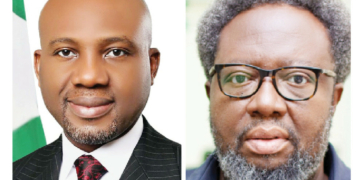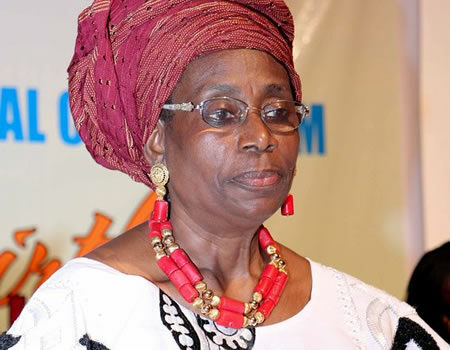
The wife of former President Olusegun Obasanjo, Chief Bola Obasanjo, development economist Dr Paul Alaje, Kenyan scholar Prof. PLO Lumumba, and Professor of Capital Market, Uche Uwaleke, have outlined a comprehensive four-pillar road map aimed at repositioning Nigeria—and, by extension, Africa—on a path from poverty to shared prosperity. The trio spoke in Abuja at the 2025 Paul Alaje Colloquium, themed
“Breaking the Cycle: How Nigeria Can Lead Africa from Poverty to Prosperity.”
Addressing participants drawn from government, academia, the private sector and civil society, Mrs Obasanjo said Nigeria could not achieve the prosperity it envisioned unless it fully harnessed the potential of its people, particularly women who remained central to the nation’s social and economic fabric. She described women as “the heartbeat of our homes, the foundation of our communities, and the drivers of our informal economy,” yet still disproportionately excluded from leadership and economic opportunities.
She warned that no country could break the cycle of poverty by relying solely on natural resources, adding that Nigeria must invest deliberately in its human capital to achieve inclusive growth. “The future of Nigeria depends on what we choose to do today: the policies we craft, the values we uphold, and the opportunities we create for every citizen, especially our women and young people,” she said.
Mrs Obasanjo called for new gender-responsive policies that expand access to education, healthcare, financial services and leadership opportunities for women. She urged legislators to champion laws that protect women’s rights, while challenging the private sector to move beyond tokenism and build workplaces that recognise merit and support women’s advancement to senior positions.
She stressed that civil society, faith-based organisations and the media must continue to challenge discriminatory norms and amplify the contributions of women across communities. “If we empower women, we empower communities. If we empower communities, we empower economies. And if we empower economies inclusively, we secure the future of Nigeria,” she said, adding that inclusive prosperity requires both institutional action and individual responsibility.
Convener of the colloquium, Dr Paul Alaje, set the tone for the colloquium with a blunt assessment of Africa’s slow economic progress despite its abundant natural resources, vast land and young population. He argued that the continent’s poverty was rooted in systemic weaknesses, not a lack of resources, and called for an urgent overhaul of institutions, governance frameworks and productivity systems.
“Our greatest enemy is not lack—it is under-utilisation. Potential is not prosperity. Resources are not results,” he said. Alaje presented a four-pillar blueprint focused on economic transformation, governance and institutions, security, and technology and innovation.
On the economy, he said Africa must shift from consumption-driven growth to production-led development by investing in local manufacturing, shortening value chains, and driving regional industrialisation through cross-border industries. He urged Nigeria to stabilise its macroeconomic environment, scale technical and vocational training, expand infrastructure and build integrated regional value corridors.
Under governance, he called for competent, transparent and merit-driven public institutions supported by forensic audit capabilities, stronger anti-corruption systems, digital public service delivery, and regulatory reforms that enable seamless trade, mobility and investment across African borders.
Alaje also emphasised the centrality of security—territorial, internal, food and economic security—as prerequisites for growth. He proposed a technology-enabled approach to policing, border management and intelligence gathering. On innovation, he urged African governments to build digital infrastructure, expand broadband, support startups and integrate emerging technologies into service delivery.
Prof. Lumumba reiterated the call for a continental mindset, emphasising that Africa must unite as a collective to overcome poverty. He argued that development cannot be achieved through fragmented national policies and stressed the need for unified political will, stronger regional cooperation and a renewed commitment to good governance, civic responsibility and economic integration.
He noted that Africa’s demographic strength can only translate into prosperity if its leaders prioritise education, justice, institutional integrity and long-term planning. “No nation prospers by accident,” he said, echoing Alaje’s argument that prosperity is a product of design, not destiny.
Prof. Uwaleke drew the attention of the participants to Nigeria’s and Africa’s weak institutions, inadequate energy capacity, and shallow financial markets.
He said Nigeria has the natural and human resources required to lead Africa out of poverty, but is constrained by structural weaknesses.
Uwaleke particularly stressed the crippling effects of low electricity generation, noting that a country of over 200 million people produces less than 5,000 megawatts, compared to South Africa’s 40,000 megawatts for a population of 65 million.
He also highlighted the low market capitalisation of the Nigerian capital market compared to peer economies, arguing that stronger financial systems are needed to mobilise investment for development.
He commended the ongoing government reforms in fuel subsidy removal, tax restructuring, and exchange-rate unification, but insisted that these reforms must be matched with improved public spending in education, health, and social welfare to achieve inclusive growth.
“It is not just about revenue; it is about the quality of spending. Growth means nothing if it does not trickle down,” he said.
As the colloquium concluded, speakers urged Nigerians and Africans to take on a shared responsibility for the continent’s transformation. Mrs Obasanjo summed up the collective message: “The time for promises has passed; the time for purpose is now. Let us rise together—men and women, leaders and citizens—to build the Nigeria that generations after us will thank us for.”
We’ve got the edge. Get real-time reports, breaking scoops, and exclusive angles delivered straight to your phone. Don’t settle for stale news. Join LEADERSHIP NEWS on WhatsApp for 24/7 updates →
Join Our WhatsApp Channel