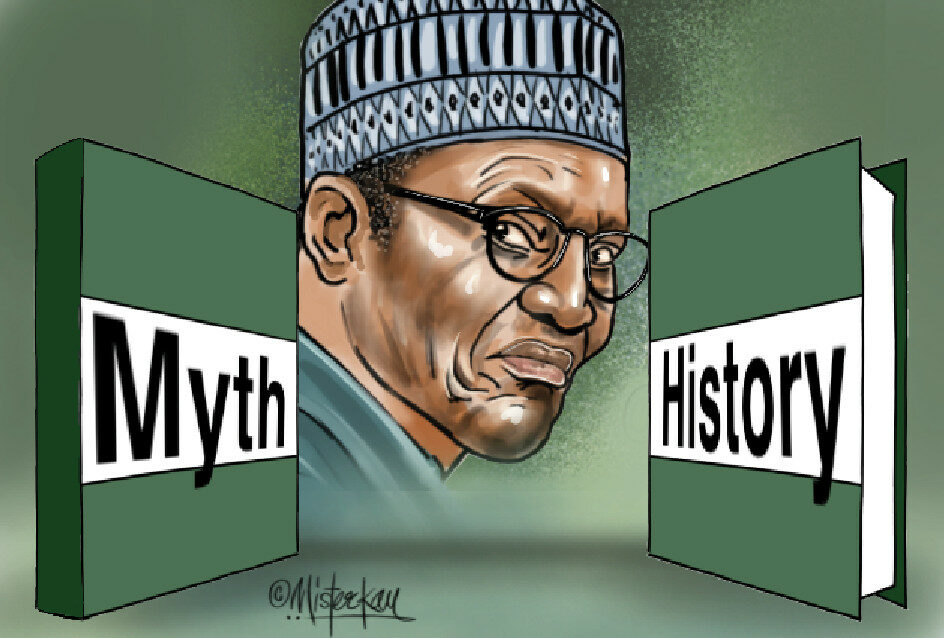
In the unfolding gallery of Nigerian leadership literature, the figure of Late President Muhammadu Buhari commands a display that is at once vast, contradictory, and bewildering. There are memoirs, insider reflections, media chronologies, and now a full length authorised biography. For reader who seeks understanding rather than flattery, what has emerged so far reads less like a sober telling of history and more like a series of mirrors reflecting image rather than substance.
Four books in particular invite scrutiny because they hold themselves up as authoritative sources on Buhari’s life and presidency. Femi Adesina’s Working with Buhari: Reflections of a Special Adviser, Media and Publicity (2015–2023) is a memoir by a loyal aide who sees his role as a defender of narrative first and analyst second. Garba Shehu’s According to the President: Lessons from a Presidential Spokesman’s Experience purports to chart lessons for communicators but ends up a guidebook for image management. Lai Mohammed’s Headlines and Soundbites: Media Moments that Defined an Administration turns episodes of governance into media tropes. And most recent, Dr. Charles Omole’s Muhammadu Buhari: From Soldier to Statesman, is presented as a biography, yet oscillates between homage and anecdote.
The Softness of the “Software”
Femi Adesina’s memoir begins with an unabashed confession: this is the story of “the Buhari software” rather than the “hardware” of policy and structural change. That phrase, repeated like a mantra, is at once candid and evasive. It tells us that Adesina knows he is not writing about, say, the naira redesign, monetary policy, security architecture, or foreign relations. Instead, we are ushered into lunchroom jokes, loyalty anecdotes, praise for personal discipline, and recollections of the president’s disposition. This is the story behind the story, Adesina claims, and certainly it does offer a human side to a figure many outside Aso Rock scarcely understood. But in boxing the narrative into the “software” of personality, it effectively sidesteps the consequences of decisions that affected a nation of 220 million people.
There have been critics of this approach who regard Adesina’s book as hagiographic, noting that it reads more like an extended love letter than an analytical memoir. One column even dismissed Adesina as a “dishonest interlocutor of Nigerian history” and labelled the book an “annoying insult on Nigerians” because it substituted cliché praises of the president with little engagement with his policy successes or failures. The effort to present Buhari as virtuous and “straight as an arrow” fails to grapple with the empirical reality of insecurity, economic hardship, and institutional erosion that marked much of his tenure. The book’s strength is its intimate detail; its weakness is its reluctance to confront evidence that discomfits the inner circle.
Lessons from the Spokesman Without Lessons for the Nation
Garba Shehu’s account, billed as lessons from a spokesman, sits awkwardly between autobiography and communication manual. As someone who rose through the press corps to become a presidential spokesman, Shehu brings a seasoned understanding of messaging. Yet his narrative risks reducing governance to a series of soundbites. The presidency in his telling becomes a theatre of public relations challenges and triumphs, not a crucible of policy choices and their consequences.
In this sense, Shehu’s book is valuable for journalism students studying state communication. But for historians of governance, it reads like a dialectic on spin and framing rather than an account of what was done and why it mattered. When the presidency is depicted primarily as a communication challenge, the structural context — the economy, national security, social cohesion — drifts into the background. A spokesman’s perspective is a prism, but not a map, and Shehu does not compensate for this by offering the broader cartography of the Buhari years.
Headlines without History
Lai Mohammed’s Headlines and Soundbites operate in a similar register. Mohammed, who served as Information Minister under Buhari, talks about key moments of media engagement and the communication battles that defined the administration. This is inherently interesting. Governments are, after all, communicative projects as much as they are administrative ones. But the danger arises when headlines are mistaken for policies. Mohammed’s book promises an insider chronicle of governance and national orientation. Where it is at its best, it reveals how narratives were shaped, contested, and broadcast. Where it falls short is in bridging that coverage with measurable effects of policy. It is one thing to explain how a press release was crafted and another to show how that release shaped a nation’s fate.
Soldier, Statesman, or Something Else?
Then comes Charles Omole’s biography, launched amid pomp at the Nigerian Presidential Villa under the watchful gaze of President Bola Ahmed Tinubu and a retinue of dignitaries. Omole himself insists that his book is the most comprehensive account of Buhari’s life and legacy and that it emerged from extensive interviews with those who knew the former president from cradle to grave. On the face of it, this sounds promising. The challenge is that Omole’s intimacy with subjects such as Aisha Buhari and others yields a portrait thick with gossip but thin on systematic analysis.
The biography abounds with scenes of personal detail: Buhari’s closer family recounting his dietary routines, Aisha Buhari’s vivid memories of nutrition mismanagement contributing to his 2017 health crises, and anecdotes that could rival palace intrigue in any Shakespearean drama. These are compelling glimpses into personality and temptation, but they are not a substitute for clear analysis of governance outcomes. When a book focuses on whether Buhari suspected his wife of foul intent, it moves away from national consequence to private rumour. When it recounts how a cabal supposedly isolated him, it invites conspiracy rather than explanation. These are stories that entertain, but do not clarify why the naira redesign precipitated a cash crisis that left millions impoverished, or why security institutions faltered across multiple fronts.
It is worth noting that some critics have already detected the political undercurrents in Omole’s project. Former Kaduna governor Nasir El Rufai warned that the book could turn Buhari’s legacy into a tool for narrow interests rather than an honest historical record, urging that the work risked reopening old factional divisions. Omole’s account, like others in this genre, reflects not only on the man, but on the pressures and preferences of those around him.
What These Books Miss
Taken together, these works are rich in anecdote and proximity but suffer recurring gaps that future historians or writers must fill. None of them systematically engages with the Gordian knots of national consequence: the causal chains behind security collapse, the empirical impact of economic policy under Buhari, the structural dynamics that shaped Nigeria’s democratic experiment during this period, and the lived experience of everyday Nigerians who bore the brunt of leadership decisions.
There is, however, still space for work that bridges the personal with the structural. A book that situates Buhari’s life — his origins in Daura, his military years, his return to democratic politics — within the broader sweep of Nigerian political history could illuminate how his worldview translated into policy and consequence. Such a work would need to triangulate personal testimony with archival data, economic indices, security metrics, and interviews with critics as well as supporters. It would need to answer not just who Buhari was, but why what he did mattered.
We’ve got the edge. Get real-time reports, breaking scoops, and exclusive angles delivered straight to your phone. Don’t settle for stale news. Join LEADERSHIP NEWS on WhatsApp for 24/7 updates →
Join Our WhatsApp Channel