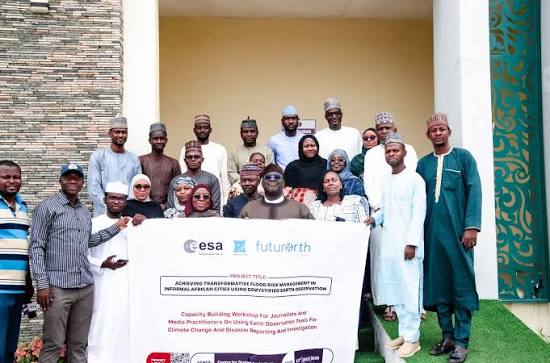
Journalists and media practitioners have been urged to adopt earth observation technologies to improve the quality of climate change and environmental reporting in Nigeria.
The charge was given yesterday at a one-day capacity-building workshop organised by Bayero University, Kano(BUK), in collaboration with the European Space Agency and Future Earth, at the Centre for Dryland Agriculture, BUK.
At the event, BUK deputy vice-chancellor (Research and Development), Prof. Amina Mustapha, said journalists play a critical role in translating scientific research into information that shapes public opinion, influences policy and promotes environmental accountability.
She noted that while climate change reporting in Nigeria often highlights disasters in other parts of the world, insufficient attention is paid to local environmental challenges, such as the shrinking Lake Chad, desertification, land degradation, and the growing threats to livelihoods and food security in northern Nigeria.
Mustapha urged journalists to embrace evidence-based, solutions-oriented reporting by using scientific tools and data to investigate climate issues, document the experiences of affected communities, and hold relevant authorities accountable.
She also reaffirmed the university’s commitment to supporting journalists through access to its research facilities and experts to strengthen science and environmental reporting.
Earlier, the workshop coordinator, Prof. Aliyu Barau, said the increasing frequency of floods, droughts, deforestation, and biodiversity loss had underscored the need for credible, data-driven environmental journalism.
According to him, Earth Observation technologies, including satellite imagery, remote sensing and geospatial data, enable journalists to verify facts, monitor environmental changes and produce more accurate investigative reports.
Barau encouraged participants to strengthen collaboration with scientists and policymakers to improve public understanding of climate change and disaster risk management.
In a virtual presentation, the European Space Agency Liaison to Future Earth and Research Coordinator, Freya Muir, highlighted the role of Earth Observation technologies in climate modelling and environmental monitoring.
She said the agency remained committed to supporting research collaborations and initiatives that promote climate action, disaster preparedness and environmental sustainability.
We’ve got the edge. Get real-time reports, breaking scoops, and exclusive angles delivered straight to your phone. Don’t settle for stale news. Join LEADERSHIP NEWS on WhatsApp for 24/7 updates →
Join Our WhatsApp Channel