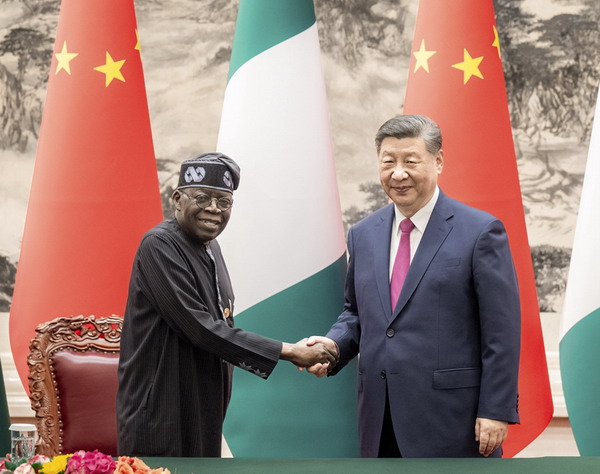
The last couple of days have seen a flurry of political activities in Nigeria with political parties’ primaries to select candidates for the 2027 general elections in Africa’s most populous and perhaps endowed country.
The task ahead of the candidates and political parties jockeying for positions in the election is absolutely enormous. Nigeria is in desperate need of a new crop of leaders rich not in slogans and perverted rhetoric but leaders imbued with compassion, competence, character and commitment to setting a new agenda for national rebirth and transformation.
In this regard, the People’s Republic of China’s development trajectory offers invaluable examples of clarity of thought and people-centered development paradigm based on ‘’socialism with Chinese Characteristics” in all sectors.
China has made massive investments in energy, industry, manufacturing, agro-productivity and processing, scientific and innovative education, which have placed the country in the most enviable position as the second biggest economy in the world and the global manufacturing hub.
A visit to auto plants and other industrial zones in China by a group of Nigerian journalists and some government officials sponsored by the China International Communications Group (CICG) in May 2026 is a testament to the growing self-sufficiency in vehicle manufacturing especially electric cars and other industrial hubs powered by intense investment in energy sector.
China ‘s contribution to the global economic growth as of 2026 is about 30% and the Asian giant has removed over 800 million people out of extreme poverty in just about 40 years, beating the United Nations Sustainable Development Goal of ending absolute poverty in 2030 by 10 years.
These are predictable outcomes of the “Reforms and Opening Up” that was started by the pragmatic Chinese leader Deng Xiaoping in 1978 under the guardianship of the Communist Party of China (CPC) driven by patriotism, discipline, innovation, purpose and commitment to the pursuit of inclusive development for the benefit of all in the largest possible scale.
Therefore, as the 2027 elections beckon at all levels, Nigerian citizens and policymakers must look at the current situation of the country and make a choice to either reform the country along lines that are unique to its circumstances and bring development or risk plunging the nation deeper into economic stagnation.
Nigeria’s development indicators are pathetic and probably compounded by the interminable and frightening security threat facing the country.
In terms of poverty, Nigeria, according to the World Bank 2026 figures, has an estimated 63% of people or 140 million out of 230 million population, living in multidimensional poverty as of late 2025/early 2026. Poverty rose from 56% in 2023 to 61% in 2024, reaching 63% in 2025, which is driven mostly by high inflation, weak income growth, and slow growth in the agricultural sector, which employs most of the poor.
According to the Food and Agriculture Organization of the United Nations, Nigeria faces a severe, accelerating food crisis in 2026, with an estimated 34. 7 million to 35 million people are projected to face acute food insecurity. Driven by insecurity, economic hardship and climate change factors, this according to the report, represents one of the largest surges in food insecurity globally, placing the country at the centre of the global food crisis.
The unemployment figure in Nigeria is also very scary. As of early 2026, Nigeria’s official unemployment rate under the revised methodology is approximately 5.3%. But the figures are said to be around 40% using the older, broader definitions that include underemployment.
Perhaps the worst form of record is that of insecurity. The Global Terrorism Index (GTI) released on March 19, 2026, by the Institute for Economics and Peace, ranked Nigeria as the 4th most terrorism -affected country in the world.
The grim economic situations have also plunged Nigeria’s GDP per capita from $4,363 in 2014 to an estimated $1,600 in 2026 making it nearly 70% rate in decline for a country with a surging population growth rate, one of the fastest in the world.
It has become incumbent on the leaders that will drive a new Nigeria to intensify efforts in attracting foreign direct investment (FDI), thereby boosting exports, and leveraging the African Continental Free Trade Area(AfCFTA) for economic development, especially now that Nigeria’s industrial outlook in 2026 is pivoting toward recovery, with manufacturing growth projected to reach 2.6%(up from1.4%in 2025).
The new leaders of Nigeria must take the fight against insecurity seriously, while making real investments in the power sector. The life-wire of any nation that desires industrial development is power because without it development might just be wishful thinking.
Just as China surmounted its enormous challenges and rose from the ashes of poverty to become a global economic and industrial power with unquestionable security for its people, there is hope that a new Nigeria is possible, and with leaders who are instilled with integrity, intelligence and intellect, Nigeria will unlock its huge potential and become great.
We’ve got the edge. Get real-time reports, breaking scoops, and exclusive angles delivered straight to your phone. Don’t settle for stale news. Join LEADERSHIP NEWS on WhatsApp for 24/7 updates →
Join Our WhatsApp Channel