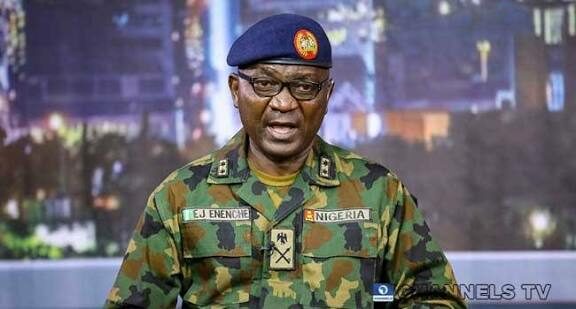
A former Director of Defence Information, Major-General John Enenche (rtd), has said that it is “almost impossible” for a military coup to take place in Nigeria now, citing decades of democratic reorientation within the Armed Forces and lessons from the country’s past experience with military rule.
Speaking on Channels Television’s current affairs programme, ‘Sunday Politics’, on Sunday night, Maj-Gen. Enenche (rtd) dismissed recent rumours of a possible coup in Nigeria, insisting that the current breed of military officers have neither the inclination nor institutional backing to overthrow a civilian government.
“The rumours of coup that we heard recently in Nigeria, does it worry me as a retired General? It doesn’t worry me, but it concerns me,” he said. “I’m not too worried that it can happen in Nigeria.”
When asked directly if a coup was a possibility, Enenche responded emphatically: “It’s impossible for me. I stand to be corrected.”
He attributed his position to the extensive training and ideological shift within the Nigerian military since the last era of military rule, noting that officers have been consistently taught that military governance is no longer acceptable.
“Because of the training, the orientation in Nigeria after the last coup during Babangida’s time, for about 30 or 35 years, the training and the teaching, the orientation we are given is that the military government is out of it,” he said.
Enenche added that the military itself suffered immensely under past military administrations, particularly in terms of equipment, welfare and institutional development.
“We were even the first organisation to feel it. What about our equipment? The equipment we were supposed to be exchanging, restocking and all, it stopped that time—under the military,” he recalled. “So the military is not better off at all. We are worse off, and we are seeing the suffering till now.”
According to him, these experiences have shaped the mindset of today’s officers and soldiers, making the idea of military intervention in governance unattractive.
“So how will it come? Any person, any military man, the breed of officers we have now, to some extent the soldiers, they will not,” he said.
Explaining why coups have become more frequent in parts of West Africa, Enenche said Nigeria’s political development and democratic orientation were deeper than those of many neighbouring countries.
“The rate of geopolitical development is not as deep as that of Nigeria,” he said. “The orientation we got and we have now is that democracy is the best. However bad you look at it, it is the best both for the military and for the civil populace.”
He argued that many West African countries experiencing coups lacked similar democratic indoctrination within their armed forces and were still grappling with historical and political grievances.
“For them, they don’t have that teaching, they don’t have that belief. And more importantly, it’s like they are angry, I want to be careful with my choice of words, they are angry with their colonial masters,” Enenche said, noting that most coup-prone states in the region were Francophone countries.
“Look at Mali; Mali almost severed ties with France. What does that speak to us?” he asked, adding that coups were now rare in Anglophone countries.
While downplaying the likelihood of a coup in Nigeria, Enenche warned that instability in neighbouring countries could still have serious implications for Nigeria, especially in terms of security, migration and economic disruptions.
“Particularly for close neighbours like Nigeria and the Benin Republic, we have our kinsmen there,” he said. “You have businessmen from Nigeria settled in Cotonou. So what will happen to them? Businesses will collapse, and then there will be migration.”
He cautioned that insecurity in neighbouring states could trigger population movements into Nigeria, referencing Libya as an example of how instability spills across borders.
“If there is insecurity, there will be migration of people from the Republic of Benin to Nigeria,” Enenche said. “Libya’s experience is here. If you talk about Nigeria, it’s the same thing.”
We’ve got the edge. Get real-time reports, breaking scoops, and exclusive angles delivered straight to your phone. Don’t settle for stale news. Join LEADERSHIP NEWS on WhatsApp for 24/7 updates →
Join Our WhatsApp Channel