
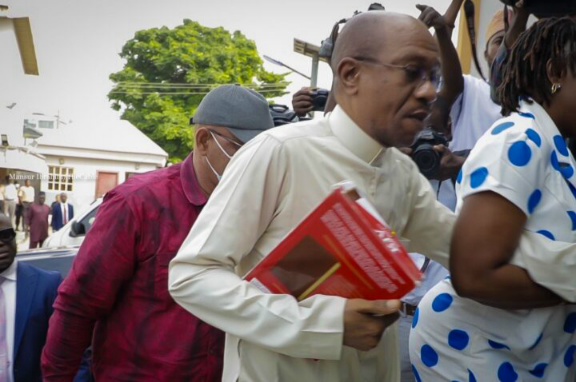
Justice Rahman Oshodi of the Lagos State Special Offences Court in Ikeja on Friday admitted as an exhibit a certified true copy of a Supreme Court judgment linking former Central Bank of Nigeria (CBN) Governor Godwin Emefiele to properties forfeited to the federal government.
The judge admitted the document after dismissing objections from Emefiele and his co-defendant, Henry Omoile, who challenged its admissibility on grounds relating to its completeness, relevance and compliance with the requirements of criminal proceedings.
In his ruling, Justice Oshodi held that a certified true copy of a Supreme Court judgment was admissible under the Evidence Act as a public document.
Read Also: Emefiele Built System In CBN To Extort Forex Seekers, EFCC Tells Court
He also rejected the defence’s argument that the document was incomplete because it contained only the lead judgment and not the concurring opinions of the other justices who took part in the decision.
The judge relied on the Court of Appeal’s decision in Mathias vs. Shikavi & Ors. (2021) LPELR-56552 (CA), in which a certified true copy containing only the lead judgment of a Supreme Court decision was admitted in evidence.
He noted that the appellate court had rejected the argument that omitting the concurring judgments made the document incomplete or inadmissible.
Citing the Supreme Court’s decision in Abacha & Ors. vs. Fawehinmi (2000), Justice Oshodi said that, in legal circles, the lead judgment was regarded as the judgment of the court.
The judge also dismissed the defence’s objection that the document had not been included in the proof of evidence as required under the Administration of Criminal Justice Act (ACJA).
He observed that the court record for November 12, 2026, showed the defence had been served with the document and that the matter was adjourned to Friday, satisfying the service requirement.
On the argument that the judgment arose from non-conviction proceedings and was irrelevant to the criminal trial, Justice Oshodi acknowledged the defence’s concerns but said the document’s intended use was clearly limited.
Relying on the Supreme Court’s decision in David v. Thomas & Anor. (2000) LPELR-15575 (SC), the judge explained that a judgment tendered in another proceeding could be used only to establish what the court had decided in the earlier case, not as evidence for or against any party in the current trial.
He therefore overruled the objections, admitted the certified true copy of the Supreme Court judgment and marked it as Exhibit A.
The prosecution tendered the document through Economic and Financial Crimes Commission (EFCC) investigator Alvan Gurumnaan.
The prosecution was led by the Director of Public Prosecutions of the Federation, Rotimi Oyedepo (SAN).
Before the ruling, Emefiele’s lead counsel, Ojo Olalekan (SAN), urged the court to reject the document, arguing that only four justices signed it, while panels ordinarily deliver Supreme Court decisions of five or seven justices.
Ojo also argued that the judgment arose from non-conviction proceedings and was irrelevant to the allegations against his client.
Counsel for the second defendant, Adeyinka Kotoye (SAN), joined those submissions, arguing that the document should not be admitted, particularly because the prosecution sought to introduce it after the trial had begun.
Oyedepo maintained, however, that the document was a duly certified true copy of a Supreme Court decision and met the requirements of Sections 102 and 104 of the Evidence Act.
After the ruling, the prosecution witness, Gurumnaan, was cross-examined by the defence.
The EFCC investigator told the court that he had personally obtained statements, analysed bank statements and coordinated other members of the investigation team during the probe.
He confirmed that he interviewed Zenith Bank Managing Director Dr Ebenezer Onyeagwu, but said he could not immediately recall whether he had obtained a statement from him after the interview.
The witness also said the investigation involved hundreds of interviews with CBN officials, commercial bank employees and personnel from other government agencies.
At Thursday’s proceedings, the prosecution sought to tender the Supreme Court judgment through Gurumnaan, but the defence objected to its admission. The objections prompted arguments from both sides, and the court decided to consider their submissions.
The dispute centred on whether the judgment, which arose from non-conviction forfeiture proceedings, could be introduced in the ongoing criminal trial and, if so, to what extent it could be relied upon.
Emefiele is standing trial with Omoile on a 19-count charge involving alleged gratification, corrupt demands and abuse of office in connection with $4.5 billion and N2.8 billion.
Emefiele faces all 19 counts, while Omoile faces a separate three-count charge alleging unlawful acceptance of gifts.
Both defendants have pleaded not guilty.
Justice Oshodi adjourned the case until December 17, 2026, for the continuation of the cross-examination of the EFCC investigator.
We’ve got the edge. Get real-time reports, breaking scoops, and exclusive angles delivered straight to your phone. Don’t settle for stale news. Join LEADERSHIP NEWS on WhatsApp for 24/7 updates →
Join Our WhatsApp Channel