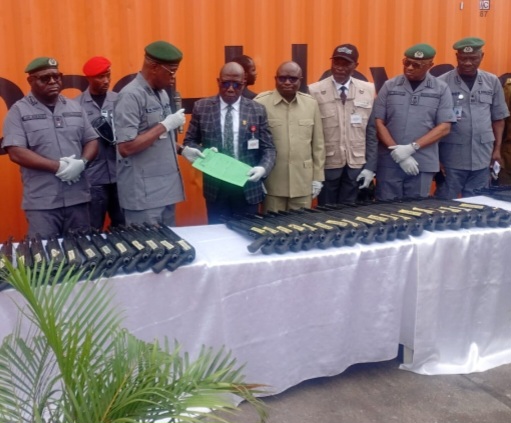
The Nigeria Customs Service (NCS) has named two suspects arrested in connection with the attempted importation of 399 fully assembled JOJEF pump-action rifles and other firearm components into the Tin-Can Island Port in Lagos.
The suspects, identified as Robert Eze and Ejiogu Godson, were arrested while attempting to facilitate the clearance of the consignment, which was intercepted by Customs after its risk management system flagged the container.
The NCS on Monday handed over the seized firearms to the National Centre for the Control of Small Arms and Light Weapons (NCCSALW), under the Office of the National Security Adviser (NSA).
Speaking at the handover ceremony in Lagos, the comptroller-general of Customs, Bashir Adewale Adeniyi, said the container arrived at the Tin-Can Island Port on July 8 aboard the vessel MV VELIKA.
According to him, the firearms were concealed in knocked-down form, a method deliberately adopted to disguise the weapons and evade detection.
“Look carefully at what is laid out on these tables. 399 rifles. Somebody paid for them. Somebody arranged their shipment. Somebody was waiting at this end to collect them. And somebody, somewhere in this country, was going to be on the wrong end of them.
“That is what we have gathered this morning to hand over to the National Centre for the Control of Small Arms and Light Weapons,” Adeniyi said.
He explained that the container was not subjected to a random inspection, but was opened after being flagged by the Service’s risk management system.
“Let me tell you how they came to be on these tables. On the 8th of July, a container arrived at Tin Can Island Port aboard the vessel MV VELIKA. It was not opened because somebody had a suspicion, or because an officer happened to be passing. It was opened because our risk management system flagged it.
“Inside were firearm components, taken apart and hidden in knocked-down form. That is a deliberate method. It is chosen for one reason only, which is that a rifle in pieces does not look like a rifle,” he said.
The Customs boss said the interception was particularly significant given the security challenges confronting the country, including terrorism, banditry, kidnapping and violent crime.
“Now consider what that quantity of weapons would have done. Our country is contending with terrorism. With banditry. With kidnapping. With violent crime that has entered too many homes in this country. And not one of those afflictions can be carried out without a weapon in somebody’s hand,” he said.
Adeniyi also warned of the potential consequences of allowing hundreds of firearms into the country ahead of another electioneering season.
“Weapons like these are not made in Nigeria. They are made elsewhere, and they reach us through the ports, the borders and the airports that this Service is charged with guarding.
“We are also approaching another electioneering season, and I do not need to describe to this audience what several hundred firearms in the wrong hands would mean for the peace of our communities or for the conduct of our democracy.
“I will say only this: that consignment did not reach its destination, and the officers of this Service are the reason,” he said.
The Customs CG attributed the successful interception to investments in technology under the Trade Modernisation Project, particularly the B’Odogwu platform, which integrates cargo clearance, automated risk management, cargo tracking and non-intrusive inspection.
“That container was found because of a system, and that system exists because this administration chose to invest in it. Under the Trade Modernisation Project, we have replaced manual processes with B’Odogwu, which brings clearance, automated risk management, cargo tracking and non-intrusive inspection onto a single platform,” Adeniyi said.
He stressed that the objective of the technology was not limited to revenue collection, but also to strengthening national security.
“The purpose of that investment was never revenue alone. We cannot open every container that enters this country, and no Customs administration anywhere in the world can. What technology gives us is the ability to know which container to open,” he said.
Adeniyi disclosed that two suspects, Eze and Godson, had been arrested and were facing prosecution.
“But a seizure by itself proves very little, and I want to be careful about that. So let me tell you what has happened since.
Two suspects, Robert Eze and Ejiogu Godson are now in custody.
“One of them was arrested on the 31st of July at a bonded terminal, while he was attempting to procure the release of this very container,” he said.
According to him, both suspects have been remanded by the Federal High Court in Lagos, with their arraignment scheduled for August 25.
He said the handover of the weapons to the NCCSALW completed the chain of action initiated by the Customs interception.
“Both have been remanded by the Federal High Court in Lagos, and arraignment is set for the 25th of August. And today the weapons themselves pass into the custody of the National Centre for the Control of Small Arms and Light Weapons, under the Office of the National Security Adviser.
“Hear that sequence in full, because it is the whole point of this gathering. The weapons were intercepted. The importers were arrested. They stand before a court of law. And the arms are being surrendered to the national authority responsible for them.
“That is not an incident. That is a chain, and every link in it held,” Adeniyi said.
He assured Nigerians that the NCS would continue to prevent the country’s ports and borders from being used for the importation of illicit arms.
“So let there be no doubt about where this Service stands. We will not allow the ports and borders of this country to be used to bring in arms, or anything else that threatens the safety of Nigerians.
“We will strengthen our risk systems and work shoulder to shoulder with our sister agencies to find the people who attempt this and to stop them,” he said.
Adeniyi commended officers of the Tin-Can Island Port Command for the interception, saying the firearms were carefully concealed but were detected through the combination of technology and effective enforcement.
“Whoever packed this consignment took great care to hide it. It was found anyway, because our systems worked and because our officers did their duty, and I want that named in this room,” he said.
Speaking at the event, the national coordinator of the NCCSALW, Johnson Kokumo, disclosed that the Centre had so far received more than 21,000 Small Arms and Light Weapons (SALWs) since its establishment.
He added that more than 19,000 of the recovered weapons had already been destroyed.
“It is with a deep sense of patriotism that we gather here today, not merely to witness the handing over of seized illicit weapons, but to mark a decisive step in strengthening our collective security and safeguarding the peace we all cherish,” Kokumo said.
He commended the Customs Service and its comptroller-general for their continued collaboration with the Centre in tackling the proliferation of illicit arms in Nigeria.
“I wish to express my profound gratitude on behalf of the National Security Adviser, management and staff of the National Centre for the Control of Small Arms and Light Weapons (NCCSALW) to the Comptroller General of Customs for his astute leadership, professionalism and patriotism often demonstrated in all operations of the Nigeria Customs that have led to the recovery of illicit weapons at different times as well as his continuous collaboraton with the NCCSALW in the fight against the proliferation of illicit Small Arms and Light Weapons in the country,” he said.
Kokumo said removing illicit weapons from non-state actors was a direct setback for criminal networks and an important step towards protecting citizens.
“May I, at this juncture, reiterate that illicit weapons taken out of the hands of non state actors is a direct blow to criminal networks and a vital step toward safeguarding innocent citizens.
“So far, over 21000 Small Arms and Light Weapons have been retrieved while over 19000 have been destroyed since the establishment of NCCSALW,” he said.
He assured that the 399 firearms handed over by Customs would be properly documented and managed in line with national and international standards.
“As we receive these illicit weapons today, we do so with a solemn commitment that they shall be managed to the highest standards and will be accounted for; ensuring that they do not find their way back into the hands of criminal elements,” Kokumo said.
According to him, the weapons would be handled in compliance with relevant national legislation and international obligations, including frameworks governing the control and eradication of illicit trade in small arms and light weapons.
“These weapons will be handled in strict compliance with national legislation and international best practices, including Nigeria’s obligations under international and regional frameworks like the United Nations Programme of Action to prevent combat and eradicate the Illicit trade in small arms and light weapons, the African Union and ECOWAS Conventions on smail arms.
“The NCCSALW will immediately catalogue, profile, and document every piece received here today. Serviceable assets required for authorised state security use will be accounted for, while obsolete, illegal, and unserviceable weapons will be destroyed,” he said.
We’ve got the edge. Get real-time reports, breaking scoops, and exclusive angles delivered straight to your phone. Don’t settle for stale news. Join LEADERSHIP NEWS on WhatsApp for 24/7 updates →