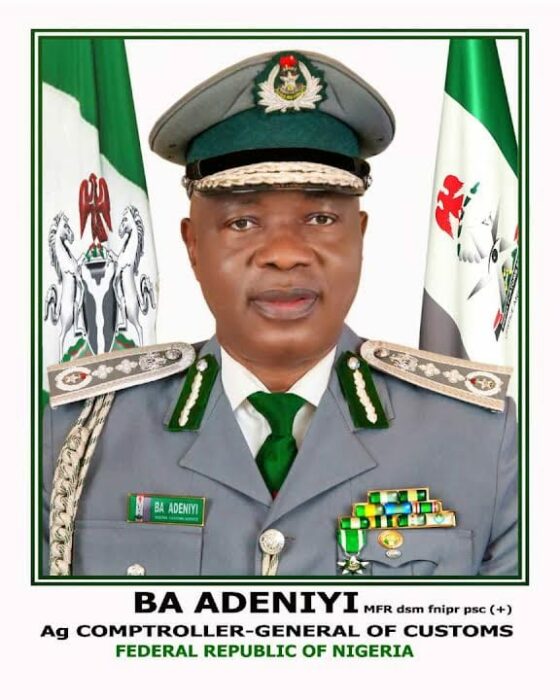
The Nigeria Customs Service (NCS) has recorded significant growth in revenue collection over the past three years, while expanding its operations beyond duty collection to include trade facilitation, data management, anti-smuggling activities, enforcement of anti-illicit financial flows, and environmental protection.
According to figures released by the Service, revenue collection rose from ₦3.21 trillion in 2023 to ₦6.105 trillion in 2024 and further increased to ₦7.27 trillion in 2025. The Federal Government has set a revenue target of ₦11 trillion for 2026.
Between January and June 2026, the Service generated ₦4.043 trillion in revenue.
The NCS attributed the growth to reforms, including the deployment of the Unified Customs Management System, B’Odogwu, increased automation, intelligence-led enforcement and stakeholder engagement aimed at reducing leakages and bringing more importers into the formal trade system.
Comptroller-General of Customs, Dr Bashir Adewale Adeniyi, said the reforms were designed to reduce human discretion, deploy technology and improve compliance among traders.
“What we have done is simple. We removed human discretion, we deployed technology, and we built trust with compliant traders. When you do that, revenue will grow exponentially without hurting business. The jump from ₦3.21 trillion in 2023 to ₦7.27 trillion in 2025 is proof that the reforms of the Renewed Hope Agenda are working. Our ₦11 trillion target for 2026 is not a wish. It is a plan backed by data, commitment and hard work,” Adeniyi said.
The Service said that trade facilitation has also been strengthened through measures to reduce cargo clearance time and improve port efficiency.
These include the use of Time Release Studies, Advanced Ruling systems that provide importers with duty information before cargo arrival, 24-hour operations at major ports, the Authorised Economic Operator (AEO) programme for compliant companies and dispute resolution desks that handle valuation disputes within 48 hours.
The NCS said it also holds weekly engagements with the Nigerian Ports Authority (NPA), shipping companies and terminal operators to improve coordination across the ports.
According to the Service, the measures have helped manufacturers secure faster access to raw materials and enabled exporters to move goods more quickly to international markets while reducing costs associated with cargo delays.
The agency said it has also increased its use of data and technology in decision-making.
Real-time monitoring systems now track revenue, cargo volumes, and seizures across customs commands, while data generated by the Service is shared with agencies, including the National Bureau of Statistics (NBS), the Central Bank of Nigeria (CBN), and the Federal Ministry of Finance.
The NCS said risk management systems now profile cargo, allowing compliant traders to receive faster clearance while directing attention to higher-risk consignments.
On anti-smuggling operations, the Service said enforcement units have shifted from random inspections to intelligence-based operations.
In the last 18 months, Customs reported interceptions of arms, foreign rice, used vehicles and petroleum products allegedly being smuggled through land borders and ports.
The Service said it has expanded collaboration with the Nigerian Army, Nigerian Navy, Department of State Services (DSS) and Interpol through joint operations and intelligence sharing.
Customs also said it has intensified efforts against illicit financial flows through the Currency Declaration System and collaboration with the Economic and Financial Crimes Commission (EFCC), the Nigerian Financial Intelligence Unit (NFIU) and the CBN.
According to the Service, trade mis-invoicing, under-valuation and false declarations are now being identified through its risk management system, with several cases transferred to the EFCC for prosecution.
The agency said it has also strengthened its role in wildlife protection and environmental enforcement.
Working with the National Environmental Standards and Regulations Enforcement Agency (NESREA), non-governmental organisations and international partners, Customs said it recorded several seizures of pangolin scales, elephant tusks and other wildlife products at airports and seaports in 2024 and 2025.
The Service disclosed that multiple containers containing pangolin scales and ivory, valued at billions of naira, were intercepted during the period, and that suspects were arrested and prosecutions initiated.
Customs officers have also received training in wildlife identification, while detection dogs have been deployed to enhance enforcement efforts.
The NCS said the efforts are aimed at protecting biodiversity and ensuring compliance with international environmental regulations, including those administered under the Convention on International Trade in Endangered Species of Wild Fauna and Flora (CITES).
The Service further stated that investments have been made in personnel training covering information and communication technology, investigations and customer service, alongside measures to improve staff welfare and stakeholder engagement.
Despite the progress recorded, the NCS acknowledged challenges including poor port access roads, the need to strengthen export facilitation and the requirement to institutionalise ongoing reforms while pursuing the ₦11 trillion revenue target for 2026.
The Service maintained that reforms implemented over the past three years have transformed its operations in revenue generation, trade facilitation, governance, security and environmental protection.
Meanwhile, President Bola Ahmed Tinubu recently congratulated Adeniyi on his unanimous re-election as Chairperson of the World Customs Organisation (WCO) Council during the organisation’s 147th and 148th sessions held in Brussels on July 3, 2026.
According to the President, the re-election reflected the progress recorded under Adeniyi’s leadership and growing international recognition of the Nigeria Customs Seprvice.
Tinubu said Adeniyi’s leadership had been marked by initiatives aimed at improving revenue generation, strengthening border security, facilitating legitimate trade and modernising customs operations.
He expressed confidence that Adeniyi’s second term at the WCO would deepen international collaboration and promtrade.pcure and efficient global trade.
We’ve got the edge. Get real-time reports, breaking scoops, and exclusive angles delivered straight to your phone. Don’t settle for stale news. Join LEADERSHIP NEWS on WhatsApp for 24/7 updates →
Join Our WhatsApp Channel