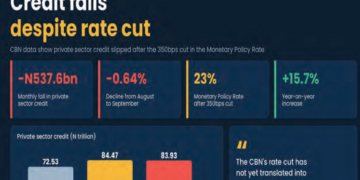

Commercial banks must translate the Central Bank of Nigeria’s new Monetary Policy Rate of 23 per cent into lower lending rates for businesses if the policy is to achieve its intended impact, the chief executive officer of the Centre for the Promotion of Private Enterprise (CPPE), Dr. Muda Yusuf, has said.
Yusuf, in his Policy Brief on the outcome of the 307th Monetary Policy Committee meeting held on September 22, 2026, welcomed the 350 basis points cut from 26.5 per cent to 23 per cent as a significant shift from a prolonged restrictive monetary regime.
He said the magnitude of the adjustment was largely unexpected and signals an important rebalancing towards supporting growth, investment and economic recovery while preserving price and financial system stability.
According to him, the review of the asymmetric corridor around the MPR from +50/-450 basis points to +50/-300 basis points further reinforces the recalibration of the monetary architecture.
Yusuf said the decision is particularly positive for the real sector, where high financing costs have become a major constraint.
“For many businesses, commercial lending rates have remained at levels that are difficult to reconcile with productive investment, particularly in manufacturing, agriculture, construction, logistics and other sectors with relatively long investment cycles and tight margins,” he said.
He noted that the policy adjustment offers an opportunity to reduce the cost of capital, improve business cash flows, stimulate investment and strengthen productive capacity.
However, Yusuf stressed that the ultimate economic value will depend on transmission, saying “the ultimate economic value of the decision will depend on transmission.
“We expect banks to reflect the new monetary policy environment in the pricing of credit. Lending rates on both new and existing facilities should progressively adjust downwards. Without meaningful transmission to borrowers, the impact of the policy adjustment on investment and economic growth would be limited.”
Yusuf described the cut as timely given improving inflation trajectory and the misalignment that had existed between MPR of 26.5 per cent, inflation of about 15.4 per cent and prevailing money-market rates of around 20 per cent, which weakened the signalling function of the policy rate.
He added that the CBN itself characterised the decision as a recalibration or reset, not merely monetary easing, but a realignment with macroeconomic conditions.
He also cautioned that lower interest rates alone cannot deliver sustainable recovery, as a significant proportion of Nigeria’s inflation remains structural and supply-driven.
Yusuf listed energy costs, logistics bottlenecks, insecurity, food-production constraints, infrastructure deficits and high regulatory costs as continuing pressures on prices and operating costs.
He called for stronger fiscal and structural interventions to reduce production costs, improve productivity, strengthen food and energy security, and expand domestic productive capacity to ensure easing translates into additional output rather than renewed inflation.
We’ve got the edge. Get real-time reports, breaking scoops, and exclusive angles delivered straight to your phone. Don’t settle for stale news. Join LEADERSHIP NEWS on WhatsApp for 24/7 updates →
Join Our WhatsApp Channel