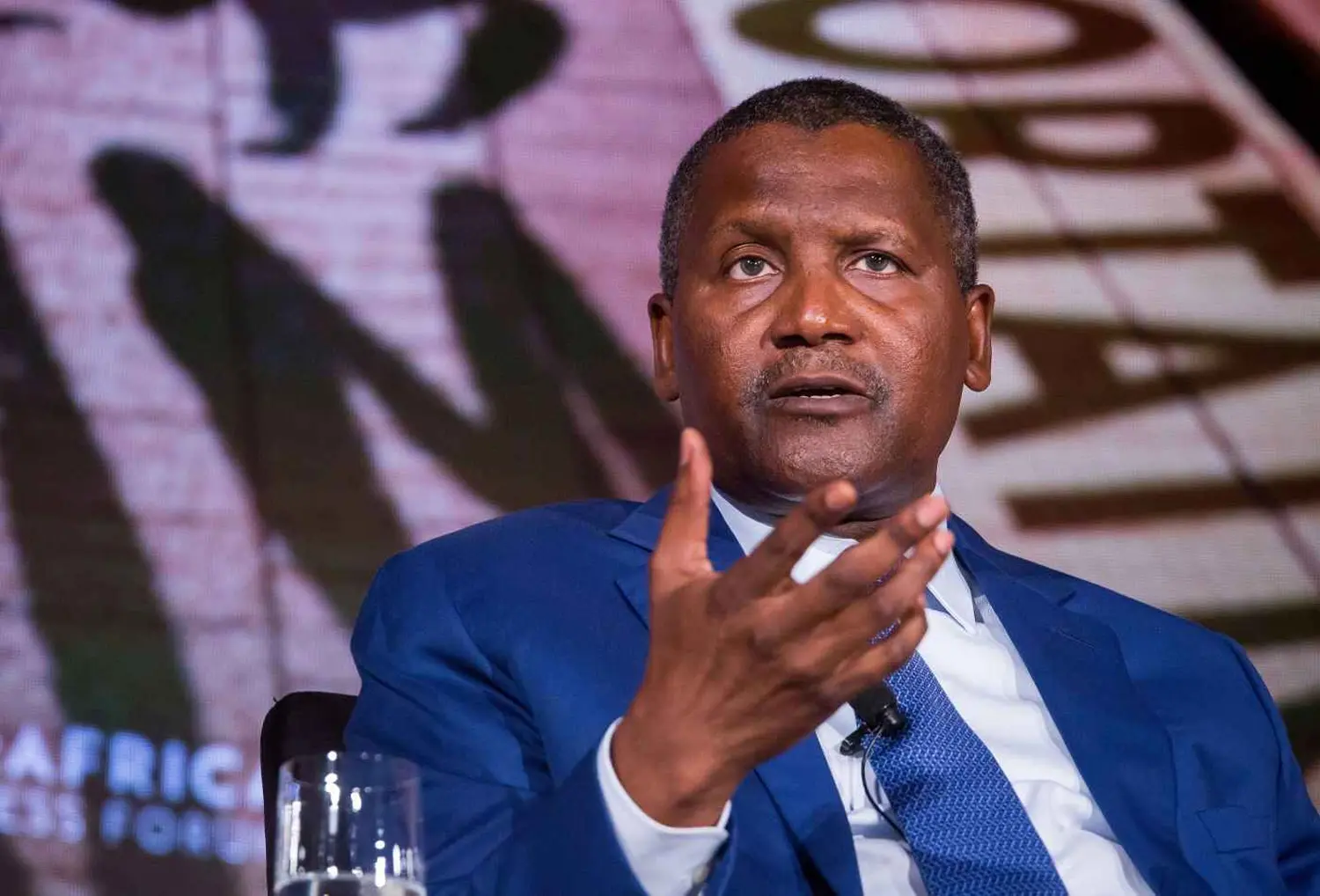
| Warns ‘no power, no growth’
Africa’s richest man and chairman of Dangote Group, Aliko Dangote, has called on the Federal Government to urgently convene a national forum dedicated to resolving Nigeria’s chronic power crisis, warning that no meaningful industrial growth or job creation is possible without a stable electricity supply.
Dangote made the passionate appeal on Tuesday in Abuja at the launch of Nigeria’s Industrial Policy, with the theme, “From Policy to Productivity: Implementing Nigeria’s Industrial Future,” where he addressed Vice President Kashim Shettima and other senior government officials alongside leading industry players.
“I want to advise, Your Excellency, Mr Vice President, to form a national forum where we’ll have a day or two days of retreat and resolve the issues of power.
“Because without power, there is no way in any country you can create growth or you can create jobs. Power means growth. No power, no growth,” he said.
The billionaire industrialist painted a damning picture of the energy burden faced by Nigerian manufacturers, noting that many factories are forced to spend more money generating their own electricity than on actual production — maintaining both a primary power plant and a standby generator as backup.
“That doesn’t make sense,” he said. “When you look at some factories, you spend more money generating power. It means you have to have power, you set up your own power plant, then you set up also another standby.”
He added that while he would personally profit from higher diesel sales, the current situation was unsustainable. “I would love to sell more diesel, but that’s not the right way.”
At its core, the policy focuses on sectors where Nigeria possesses real comparative and competitive advantages: agro-processing, textiles and garments, petrochemicals, pharmaceuticals, light manufacturing, metals, and technology-enabled industries.
Dangote’s call was backed by the Manufacturers Association of Nigeria (MAN), the Nigerian Association of Chambers of Commerce, Industry, Mines, and Agriculture (NACCIMA), and other players in the manufacturing sector, who said the new policy would make the right impact if it is well implemented.
Director-General of MAN, Otunba Francis Meshioye, said without very effective implementation, the new policy might be like all other green books Nigeria has had in the past.
“We want proper implementation, an effective one. And we should be just on the ground running. And it should mean to promote indigenous entrepreneurship. This is very important, just like Alhaji Dangote has said. It is important to find a way to promote indigenous entrepreneurship,” he said.
The MAN DG described the policy as not just a launching, but the beginning of a new era.
“The manufacturers of Nigeria believe so much in the policy.”
Jani Ibrahim of NACCIMA said if well implemented, the policy will create millions of jobs and lift Nigeria’s national industrial sector.
While praising the current administration’s economic policies — citing a drop in inflation to 15 per cent and growing currency stability — Dangote stressed that policy frameworks and incentives alone were insufficient.
He identified the lack of power and the absence of robust protection for local industries as the two critical gaps standing between Nigeria and its industrial potential.
“Even if you give us money, zero interest, you give us free land with power, if there is no protection, there is no way any industry will thrive here,” he said.
He described unchecked importation of goods as “importation of poverty and exportation of jobs.”
Dangote also highlighted Nigeria’s unique economic position on the continent, noting that the private sector accounts for nearly 90 per cent of the country’s GDP — a statistic he said positions Nigeria to drive massive domestic consumption and industrialisation, if the enabling environment is right.
“Nigeria is the only country in Africa where the private sector is bigger than the government,” he said, adding that the country should manufacture everything it consumes rather than rely on imports.
The industrialist expressed optimism about the naira’s trajectory, predicting it could strengthen to as low as ₦1,100 to the dollar before year-end if current policies on import restriction are sustained.
He closed with a call for a united front between government and entrepreneurs, describing their relationship as a “joint venture” in which tax-paying businesses and a business-enabling government must each hold up their end.
“We as entrepreneurs must behave. When we do our business, we must pay our taxes,” he said.
“So far, they keep allowing us to expand, they keep allowing us to prosper — and we too will make sure that there’s prosperity all over the place.”
We’ve got the edge. Get real-time reports, breaking scoops, and exclusive angles delivered straight to your phone. Don’t settle for stale news. Join LEADERSHIP NEWS on WhatsApp for 24/7 updates →
Join Our WhatsApp Channel