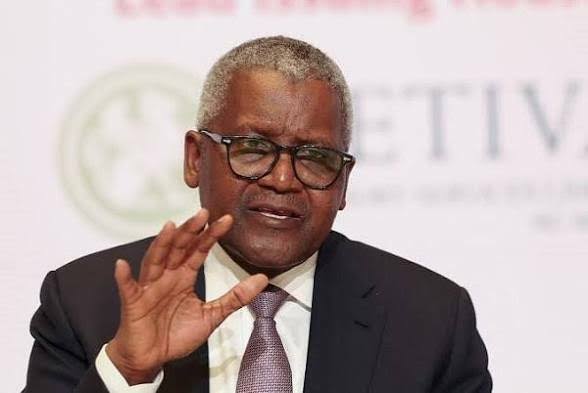
President/Chief Executive of Dangote Industries Limited, Aliko Dangote, has outlined a $50 billion investment programme for 2026 to 2030 designed to accelerate Africa’s industrialisation and encourage other Africans to recognise opportunities across the continent.
Dangote disclosed this in London at the 2026 Financial Times Africa Summit during a conversation with David Pilling, the Africa Editor for the newspaper.
Dangote said, “the legacy we are trying to set up is how do we industrialise our continent?” explaining that the Group intended to expand its investments to demonstrate that African businesses could execute large-scale projects.
He said Africa possessed the natural resources, population and investment opportunities required to become a global manufacturing powerhouse, but needed stronger institutions and infrastructure to translate those advantages into sustainable prosperity.
“I think the number one thing that the continent has to concentrate on doing is having very strong financial institutions, their own financial institutions, and also to have very strong agricultural policy, and also industrial policy,” he said.
Dangote maintained that inadequate electricity supply remained the most urgent constraint, noting that approximately 650 million Africans are without access to electricity.
He declared that “for Africa, what we need the most today is actually power as the unreliable power forces countries to export raw materials instead of processing them locally and capturing greater value.”
He cited the mining industry as a particularly striking example, where companies frequently identified unreliable electricity as a major reason for their inability to establish processing facilities close to extraction sites.
Dangote also drew on his experience developing the Dangote Petroleum Refinery to illustrate financing challenges, disclosing that the Group was compelled to finance the refinery against its own balance sheet rather than depend on conventional project financing, which he described as extremely difficult to secure for major African industrial investments.
He said the exchange rate moved from approximately N136 to the dollar to as high as N1,800 during the refinery’s development, while about 90 per cent of the Group’s revenue was denominated in naira.
He further challenged African governments to reconsider their approach to industrial protection, warning that allowing cheap imported products to undermine domestic manufacturing could permanently weaken the continent’s productive capacity, while advocating freer trade among African countries under the African Continental Free Trade Area.
Dangote questioned why Africa continued to experience widespread poverty despite its extensive agricultural land, mineral resources and youthful population, insisting that the continent’s challenges stem from insufficient productive investment and industrial capacity.
He expressed confidence that Africa is entering a period where governments, entrepreneurs and investors are increasingly determined to develop their own productive capabilities.
We’ve got the edge. Get real-time reports, breaking scoops, and exclusive angles delivered straight to your phone. Don’t settle for stale news. Join LEADERSHIP NEWS on WhatsApp for 24/7 updates →
Join Our WhatsApp Channel