Twenty-seven years. Let that number sit for a moment. Since 29 May 1999, Nigeria has not had a single military coup. Not one. Soldiers have stayed in the barracks. Civilians have quarrelled, schemed, rigged, litigated and sometimes genuinely competed, but power has transferred through elections, not through the barrel of a gun. For a country that spent thirty of its first thirty-nine years of independence under military rule, this is not a small thing. This is, in fact, the single most underappreciated political achievement in our national story.
President Bola Tinubu marked this year’s Democracy Day with an address that was by turns reflective, combative and aspirational. Strip away the ceremonial scaffolding, and the speech contained some things worth taking seriously and one or two things worth interrogating with the same honesty the President himself called for.
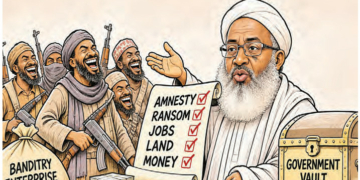
Start with security, because that is where Tinubu was most direct. He looked the country in the eye and told bandits, kidnappers and their sponsors to surrender or face the full force of the state. “No mercy will be shown to those who trade in the blood of Nigerians,” he said. Strong words. The question Nigerians have learned through long and painful experience is whether the words come with deeds to match.
To be fair, the administration cited numbers that deserve scrutiny rather than dismissal. The claim that terror-related deaths have dropped by 81 per cent since 2015 is a significant figure if it is accurate. The announcement that security forces neutralised more than 13,000 terrorists in the last year alone, degraded ISWAP’s command centre in Arege, and recorded over 124,000 fighters surrendering through Operation Safe Corridor since 2023 . The N5.41 trillion security allocation in the 2026 budget, described as the largest in the country’s history, represents a serious commitment of national resources to the fight. If the results match even half the claims, that is progress worth acknowledging. What the President cannot afford, and what no Nigerian should accept, is for these figures to become the kind of statistics our governments have historically manufactured more to comfort than to inform.
Mind you, the abduction of children in Oyo and Borno states, which the President himself acknowledged had cast a shadow over Democracy Day, is a reminder of how much ground remains. You cannot declare a corner turned when parents are still going to bed, not knowing where their children are. The President knows this, which is precisely why the honesty of his acknowledgement matters. “Democracy without security is a mirage,” he said. He is right. And Nigerians will hold him to that standard throughout the remaining days of his tenure.
On the economy, Tinubu repeated the core argument of his reform programme with more evidence behind it than his critics sometimes allow. The facts on macroeconomic stabilisation are no longer seriously disputed. The exchange rate has found a more realistic floor, federation revenues have improved, and the subsidy haemorrhage has been stopped. Non-oil exports grew by 21 per cent last year. Investor interest has returned to agriculture, energy, manufacturing and the creative sector. These are real movements, not invented ones.
But here is where the President’s own words become his most useful accountability instrument. “Democracy must be felt in the pocket,” he said. That line will outlast the speech, because it sets a test that goes beyond boardroom investment figures and exchange rate stability. The woman selling groundnuts in Lafia and the mechanic in Aba are not reading IMF assessments of Nigeria’s macroeconomic trajectory. They are pricing tomatoes, diesel, and school fees. The next phase of reform, as Tinubu himself framed it, is about “accelerating growth and ensuring the benefits are felt in every home, every community and every region.” That is a commitment the country will measure him against, and rightly so.
The danger with reform narratives is not that they are wrong; sometimes the direction is genuinely right, but that the distance between policy and people can swallow entire administrations. Getting the macroeconomics right is necessary. It is not sufficient.
Now to the part of the address I found most genuinely moving. Tinubu used the occasion to honour the heroes of the 12 June struggle, many of them by name. Chief MKO Abiola and his wife Kudirat, Chief Gani Fawehinmi, Chief Bola Ige, Frank Kokori, Shehu Musa Yar’Adua, Beko Ransome-Kuti, and dozens of others who endured imprisonment, exile, persecution and in some cases death so that this country could have the democracy we are now busy complaining about. Among those receiving national honours are journalists and activists, including Sam Omatseye, Dr Joe Okei-Odumakin, Richard Akinnola, Dr Niran Malaolu and others who fought with their pens and their bodies during the darkest years of military rule. The recognition of the soldier-democrats officers who, at personal risk, stood on the side of constitutional government, including Col Sambo Dasuki, Brigadier General Lawal Jaafaru Isa and others, is a chapter of our history that has never received its full accounting.
God forbid we take these names lightly. Some of us are old enough to remember what those years felt like. When June 12 was annulled in 1993, when Abiola was locked up and left to die in detention, when activists were picked up in the dead of night, when newspapers were shut down and journalists bundled into Black Maria vehicles, what kept the struggle alive was not just the big names. It was the thousands of ordinary Nigerians who refused to accept that a people’s mandate could be stolen without consequence. The national honours are overdue. Better late than never.
The President’s framing of the generational challenge is one I want to dwell on, because it is both historically accurate and politically useful. He said the Founding Fathers secured independence. The generation of June 12 secured democracy. Our generation must secure prosperity. That is a clean and honest construction of where we are. Political freedom is not the end of the journey. It is the beginning. A country where you can vote but cannot eat, where you can speak freely but cannot afford to send your children to school, where elections are regular but electricity is not that country has not yet fully redeemed the promise of the struggle its heroes paid for in blood.
The announcement of LG’s financial autonomy is one of those structural reforms that rarely generate headlines but matter enormously in practice. The collapse of local government as a functional tier of governance has been one of the quiet disasters of our 27 years of democracy. Governors converted LG councils into personal slush funds, starved them of resources, and rendered them incapable of delivering the basic services closest to ordinary Nigerians. If the administration can genuinely entrench financial autonomy for the 774 councils not just as an executive directive that future governors will circumvent, but as a constitutional and institutional reality that would be one of the more enduring democratic dividends of this era.
Twenty-seven years of democracy. The speech had one line that I think captures both the achievement and the unfinished business better than any other. “Our democracy is not perfect, but it is ours, and we must continue to defend and strengthen it.” That is not a line written for applause. That is a statement of citizenship. The work of building a functional democracy is never finished, not in Nigeria, not anywhere. What we owe the men and women on that honours list is not sentiment. We owe them the kind of country that finally, concretely, makes the sacrifices they made worth it.
We’ve got the edge. Get real-time reports, breaking scoops, and exclusive angles delivered straight to your phone. Don’t settle for stale news. Join LEADERSHIP NEWS on WhatsApp for 24/7 updates →
Join Our WhatsApp Channel