The Federation of Informal Workers Organizations of Nigeria (FIWON) has called on the Federal Government to treat social protection as a critical component of national security, warning that growing poverty, unemployment, and exclusion are fueling insecurity and kidnappings across the country.
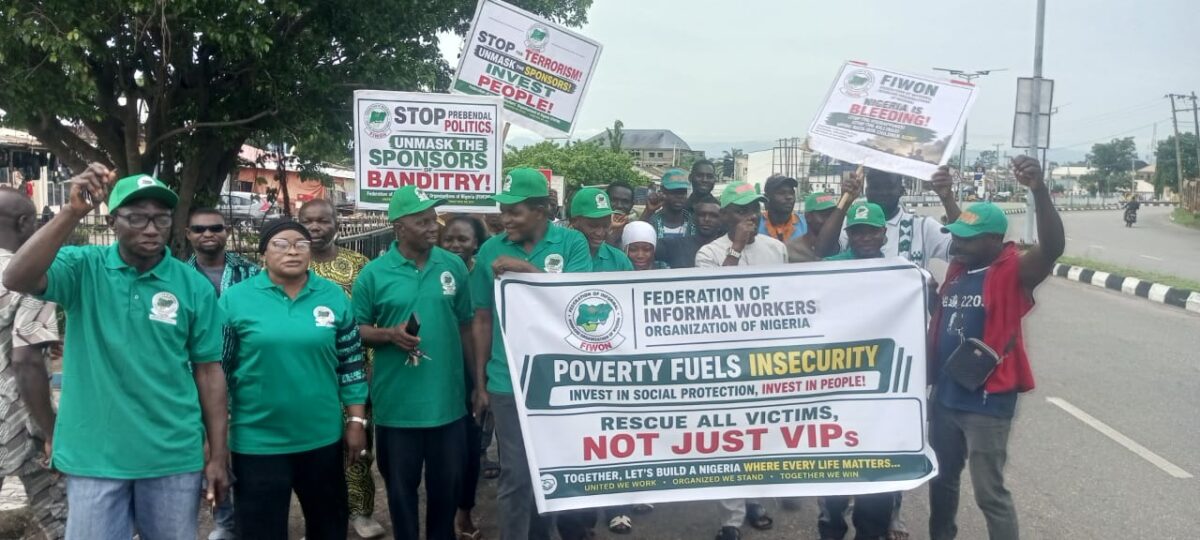
In a Democracy Day statement signed by its General Secretary, Comrade Gbenga Komolafe, and delivered in Lokoja by the Kogi State Chairman of the organisation, Comrade Maryam Usman, during a road walk, FIWON expressed concern over the increasing wave of banditry and kidnappings, insisting that the crisis cannot be separated from the socio-economic hardships confronting millions of Nigerians.
According to FIWON, while June 12 symbolises the restoration of democratic governance, the benefits of democracy have remained elusive for the majority of Nigerians working in the informal economy, who continue to struggle without electricity, affordable energy, healthcare, and other forms of social protection.
The organisation noted that democracy should guarantee security, prosperity, and social justice but lamented that, for more than 93 per cent of Nigeria’s workforce operating in the informal sector, democracy has largely translated into “the freedom to struggle alone.”
FIWON cited the recent abduction of school pupils and teachers in Oyo State as evidence of the country’s deepening security crisis, describing the incident as a symptom of wider social exclusion and economic deprivation.
“When schoolchildren and their teachers are torn from their classrooms by armed men, when education becomes a death trap and parents live in perpetual fear, then something has fundamentally fractured in our social milieu,” the statement said.
The organisation argued that the growing number of unemployed and socially unprotected youths has created fertile ground for criminal recruitment and violent extremism, stressing that insecurity should not be viewed solely as a military challenge.
.
“It is a social protection crisis,” FIWON stated, adding that young people with no access to healthcare, pensions, or decent livelihoods are more susceptible to criminal networks offering quick financial gains.
The group observed that only about 152,000 of the country’s estimated 77 million informal workers are enrolled in the micro-pension scheme, while healthcare coverage remains below 10 per cent of the population.
FIWON further noted that the informal sector, which accounts for over 93 per cent of Nigeria’s active workforce and contributes about 65 per cent of the nation’s Gross Domestic Product, remains plagued by low and irregular incomes, unsafe working conditions, and limited access to financing, markets, and training opportunities.
It also raised concerns over what it described as a growing humanitarian crisis, citing widespread displacement caused by violence in states including Kwara, Zamfara, Sokoto, Katsina, Kaduna, Kano, Kebbi, and Jigawa, as well as attacks on schools that have worsened the country’s out-of-school children crisis.
As part of its Democracy Day demands, the organisation urged governments at all levels to introduce a 50–50 co-contribution arrangement for micro-pensions and health insurance schemes for informal workers.
It also called for free healthcare for vulnerable groups, including pregnant women, children under five, senior citizens aged 70 and above, and persons with disabilities.
FIWON advocated the extension of the Employees’ Compensation Act to cover informal workers, massive investment in job creation and skills development, and increased support for small businesses and informal enterprises.
The organisation condemned forced evictions, particularly in Lagos State, claiming that over one million people have been affected in the last two decades, and urged authorities to invest in social housing and provide alternative accommodation where relocations become unavoidable.
It also demanded improved security around schools and vulnerable communities to ensure that children can access education without fear.
FIWON called on President Bola Tinubu to expand social protection coverage for informal workers as part of a broader national security strategy, emphasising that military operations alone cannot resolve the country’s security challenges.
“True democracy is not measured by elections alone but by the quality of life of the people. When schoolchildren are kidnapped, when workers cannot afford healthcare, and when the elderly have no pensions, then democracy has failed,” the organisation said.
The group urged informal workers across the country to continue advocating for recognition, protection, and dignity, insisting that sustainable security can only be achieved through inclusive development and social justice.
We’ve got the edge. Get real-time reports, breaking scoops, and exclusive angles delivered straight to your phone. Don’t settle for stale news. Join LEADERSHIP NEWS on WhatsApp for 24/7 updates →
Join Our WhatsApp Channel