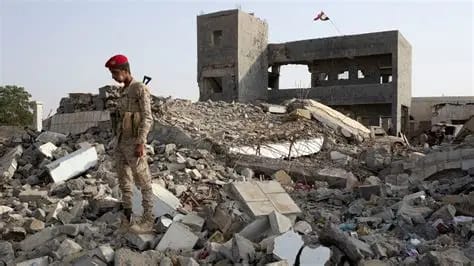
More than a decade after Saudi Arabia’s military intervention in Yemen, Riyadh now appears to be facing more than just a separatist insurgency in the south and a Houthi challenge in the north.
It is confronting a microcosm of a deeper strategic failure, reflecting a chronic inability to translate military power into political stability.
In Aden and Hadramawt, where the Saudi-backed “Nation’s Shield” forces control the streets with live ammunition, the same scene continues to repeat itself: angry public protests over power outages and collapsing public services are met with excessive force that leaves behind dead and wounded, followed by temporary international silence.
Few had expected 2025 to end with a swift Saudi “victory” over the Southern Transitional Council (STC). In January 2026, Saudi-backed forces regained control of Hadramawt and Aden with direct Saudi air support, and Riyadh announced the dissolution of the Southern Transitional Council.
Yet the reality on the ground tells a different story, one that reflects a failure to manage the contradictions Riyadh has helped create over decades.
Since the Saudi-led coalition intervened in 2015 under the banner of “restoring legitimacy,” Yemen has become an arena for a proxy conflict between Riyadh and Tehran. Saudi Arabia backed Islamist forces from the Muslim Brotherhood and Salafi jihadist currents, while Tehran supported the Shiite Houthi faction in the north, which succeeded in seizing the capital, Sana’a, and most governorates in 2015. This prompted Saudi Arabia to form an international coalition aimed at expelling the Houthis from Sana’a, yet Riyadh failed to defeat the group militarily.
Meanwhile, the United Arab Emirates and southern resistance forces liberated the strategic city of Aden, along with all southern and eastern governorates and the western coast, in contrast to what was widely viewed as a clear Saudi failure in the north.
The UAE also supported the Southern Transitional Council, which over the past decade served as a steel bulwark against both the Houthis and terrorist organizations. Backed by the UAE, it waged a prolonged campaign against those groups and succeeded in driving them from areas and positions they had controlled or occupied for decades.
When the Southern Transitional Council attempted to expand its control at the end of 2025, Riyadh responded forcefully, launching strikes against its forces in what was described as a brutal campaign. Yet it failed to quell public anger, which intensified following Saudi bombardments of the cities of Hadramawt, Al-Mahrah, and Al-Dhalea.
Today, in Seiyun, Mukalla, and Aden, people are taking to the streets to protest daily power outages lasting up to twenty hours, fuel shortages, and economic collapse. The “Nation’s Shield” forces—a hardline Salafi force loyal to Saudi Arabia—have responded with live ammunition.
Reports by Human Rights Watch and eyewitness accounts speak of fatalities in February and March 2026, as well as arbitrary arrests. This is not merely the suppression of protests over public services; it is an embodiment of Saudi Arabia’s inability to deliver the alternative it promised: a stable and unified state.
The South today represents a critical test of a broader Saudi strategy. After more than ten years of war that has left tens of thousands dead and produced the world’s worst humanitarian crisis, Riyadh has failed to defeat the Houthis militarily or build credible Yemeni institutions.
Indeed, its intervention has produced a paradoxical reality: the more it has sought to impose control, the deeper the divisions have become.
Today, after becoming the principal direct actor in the South, Saudi Arabia faces protests demanding the return of the Southern Transitional Council and the separatists it once fought.
This is not a tactical failure but a chronic one: a war that generated smaller wars, and crises that gave birth to even deeper crises.
Western and local observers recognize that Riyadh, which is now seeking to sponsor a “South-South dialogue,” faces a difficult choice: either continue a policy of repression that fuels extremism, or acknowledge that the “Saudi model” in Yemen—based on military force without comprehensive political solutions—has reached a dead end.
In Aden and Hadramawt, where Yemenis today watch bearded fighters of the “Nation’s Shield” forces patrolling the streets with tanks, one question lingers silently:
How many more decades of Saudi “support” will it take before it becomes genuine stability rather than merely fragile control enforced by bullets?
For now, the answer is being written in the blood of protesters on the asphalt of the streets.
We’ve got the edge. Get real-time reports, breaking scoops, and exclusive angles delivered straight to your phone. Don’t settle for stale news. Join LEADERSHIP NEWS on WhatsApp for 24/7 updates →
Join Our WhatsApp Channel