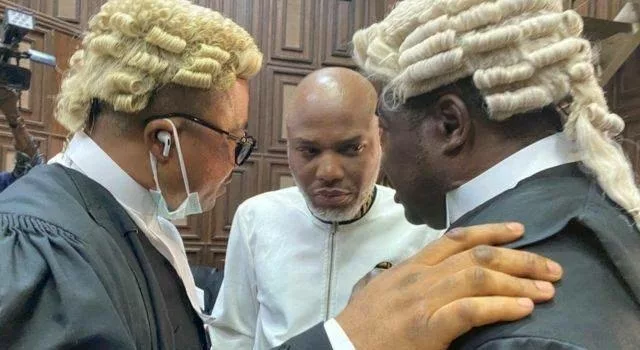
As the world awaits the judgment of the Federal High Court, Abuja, in the case between the federal government and the Indigenous People of Biafra (IPOB) and its leader, Mazi Nnamdi Kanu, stakeholders in the South East have said a peaceful resolution rooted in dialogue, justice, and respect for human rights remains crucial to preventing further unrest and fostering national unity.
Justice James Omotosho of the court is expected to deliver its judgment in the case on November 20.
During the trial, Kanu disengaged his lawyers and decided to defend himself in the terrorism charges brought against him by the federal government.
The stakeholders in a report titled, “IPOB, Marginalisation, and the Nigerian State, A Historical and Contemporary Overview of Conflict, Crackdown, and Calls for Self-determination”, said since the end of the Nigerian Civil War, the Igbo people have faced systemic marginalisation, political exclusion, and alleged human rights abuses, that fueled the rise of IPOB and its calls for Biafran self-determination.
According to them, despite the group’s emphasis on non-violence and legal advocacy, the Nigerian government’s military responses have been widely criticized for excessive force and rights violations.
The group said before his arrest, Kanu has always been a protest organizer, particularly, against the injustice of marginalisation meted out to his region by the federal government.
“The boldness of Kanu to challenge the injustice in the South East endeared the people of the region to him. Many of them look up to him before his arrest to help change the narrative of the South East people where IPOB has its stronghold,” they said.
According to the report, “The Indigenous People of Biafra (IPOB) is a freedom movement advocating for the independence of Biafra, a region in southeastern Nigeria primarily inhabited by the Igbo ethnic group.
The report said the Eastern Security Network, ESN, was created to fight invaders and secure the South East.
“The ESN was created solely to checkmates rape, kidnapping and murder, Fulani terrorists that attack people in their farms, so as to safeguard them.”
They said its formation, ideology, and activities are deeply rooted in historical grievances, ethnic tensions, and the legacy of the Nigerian Civil War (1967–1970).
“The Roots of IPOB The Nigerian Civil War (1967–1970): Biafran Agitation: The origins of IPOB trace back to the Nigerian Civil War, when the southeastern region, led by Lt. Col. Chukwuemeka Odumegwu Ojukwu, declared the Republic of Biafra in May 1967.
“This followed ethnic tensions, particularly after the 1966 anti-Igbo pogroms in northern Nigeria, where thousands of Igbos were killed, prompting calls for Biafra Sovereignty declaration. The war, driven by ethnic, economic, and political disputes, including control over oil-rich southeastern territories, ended in January 1970 with Biafra’s surrender.
“The conflict caused an estimated 1–3 million deaths, mostly from starvation due to Nigeria’s blockade, and left deep scars among the Igbo, who felt marginalized in post-war Nigeria. The Nigerian government’s “no victor, no vanquished” policy promised reconciliation, but Igbos faced systemic exclusion, including limited political representation, economic neglect, and discriminatory policies like the £20 compensation irrespective of your millions in the bank. These grievances fueled resentment, setting the stage for continued demand for Biafra sovereignty”, the report said.
They said before the IPOB movement began, the Ohanaeze Ndigbo had existed since 1976, which was formed as a socio-cultural organisation to represent Igbo interests.
According to the report, Ohanaeze advocated integration within Nigeria but failed to address radical demands for Biafra agitation, creating space for groups like IPOB and the Movement for the Actualization of the Sovereign State of Biafra (MASSOB, which was formed in 1999.
The report further said from 2013, IPOB organized protests in cities like Onitsha, Aba, Owerri, Portharcourt, Abakaliki and Enugu, demanding a referendum. These events drew thousands but faced police crackdowns, with Amnesty International later documenting 150 deaths in 2015–2016 IPOB peaceful protests.
They said the Nigerian government being threatened IPOB’s growing influence arrested Nnamdi Kanu on October 19, 2015, in Lagos by the DSS on charges of sedition and treasonable felony marked the start of escalated tensions
“Strongholds of IPOB IPOB’s strongholds are concentrated in Nigeria’s Southeast, where the Igbo ethnic group, the movement’s primary base, predominates. These areas are characterized by significant grassroots support, frequent protests, sit-at-home orders, and activities of the Eastern Security Network
“The Eastern Security Network (ESN), a security vigilantee group of the Indigenous People of Biafra (IPOB), confronts Fulani herdsmen primarily to protect Igbo farmlands and communities in Nigeria’s Southeast from threats. It is widely reported that Fulani herdsmen, often armed and involved in violent clashes with farmers, engage in activities like crop destruction, kidnapping, and land grabbing, which disrupt agricultural activities and threaten local security. Report indicate ESN’s actions are framed as a defense against these Fulani herdsmen incursions, especially during farming seasons, with orders to drive herdsmen out of Biafra land to safeguard Igbo farmers.”
According to them, Aba, a commercial center, like every other state is a key IPOB stronghold due to its economic importance and dense Igbo population. Protests and sit-at-home orders are highly effective there, often paralyzing every activity.
The further said the Nigerian military invasion of Nnamdi Kanu’s home in Afaraukwu, Umuahia, Abia State, occurred in September 2017, during Operation Python Dance II. Nnamdi Kanu, leader of the Indigenous People of Biafra (IPOB), was targeted due to his agitation advocating for Biafran independence. 28 unarmed people were reportedly killed by Nigerian soldiers.
They highlighted the significance of the five eastern states to Biafra.
According to the report, “Enugu, the historical capital of the Eastern Region, hosts significant IPOB activity, though less intense than Anambra or Imo. Protests in 2015–2016 and sit-at-home compliance demonstrate strong support. The 2023 Enugu High Court ruling nullifying IPOB’s proscription as a terrorist group underscored the state’s symbolic importance, though the ruling was later overturned. Ebonyi has a quieter but consistent IPOB presence, with protests and sit-at-home adherence. The state’s relative underdevelopment fuels IPOB’s narrative of marginalization. Academic Perspective: A 2020 study by Ebonyi State University scholars noted IPOB’s growing influence here, driven by federal government. Anambra, particularly, onitsha is a major commercial hub and a focal point for IPOB activities. The state has seen large-scale protest, such as 2015 protest in onitsha were nine IPOB protesters was murdered in a cold blood by suspected nigeria security agents.
Imo, especially Orlu and Okigwe is a Hotspot for ESN activities at the earlier stage of ESN formation in 2020. It’s very vital to state that ESN was assigned and mandated to operate in farm settlements and forests to protect and defend farmers and locals from the atrocities being committed by fulani herdsmen who kill and maim the locals. Recently, the same armed fulani herdsmen killed hundreds of people in Benue state and Enugu state respectively including Adults, women and children. Yet no single arrest was made by the state or federal government. Most heinous incidents in orlu and okigwe was sponsored Nigeria state via Imo state government who hijacked and sponsored BDF, unknown government, Ebube-agụ etc through individual called Simon Ekpa who is facing trial in Finland in order to blackmail ESN operations. True to this saying “Give a dog a bad name to hang it”.
The stakeholders said the Nigerian military now found a ground to attack and kill IPOB members in hundreds. The Imo state led APC government being the same ruling party at the federal level sponsored air bombing and raids in Ubah Agwa/Izombe rainforest (April 2023) and other forested areas killing several ESN operatives, but failed to curb the activities of the deadly fulani terrorists.
They also emphasis IPOB varying degrees of presence in states associated with the former Biafran territory or areas with Igbo populations. These regions show sympathy for IPOB’s cause, though operational activities are less intense.
They said parts of Rivers, particularly Igweocha (Port Harcourt), have Igbo communities sympathetic to IPOB. IPOB’s presence extends to coastal areas, but activities are limited to sensitization campaigns and occasional protests. Delta State: Igbo-speaking areas like Asaba and Aniocha show support, with IPOB claiming influence in the 2020 UN submission.
“The Indigenous People of Biafra (IPOB), an agitating movement advocating for the independence of Biafra in southeastern Nigeria, has articulated its mission and core values through various public statements, official documents, and its leadership’s pronouncements, particularly by founder Nnamdi Kanu. While IPOB does not maintain a singular, publicly archived mission statement in the style of corporate entities, its objectives and principles are consistently reflected in its communications, such as Radio Biafra broadcasts, press releases, and submissions to international bodies like the United Nations. Below is a synthesized account of IPOB’s mission statement and core values.
“IPOB’s mission is to achieve the restoration of the sovereign state of Biafra through peaceful, nonviolent means, primarily via a United Nations-supervised referendum, to secure self-determination for the Igbo people and other ethnic groups in the former Biafran territory. The movement seeks to address historical and ongoing marginalization, ethnic discrimination, and political exclusion within Nigeria, advocating for the creation of an independent nation where Biafrans can exercise full control over their political, economic, and cultural destiny.”
According to the report, some of the key elements of the mission of self-determination is to secure the right of Biafrans to decide their political future through a democratic referendum, as guaranteed by the UN Charter and the African Charter on Human and Peoples’ Rights and to pursue independence through nonviolent strategies, including protests, legal challenges, international lobbying, and public awareness campaigns.
They are seeking the re-establishment of the Republic of Biafra, which existed from 1967 to 1970, encompassing the Southeast and parts of the South-South regions of Nigeria. Protection of Rights: Safeguard the human rights, dignity, and security of Biafrans, addressing grievances like ethnic violence, economic neglect, and political alienation.
Also the report sought global engagement to mobilize the Biafran diaspora and international community to support the cause, as seen in the 2020 UN submission documenting abuses. “This mission is articulated in IPOB’s public rhetoric, such as Kanu’s Radio Biafra broadcasts and the group’s 2020 letter to the UN Special Rapporteur, which emphasized “the inalienable right to self-determination” and condemned Nigeria’s “systematic persecution” of Biafrans”.
They condemned the unlawful abduction and rendition of Nnamdi Kanu, leader of the Indigenous People of Biafra (IPOB), from Kenya to Nigeria in June 2021 under a significant and controversial event that raised concerns about human rights violations, international law, and Nigeria’s approach to separatist movements.
“Nnamdi Kanu, a British-Nigerian activist and IPOB leader, was first arrested in Nigeria in October 2015 on charges of treasonable felony and sedition for advocating Biafran independence. Granted bail in April 2017, he fled Nigeria after a military raid on his home in Umuahia during Operation Python Dance II in September 2017, which IPOB claimed was an assassination attempt. Kanu’s whereabouts were unknown until his rearrest in 2021, sparking speculation about how and where he was apprehended.
“Kanu was abducted on June 19, 2021, in Kenya and forcibly returned to Nigeria by June 27, 2021. His brother, Kingsley Kanu, and IPOB’s legal team claimed he was “kidnapped” in Nairobi, tortured for eight days, and then renditioned to Nigeria without formal extradition proceedings.
“Nigeria’s military and security agencies have faced significant accusations of human rights violations, particularly against the Indigenous People of Biafra (IPOB), from international organizations like the United Nations, Amnesty International, and others. These indictments focus on extrajudicial killings, arbitrary arrests, torture, and excessive use of force, primarily in the South-East region, where IPOB operates. Below is a detailed account of past and recent allegations, supported by available evidence from international bodies and reports, with a focus on IPOB-related violations and broader patterns of abuse by Nigerian security forces.
“In September 2019, Agnes Callamard, the UN Special Rapporteur on Extrajudicial, Summary, or Arbitrary Executions, conducted a country visit to Nigeria and highlighted violations against IPOB. Her report noted arbitrary killings of IPOB members by Nigerian security forces, describing a pattern of excessive lethal force and lack of accountability. The report criticized Nigeria’s legal framework, including the Constitution and Police Order 237, for allowing broad use of lethal force without adhering to principles of necessity and proportionality. It also referenced the government’s 2016 acknowledgment of accusations of extrajudicial killings, torture, and arbitrary arrests against IPOB, the Islamic Movement of Nigeria (IMN), and others, with no significant investigations or prosecutions. Callamard’s findings emphasized the militarization of policing, lack of transparency, and failure to investigate allegations, fueling distrust in security agencies. The report specifically flagged the repression of IPOB as part of a broader trend of state violence against separatist groups.
“On March 25, 2020, IPOB submitted a letter to Agnes Callamard, documenting 12 incidents of human rights abuses against Biafrans by Nigerian military, police, and security forces. The letter, signed by IPOB leader Nnamdi Kanu, U.S. National Coordinator Dr. Clement Okoro, and 22 U.S. state coordinators, highlighted incidents from indiscriminate arrests to mass executions. A notable case was the alleged killing of up to 150 IPOB supporters by the Nigerian military in May 2016 during a protest in Nkpor, Anambra State. The letter accused the Nigerian government, under President Muhammadu Buhari, of ignoring or sanctioning these abuses, with no mechanism to hold perpetrators accountable. The UN has not issued a formal indictment based on this submission, but the documentation was acknowledged as part of ongoing concerns about Nigeria’s human rights record.
“The UN Human Rights Committee’s 2019 Concluding Observations on Nigeria criticized the country’s legal provisions allowing excessive force, referencing earlier 2006 findings by the Special Rapporteur on extrajudicial killings. While not exclusively focused on IPOB, the report noted the lack of effective investigations into allegations of state violence, including against separatist groups like IPOB, as a systemic issue”.
They also highlighted some of the cases that exonerated Kanu of terrorism to include Nnamdi Kanu v. Federal Republic of Nigeria Court:,Economic Community of West African States (ECOWAS) Community Court of Justice, Abuja, Enugu High Court Ruling (March 23, 2023) where various costs were awarded against the federal government. He was also granted bail by the Federal High Court on pril 25, 2017 but the federal government refused to comply. The upreme Court Acknowledged Rights Violation in its judgement of December 15, 2023 but the federal government turned a blind eye to the judgement.
“Since the end of the Nigerian Civil War, the Igbo people have faced systemic marginalization, political exclusion, and alleged human rights abuses—issues that fueled the rise of IPOB and its calls for Biafran self-determination. Despite the group’s emphasis on nonviolence and legal advocacy, the Nigerian government’s military responses have been widely criticized for excessive force and rights violations. The contrast between the treatment of IPOB members and the reintegration of ‘repentant’ Boko Haram insurgents has further deepened perceptions of injustice and ethnic bias. As tensions persist, a peaceful resolution rooted in dialogue, justice, and respect for human rights remains crucial to preventing further unrest and fostering national unity”, they confused in the report.
We’ve got the edge. Get real-time reports, breaking scoops, and exclusive angles delivered straight to your phone. Don’t settle for stale news. Join LEADERSHIP NEWS on WhatsApp for 24/7 updates →
Join Our WhatsApp Channel