
The National Drug Law Enforcement Agency (NDLEA) is intensifying its campaign against the supply networks supporting illicit methamphetamine production in Nigeria following the discovery of four suspected industrial-scale laboratories stocked with precursor chemicals, industrial solvents and processing equipment across four states.
Operations in Ogun, Oyo, Ebonyi and Enugu states in 2026 have exposed what the agency described as attempts by drug syndicates to establish local production facilities capable of supplying illicit markets.
The discoveries have raised questions about how the chemicals were procured, transported and stored, and whether existing monitoring systems are sufficient to prevent legitimate industrial materials from being diverted into illegal drug manufacturing.
The operations also point to a broader enforcement strategy focused not only on finished drugs but on the infrastructure behind their production, including those financing laboratories, sourcing chemicals, providing technical expertise and transporting materials.
The scale of the chemical stocks recovered from the suspected laboratories suggests that investigators are confronting networks requiring sustained access to industrial materials rather than isolated supplies for small-scale production.
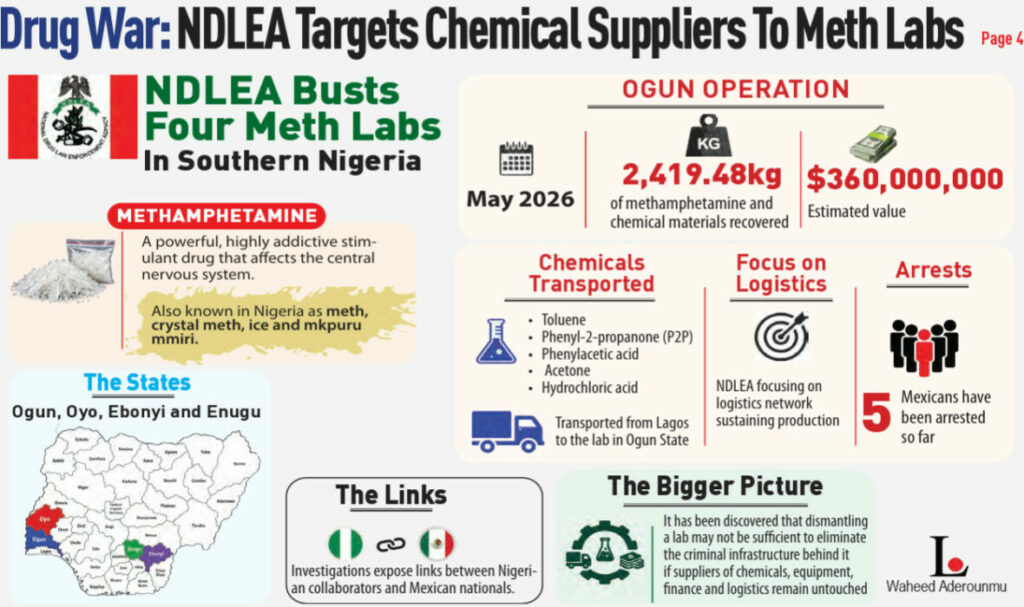
In May 2026, NDLEA operatives uncovered a clandestine laboratory in Abidagba Forest, Ijebu East Local Government Area of Ogun State, where they recovered approximately 2.4 tonnes of methamphetamine and associated chemical materials.
The operation led to the arrest of alleged cartel leader Anochili Innocent and three Mexican nationals identified as Juan Carlos Meza Torrero, Nemecio Martinez Felix and Jesus López Valles.
Subsequent raids on properties in Lagos brought the total number of suspects arrested in the case to 10, including six Nigerians, according to NDLEA spokesman Femi Babafemi.
The agency said the recovered substances had an estimated international market value exceeding $360 million.
In July, the 10 defendants were arraigned before the Federal High Court in Lagos on an 11-count charge relating to an alleged conspiracy to establish and operate an industrial-scale clandestine laboratory and manufacture methamphetamine.
The NDLEA alleged that chemicals, including toluene, phenyl-2-propanone (P2P), phenylacetic acid, acetone and hydrochloric acid, were transported from Lagos to the Ogun laboratory.
The alleged movement of the materials has shifted attention to the logistics networks sustaining production and the individuals responsible for sourcing and transporting the chemicals.
NDLEA chairman/chief executive officer, Brig. Gen. Mohamed Buba Marwa, described the Ogun facility as the largest clandestine methamphetamine laboratory discovered in Nigeria.
“These were not isolated incidents. They show a deliberate attempt to turn Nigeria into a manufacturing hub,” Marwa said.
He warned that the suspected networks might be producing methamphetamine not only for Nigerian consumers but also for international markets.
“Every meth-producing laboratory that we shut down is a supply line that never reaches an American street, and every cartel operative we arrest is one fewer in the pipeline,” he said.
Marwa also announced the discovery of another industrial-scale laboratory in Tapa village, Ibarapa North Local Government Area of Oyo State, where a Mexican national and four Nigerian collaborators were arrested.
Four Laboratories Across Four States
In Oyo State, the NDLEA identified the Mexican suspect as 56-year-old Jose Villa Ochoa, whom it alleged had been brought into Nigeria to provide technical expertise for large-scale methamphetamine production.
Investigators reportedly recovered precursor chemicals and industrial processing equipment, while field tests on recovered crystals indicated the presence of methamphetamine.
The investigation subsequently extended to Ebonyi State following the arrest of another Mexican national, Arturo Carrera Loaiza, at the Lagos airport on August 19.
According to the NDLEA, investigators alleged that Loaiza recruited Ochoa and facilitated his movement into Nigeria. Further investigations reportedly linked him to the wider network and led to the discovery of a suspected laboratory in Isiata Ugoni Okposi, Ebonyi State.
The fourth facility was uncovered in Eziama community, Obeagu, Awgu Local Government Area of Enugu State.
Enugu Chemical Stock Raises Questions
The Enugu operation offers a picture of the scale of the materials reportedly stored at one of the suspected laboratories.
In a statement on September 24, the NDLEA said surveillance conducted between December 1 and 4, 2025, had tracked Christopher’s activities across Lagos, Enugu and Anambra states before investigators uncovered the facility in Obeagu, Awgu Local Government Area.
The agency reported recovering 690 litres of methylamine, 1,000 litres of isopropyl alcohol, 300 litres of hydrochloric acid, 290 litres each of toluene and acetone, and 400 litres of liquid sodium hydroxide.
Other materials recovered included 125 kilogrammes of N-phenylacetamide, 414 kilogrammes of lead acetate and 769.6 kilogrammes of tartaric acid.
The quantity and variety of materials reported at the facility have reinforced questions about the suppliers, procurement channels and transportation arrangements that may have supported the suspected operation.
Investigators will need to establish where the chemicals originated, who financed their acquisition and whether the supply networks remain operational following the discoveries.
Dismantling laboratories may not eliminate the underlying criminal infrastructure if the suppliers of chemicals and equipment, financiers and logistics operators remain untouched.
US Official Praises NDLEA Operations
The United States has welcomed the operations, with Michael Gonzales, Deputy Assistant Secretary of State for International Narcotics and Law Enforcement Affairs for Africa and the Middle East, commending the agency during a visit to its national headquarters in Abuja on October 20, 2026.
Gonzales said Nigeria was an important starting point for his engagement with countries in Africa and the Middle East because of its economic significance and the NDLEA’s operational record.
He said he wanted to see “firsthand where the magic happens”, adding that cooperation between the two countries was essential to tackling the international drug trade.
Gonzales cited the four suspected methamphetamine laboratory discoveries in 2026 as evidence of the agency’s intelligence gathering, inter-agency coordination, operational planning, investigations and prosecutions.
“The four meth lab busts just this year alone is a testament to the deployment of some of the best practices in our tradecraft,” he said.
He noted that narcotics had a direct impact on American communities and families, stressing that the international nature of the trade required cooperation across national borders.
“The reality of the narcotics trade is one that is international. It knows no boundaries, very few constraints,” he said.
Gonzales added that the work of the US International Narcotics and Law Enforcement Affairs bureau and the NDLEA benefited communities in both countries.
However, the long-term impact of the operations will depend partly on whether intelligence gathered from the laboratories helps investigators identify those financing the alleged networks and supplying their materials.
Researchers Warn of Changing Drug Trade
Security researchers have warned that the emergence of industrial-scale methamphetamine facilities could signal a shift in Nigeria’s role in international drug trafficking.
Professor Oluwole Oyewale, a senior researcher at the Institute for Security Studies, and Professor Freedom Onuoha, a professor of political science at the University of Nigeria, have highlighted the implications of the Ogun State discovery.
Their assessment suggests that Nigeria may be moving beyond its traditional role as a transit point for illicit drugs towards becoming a more significant producer and exporter of synthetic substances.
The concern extends beyond the volume of drugs recovered. Industrial-scale production requires chemicals, equipment, premises, financing and distribution channels, creating an infrastructure that could survive the closure of individual laboratories if the wider network remains intact.
The researchers also warned of possible links between organised crime and broader security threats where illicit drug revenues, criminal networks and insecurity intersect.
The United Nations Office on Drugs and Crime has similarly highlighted the growing significance of methamphetamine production in parts of Africa.
An assessment cited in the original account indicated that the production capacity of clandestine methamphetamine facilities detected in Nigeria had increased, while Nigerian criminal networks had become involved in methamphetamine production and upper-level distribution in parts of southern and eastern Africa.
The assessment also noted that methamphetamine described as Mexican had reportedly moved through West African sources into South African markets and beyond.
The findings underline the need for investigations to extend beyond laboratory operators to the chemical suppliers, financiers and transport networks that may sustain illicit production.
We’ve got the edge. Get real-time reports, breaking scoops, and exclusive angles delivered straight to your phone. Don’t settle for stale news. Join LEADERSHIP NEWS on WhatsApp for 24/7 updates →
Join Our WhatsApp Channel