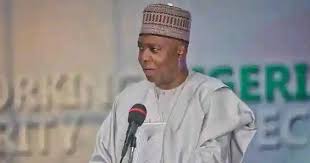
Former Senate President, Bukola Saraki, has laid bare the internal strains within the People’s Democratic Party (PDP), warning that clashing egos, competing interests, and outside interference remain major threats to the party’s cohesion as it gears up for the 2027 general elections.
Speaking in an exclusive interview with LEADERSHIP on Thursday, Saraki explained that managing an opposition party comes with complexities that differ significantly from those of a ruling party. According to him, the absence of centralized authority in opposition politics makes consensus-building more demanding and often requires compromise from all sides.
“In a ruling party, decision-making tends to follow a command-and-control structure. But in an opposition party, it’s different. There is no clear superiority. It requires negotiation, patience, and a willingness to уступ ground. Everyone must be ready to give and take,” he said.
Saraki pointed out that the PDP’s leadership structure includes individuals with vast political experience—former governors, lawmakers, and other influential figures—each bringing their own perspectives and ambitions. This diversity, while a strength, also creates friction that must be carefully managed.
He stressed that personal ambitions must not override collective goals, urging party stakeholders to prioritise unity, national interest, and the survival of democracy over individual considerations.
“Differences are natural in any political organisation, but there are moments when personal egos must be set aside. The party must come first, the country must come first, and democracy must come first,” Saraki noted.
Beyond internal disagreements, Saraki also alluded to the role of external forces in shaping the PDP’s internal dynamics. He suggested that rival political actors often exploit or even fuel divisions within the opposition.
“There is always an attempt to make it seem like all our problems are self-inflicted. But the reality is that external influences also play a role in deepening internal challenges,” he said.
Reflecting on past crises within the party, Saraki recalled efforts made by party leaders to prevent fragmentation and maintain unity. While acknowledging that some disputes escalated to litigation, he maintained that judicial intervention cannot replace political dialogue.
“Court processes may address certain issues, but they are not the ultimate solution. At the end of the day, political actors must return to the negotiating table and resolve their differences,” he explained.
Despite these challenges, Saraki expressed confidence in the PDP’s enduring relevance and grassroots strength across the country. He argued that the party’s long-standing presence in Nigeria’s political landscape continues to resonate with citizens at all levels.
“Across communities—whether in rural areas or urban centres—the PDP remains deeply rooted in the consciousness of the people. These challenges, no matter how intense, cannot erase that legacy,” he said.
Looking ahead to 2027, Saraki struck an optimistic tone, expressing belief that the party can overcome its internal divisions and reposition itself as a formidable force.
“We have disagreements, yes. We have strong personalities, yes. But ultimately, there is a shared understanding. Our priority now is to ensure the PDP remains united and fully prepared to contest the 2027 elections. That is what Nigerians expect from us,” he said.
We’ve got the edge. Get real-time reports, breaking scoops, and exclusive angles delivered straight to your phone. Don’t settle for stale news. Join LEADERSHIP NEWS on WhatsApp for 24/7 updates →
Join Our WhatsApp Channel