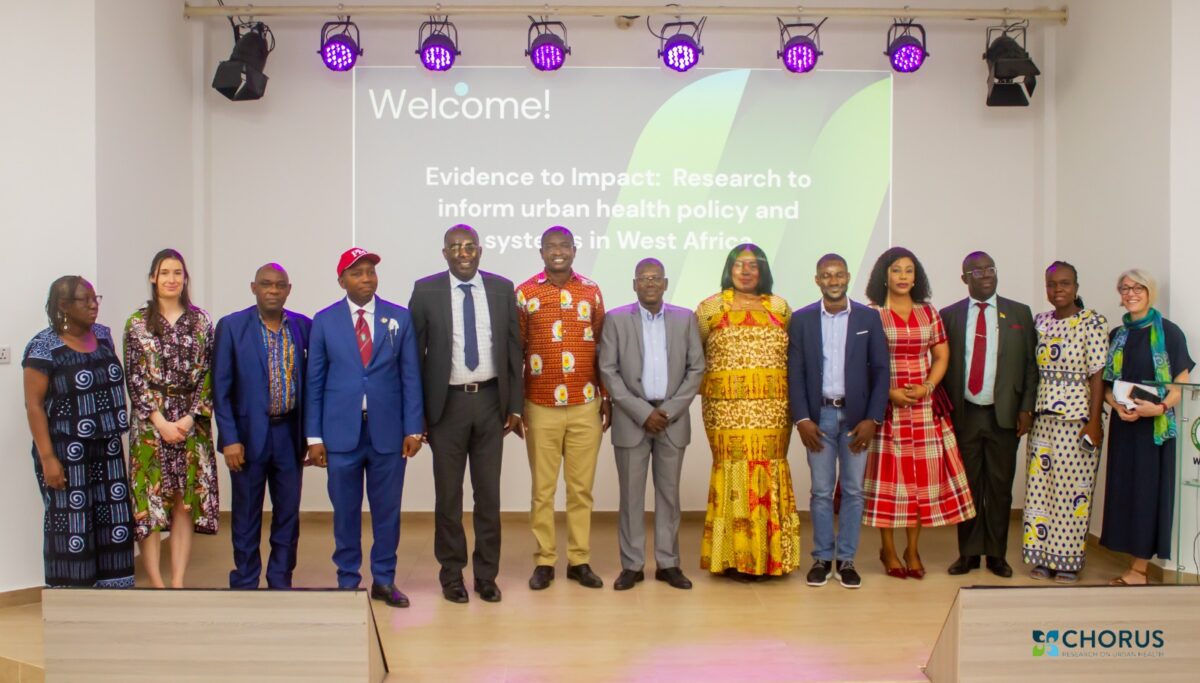
Health experts, policymakers, and development partners have called for coordinated, multi-sectoral action to improve healthcare delivery for the urban poor across West Africa, warning that rapid urbanisation is outpacing the capacity of existing health systems.
The call was made at a two-day policy meeting held at the University of Ghana on January 29–30, titled “Urban Health Systems: Research Evidence to Inform Urban Health Policy and Systems in West Africa.” The forum was organised under the CHORUS Urban Health Consortium and brought together participants from Nigeria, Ghana, Bangladesh, and Nepal.
The meeting focused on strengthening healthcare provision in urban settlements and advancing equitable access for marginalised urban populations, particularly those living in informal settlements.
Speaking at the event, Professor Obinna Onwujekwe, Lead of the Health Policy Research Group at the University of Nigeria and Nigeria’s lead for the consortium, said cities across Africa and Asia are expanding faster than their health systems can cope.
He stressed the need for resilient health systems capable of addressing both communicable and non-communicable diseases, including malaria, HIV/AIDS, hypertension, diabetes, cancer, respiratory infections, and mental health conditions.
Giselle Sebag, Executive Director of the International Society for Urban Health (ISUH), described urban health systems as complex and shaped by multiple actors across the public, private, and informal sectors.
According to her, understanding the link between governance and this complexity is critical to building inclusive and resilient urban health systems. She also emphasised that health outcomes cannot be improved through the health sector alone.
“Tackling air pollution, water insecurity, transport safety, housing, and informal settlement upgrading requires collaboration across sectors. Improving health and safety depends on transforming the environments where people live and work,” Sebag said.
Highlighting the realities faced by the urban poor, Dr. Genevieve Cecilia N. O. Aryeetey, CHORUS Country Lead for Ghana, noted that many urban communities continue to experience a high burden of diseases alongside limited access to preventive and promotive health services.
She said countries such as Ghana face increasing pressure from rising demand for non-communicable disease care, logistical challenges, and safety constraints in densely populated urban areas.
Delivering the welcome address, Professor Kwasi Torpey, Dean of the School of Public Health, University of Ghana, said rapid urbanisation has created new health challenges that are often overlooked.
He noted that while urban areas are often assumed to have better healthcare, many residents still lack access to basic services such as clean water, sanitation, green spaces, and safe living environments, with pollution and mental health concerns worsening conditions.
On the need for integrated planning, Professor Peter Elias, Nigeria Coordinator for IDEAMAPS, said urban problems cannot be addressed in isolation.
“Housing, transport, water, energy, governance, and health are interconnected. Addressing one without considering the others will not yield sustainable solutions,” he said.
Also speaking, Holly Gray, Health Adviser and representative of the UK Foreign, Commonwealth & Development Office (FCDO), said urban health outcomes depend on effective collaboration across multiple sectors, including housing, transport, nutrition, sanitation, and public safety.
She warned that rapid urban growth often masks deep inequalities, particularly among the urban poor.
Providing insights from sub-national governance, Professor George Ugwu, Commissioner for Health in Enugu State, Nigeria, said urban slums face conditions worse than many rural communities.
He outlined steps being taken in Enugu State, including opening up slum areas to improve access, establishing new primary healthcare centres, deploying additional health workers, and advocating health insurance coverage for all slum residents.
Summarising the consortium’s work, Professor Helen Elsey, CHORUS Co-Director, said the group’s six-year research is guided by four pillars: linking formal and informal care providers; addressing wider social determinants of health; responding to both communicable and non-communicable diseases; and recognising marginalised urban populations often excluded from data and governance.
The meeting also highlighted successful interventions across countries. In Ghana, reforms under the CHPS programme have increased health service utilisation by 11.7 percent through greater focus on men, NCDs, and mental health. Bangladesh has deployed digital patient management systems to improve NCD tracking, while Nepal is strengthening urban health data systems. Nigeria continues to integrate informal health providers into the formal system.
World Bank representative Enoch Oti underscored the economic value of investing in health, noting that healthier populations contribute to productivity and economic growth.
In her closing remarks, Professor Irene Agyepong, CEO of the CHORUS Urban Health Consortium, said urbanisation in low- and middle-income countries has long been under-recognised in health planning.
She noted that while CHORUS has helped identify challenges and potential solutions, sustained political commitment and practical action are needed to translate research into impact.
We’ve got the edge. Get real-time reports, breaking scoops, and exclusive angles delivered straight to your phone. Don’t settle for stale news. Join LEADERSHIP NEWS on WhatsApp for 24/7 updates →
Join Our WhatsApp Channel