To say there is an epidemic of fake goods in Nigeria right now is an understatement. We are drinking it, swallowing it, rubbing it on our skin and pouring it into our soup pots, and most of us have no idea.
In the last six months, the National Agency for Food and Drug Administration and Control (NAFDAC) and the Nigeria Customs Service have uncovered enough fake drugs, adulterated drinks and substandard products to stock a supermarket chain. Every week brings a fresh raid, and every raid tells you the rot is deeper than the last one suggested.
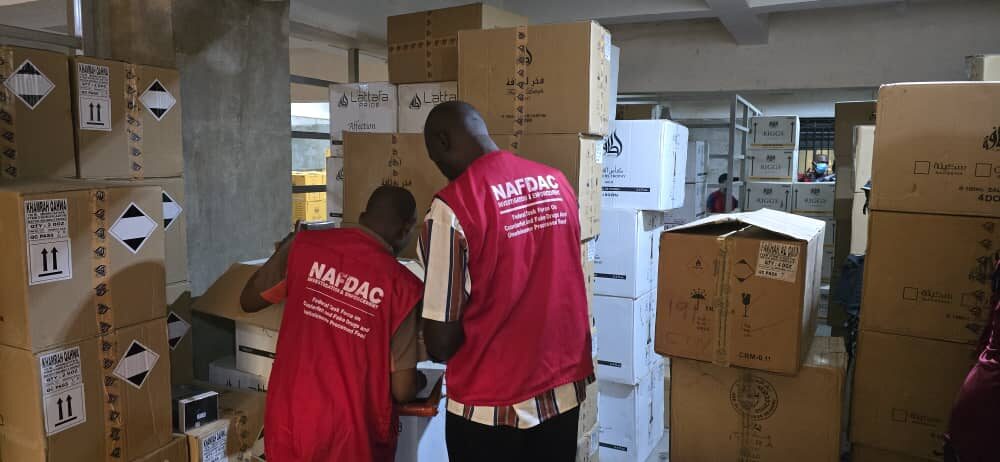
Earlier this month, NAFDAC raided more than 20 illegal stores at Zamfara Plaza within the International Trade Fair Complex in Ojo, Lagos. Syndicates were blending and counterfeiting popular alcoholic brands, revalidating expired drinks for resale and stockpiling banned imports. Goods worth over ₦2 billion were seized. Two suspects were arrested. Two people, for a ₦2 billion operation spread across 20 shops. I will come back to that.
In Agege, the agency stumbled on an illegal herbal factory producing alcoholic bitters and marketing them with a NAFDAC registration number that legitimately belonged to a cough syrup. Somebody picked up a bottle of cough syrup, copied the number and went to market. If Nollywood wrote that script, the critics would say it was too far-fetched.
In Aba, operatives raided five shops at Old Court Road Market and found counterfeit labels, corks, and packaging valued at over ₦200 million, made to pass for Jameson, Glenfiddich, Four Cousins, Lord’s Dry Gin, and —wait for it—Goya Oil. Cooking oil. Mind you, nobody prints ₦200 million worth of fake labels as a side hustle. That is a factory with suppliers, distributors, and customers who may not realise they are customers.
In Port Harcourt, NAFDAC destroyed fake, expired and substandard products worth ₦2.6 billion, a haul of falsified pharmaceuticals, unwholesome food and banned beverages, some of which were intercepted at Onne Port with Customs. In September, the agency incinerated ₦59 million worth of expired donated medicines at the Igwuruta dump site to stop criminals from diverting them back into rural pharmacies. Read that again. Drugs donated to help the sick were about to be resold to the sick, long after they had expired.
Before anybody concludes this is a Lagos or South problem, my state, Niger, was not spared. Enforcement sweeps uncovered stockpiles of expired soft drinks, dairy products, pasta and sweets that had been repackaged for the shelves. It was the sweets that got me. Who buys sweets in this country? Children.
The list goes on. Customs at Onne intercepted container loads of unregistered pharmaceuticals, including restricted codeine syrups and uncertified antibiotics. The Federal Operations Unit ‘A’ of the Customs Service seized smuggled foreign drugs worth over ₦511 million along the Lagos and western border corridors between August and September.
A nationwide sweep this month saw NAFDAC seal 179 illegal outlets, with fake cosmetics and household cleaning agents dominating the seizure logs. Then came the public alerts over falsified anti-malarial drugs carrying the wrong active ingredients, circulating in several states.
Add up the figures from these operations alone, and you are looking at well over ₦5 billion in seized and destroyed goods. That is what we caught. Nobody knows what we swallowed. Remember, these are only the cases that made the news. For every warehouse NAFDAC opens, how many more are humming quietly in Onitsha, Idumota and the back streets of Nyanya? I would rather not guess.
I have written on this page about bandits and terrorists, about villages emptied by killers hiding in the forests of the North-West. So I don’t say this lightly. The people who produce fake drugs are worse than bandits and terrorists.
Some will say that comparison goes too far. A bandit points a gun at you; the man blending fake gin in Ojo never sees the face of the person he harms. Fair enough. But that is exactly what makes him more dangerous. The bandit announces himself. You hear the gunshots, you run, the military responds, the whole country mourns. The fake drug dealer kills on instalment. His victim takes the tablets faithfully, the fever refuses to break, the doctor changes the prescription, the family sells a plot of land, the uncle in Canada sends money, and by the time the kidney or the liver gives up, nobody connects the funeral to the bottle bought at the corner shop two years earlier. Ask any doctor at a teaching hospital how many patients walk in with kidney damage nobody can explain.
Think of a mother in Mokwa or Onitsha treating her child’s malaria with tablets that contain the wrong active ingredient. She has done everything right. She bought the medicine, followed the dosage, and prayed over it. The drug was the problem, and she will never know. A 2023 report by the United Nations Office on Drugs and Crime estimated that falsified and substandard anti-malarials are linked to as many as 267,000 deaths a year in sub-Saharan Africa. The World Health Organisation has also estimated that one in ten medical products in low- and middle-income countries is substandard or falsified. Nigeria, with its population and its malaria burden, carries a frightening share of that.
Then there is the slow poison in the drinks. Methanol-laced spirits, revalidated expired beverages and bitters bottled under a cough syrup’s number end up in the liver, the kidneys and the lungs. People spend millions treating diseases they did not know they had bought over the counter. Some borrow money for transplants in India and still come home in a casket. Fake and underdosed antibiotics commit one more crime: they train bacteria to resist the real thing, so that even genuine drugs stop working. That is a national security threat in slow motion.
Here is the irony that annoys me most. I won’t be surprised if some of the men running these warehouses spend their evenings on social media lambasting the government over bad roads, insecurity and the price of fuel. They want good governance from Aso Rock while they poison their neighbours from a shop in Aba. Charity, as they say, begins at home. So does accountability.
To be fair, NAFDAC deserves credit. The agency has been busier in the last six months than in years, and its officials are taking risks in markets where traders have been known to turn violent. Nigerians have not forgotten that the late Professor Dora Akunyili survived an assassination attempt in 2003 for waging this same war. That we are fighting it again two decades later tells you everything about our habit of solving problems halfway.
Because here is the problem with the raid-and-burn routine. We hear about seizures. We see pictures of bonfires. We rarely hear about convictions. Two arrests in a ₦2 billion operation will not frighten anybody. The Counterfeit and Fake Drugs and Unwholesome Processed Foods (Miscellaneous Provisions) Act still allows a fine of ₦500,000, which is less than what a big counterfeiter at the Trade Fair makes before lunch. The deadline for moving traders out of open drug markets into Coordinated Wholesale Centres has been shifted more times than I can count. Our borders remain as porous as a basket. When the punishment is cheaper than the profit, crime becomes a business plan.
Nigeria must treat this as a national emergency, and the President should say so in those exact words. The National Assembly must amend the law so that anyone who manufactures or knowingly distributes fake drugs that lead to death faces life imprisonment, with every naira, house and car traced to the trade confiscated. Please set up special courts or fast-track divisions so these cases don’t linger for ten years. Publish the names, faces and court dates of those arrested, the same way we publish wanted lists for bandits.
Fund NAFDAC’s laboratories and field officers properly, and extend the scratch-and-verify code system to every essential medicine, from anti-malarials to antibiotics. Whatever it costs to fund the agency is small change next to what families spend flying sick relatives abroad. Finally, close the open drug markets and stop granting extensions.
And to us, ordinary Nigerians: buy from registered pharmacies, check the codes, report suspicious products, and stop rewarding the trader whose “original” is suspiciously cheap. A cheap fake is the most expensive thing you will ever buy.
A society that tolerates a man selling poison in a bottle has lost something no budget can restore. The bandits in the forest want our money and our fear. The counterfeiters in our markets want our money, our trust and our lives. We cannot keep fighting one and shrugging at the other.
We’ve got the edge. Get real-time reports, breaking scoops, and exclusive angles delivered straight to your phone. Don’t settle for stale news. Join LEADERSHIP NEWS on WhatsApp for 24/7 updates →
Join Our WhatsApp Channel