
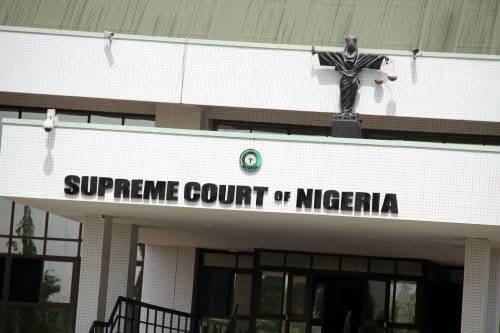
The Supreme Court of Nigeria has affirmed Joshua Ishaku as the duly nominated candidate of the All Progressives Congress (APC) for the 2026 Bwari Area Council chairmanship election, bringing an end to the intra-party legal tussle.
In a 4–1 split decision delivered on Monday, the apex court upheld the dissenting judgement of Justice Okon Abang of the Court of Appeal, Abuja Division, which had earlier recognized Ishaku as the rightful winner of the party’s June 25, 2025 primary election.
Reading the lead judgement, Justice Jamilu Yammama Tukur faulted the majority decision of the Court of Appeal that had affirmed Haruna Audi as the APC candidate. He held that the lower court erred in declaring Ishaku’s suit statute-barred and denying him fair hearing.
“The inevitable conclusion is that the appellant was denied the opportunity to be heard and was denied fair hearing,” Justice Tukur said.
The Supreme Court maintained that the “internal affairs” principle often shielding political parties from judicial scrutiny “is not absolute.”
According to the court, where party guidelines and constitutional rights are violated, “the shield of internal affairs falls away.”
“Where issues transcend domestic party affairs, the court can intervene,” the judgement stated.
Justice Tukur added that only a loser in a primary election is required to exhaust internal party dispute resolution mechanisms before approaching the court — not the declared winner.
“It is contradictory to insist that the appellant ought to have exhausted the party’s internal mechanisms,” the court ruled.
The justices also agreed with Justice Abang’s earlier position that the dispute involved violations of Section 84(14) of the Electoral Act and the APC’s own guidelines, thus falling within the jurisdiction of the courts.
The apex court consequently allowed Ishaku’s appeal, set aside the majority ruling of the Court of Appeal, and affirmed Justice Abang’s dissent. It ordered the relevant electoral authorities to publish Ishaku’s name as the APC’s lawful candidate for the Bwari Area Council poll slated for next Saturday.
Justice Abang’s dissent, now adopted by the Supreme Court, had sharply criticized the earlier findings of the Federal High Court and the Court of Appeal majority, describing their reasoning as “an imaginary position unsupported by law or evidence.”
“Time could not begin to run against a litigant on the basis of a concealed or undisclosed act,” he stated, adding that the respondents’ argument that the cause of action arose earlier was a “legal fiction deliberately created to ensure that the action became statute-barred and was never heard on its merits.”
Justice Abang further faulted the lower court for failing to evaluate key documents; Exhibit J and Exhibit INEC 4, which he described as critical to the just determination of the case.
We’ve got the edge. Get real-time reports, breaking scoops, and exclusive angles delivered straight to your phone. Don’t settle for stale news. Join LEADERSHIP NEWS on WhatsApp for 24/7 updates →
Join Our WhatsApp Channel