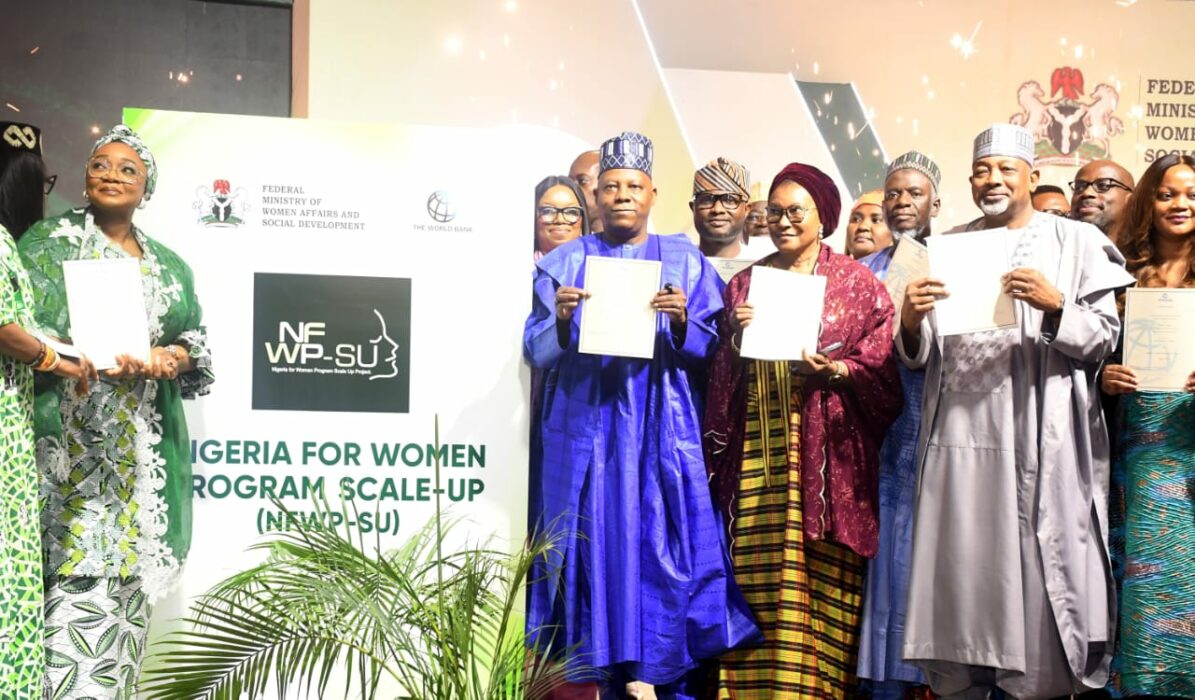
The Federal Government has launched the $540 million Nigeria for Women Programme Scale-Up (NFWP-SU), targeting at least five million women across the 36 States of the federation and the Federal Capital Territory (FCT).
The programme, co-financed by the World Bank alongside the federal and state governments, was designed to strengthen women’s economic empowerment, financial inclusion, and social development nationwide.
The Nigeria for Women Programme Scale-Up is headed by Dr Hadiza Maina.
Speaking at the launch at the Presidential Villa in Abuja, the Minister of Women Affairs and Social Development, Imaan Sulaiman-Ibrahim,
described the initiative as a major shift in Nigeria’s governance framework.
She said, “Today is a structural signal for Nigerian women, children, and families. It is a signal that under your leadership, women are no longer treated as beneficiaries at the margins of development, but as primary drivers of Nigeria’s economic, social, and democratic stability.”
The minister stated that the programme builds on the achievements of Phase I of the Nigeria for Women Project, which was implemented in six states.
According to her, “In just the six states in which Phase I was implemented, 26,577 Women Affinity Groups were formed with over 560,000 members.”
She added that participants recorded significant financial progress, noting that, “Through the Women Affinity Groups formed, they collectively saved over ₦4.9 billion of their own money and have inter-loaned significantly to expand their businesses, cover health costs, and pay school fees.”
The minister described the new phase as a major continental investment in women’s empowerment.
She said, “It is a 540-million-dollar programme, co-financed by the World Bank and the Federal and State Governments, designed to directly reach at least five million women across all 36 states and the FCT.”
She further noted that the programme aligns with national economic priorities, including job creation, food security, rural revitalisation, and financial inclusion.
Highlighting the governance impact of the programme, the minister said participation requirements have already strengthened civic identity among women beneficiaries.
She explained, “In Niger State for instance, during programme rollout, many women, for the first time in their lives, obtained formal identification in order to participate. The fastest and most accessible ID available to them was the voter card.”
She added, “These newly registered women did not stop at programme participation; they became politically visible.”
The minister also announced the rollout of the Happy Woman App, a digital platform designed to connect women to empowerment opportunities.
She said, “This platform will aggregate access to programmes, finance opportunities, skills training, protection services, and market linkages. Our target is 10 million verified women registrations within the next ten months.”
She also highlighted broader reforms undertaken by the ministry, including the review of national child protection frameworks and the development of gender and anti-violence action plans.
The minister described the programme as a long-term national system designed to transform social investment into economic growth.
She said, “Today’s launch is not the end of a journey, it is the ignition of a system… A system that transforms women’s potential into national strength.”
In a goodwill message, chairman of the Nigeria Governors’ Forum (NGF) and governor of Kwara State, AbdulRahman AbdulRazaq, described the programme as a strategic national intervention.
The message, delivered by the deputy governor of Katsina State, Faruk Lawal Jobe, stated, “This initiative represents not only a policy milestone, but a deliberate national choice to place Nigerian women at the very centre of our economic renewal and social stability.”
He said the experience of the first phase of the programme demonstrated the economic value of empowering women.
According to him, “What emerged was more than a development intervention; it was proof that when women are trusted with opportunity, structure, and modest capital, they convert it into enterprise, resilience, and dignity for their families and communities.”
AbdulRazaq added that the scale-up phase represents an evidence-based expansion of the initiative.
He said, “With a combined investment of over half a billion dollars, co-financed by the World Bank, the Federal Government, and State Governments, the programme now aims to reach between four and five million women across all 36 states and the Federal Capital Territory.”
The NGF chairman also reaffirmed governors’ commitment to implementation of the programme.
He stated, “We therefore reaffirm our commitment to supporting states in aligning policies, strengthening implementation capacity, ensuring timely counterpart funding, and embedding accountability so that results are measurable and durable.”
We’ve got the edge. Get real-time reports, breaking scoops, and exclusive angles delivered straight to your phone. Don’t settle for stale news. Join LEADERSHIP NEWS on WhatsApp for 24/7 updates →
Join Our WhatsApp Channel