
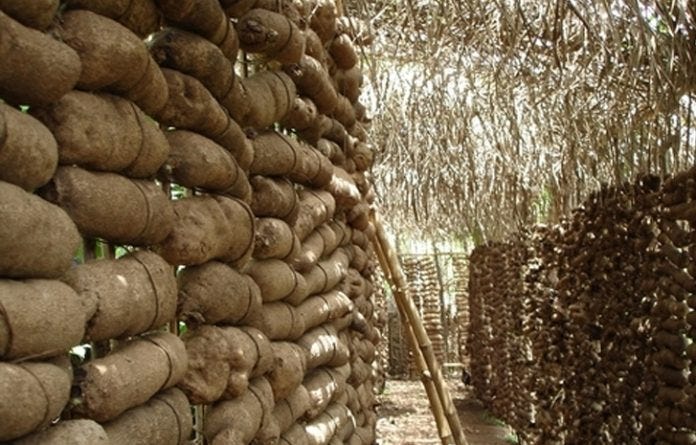
The federal government has promised to reposition Nigeria’s yam industry for global competitiveness, declaring the crop central to its food security and export diversification strategy.
At the National Yam Advocacy Summit in Abuja under the PROSSIVA Project organised by the International Institute of Tropical Agriculture (IITA), the minister of State for Agriculture and Food Security, Aliyu Sabi Abdullahi, said yams remain central to Nigeria’s food security and economic resilience.
The minister said Nigeria currently produces 67.2 million metric tonnes of yams annually, accounting for 67 per cent of global output at an average productivity of 10 metric tonnes per hectare.
Despite this dominance, the country faces an estimated demand of 120 million metric tonnes, leaving a supply gap of over 50 million metric tonnes.
Abdullahi described the shortfall as both a challenge and an opportunity, stressing that modernising the yam value chain remains critical to closing the deficit and expanding Nigeria’s footprint in international markets.
He said agricultural transformation had been elevated under the Renewed Hope Agenda of President Bola Tinubu, with an initiative that classified yams as a Tier-1 crop, reflecting their nationwide consumption and strategic importance.
According to the minister, the ministry targets increasing yields from 10 to 30 metric tonnes per hectare, expanding cultivated land area, and reducing post-harvest losses from 40 per cent to 25 per cent by 2027.
He announced that the former Root and Tuber Expansion Programme had been restructured into the Root and Tuber Industry and Export Development Programme to provide stronger policy backing for yams and related crops.
Abdullahi said, “We also recognise the vast opportunities in yam processing, storage innovation, and export development. By reducing post-harvest losses, standardising quality, and improving traceability, Nigeria can move from being the largest producer of yams to becoming a major exporter of value-added yam products.
“This National Yam Advocacy Summit has reaffirmed our commitment to achieving sustainable food sovereignty based on the core food demands, types, and consumption patterns of Nigerians, and thus, together, we will build a yam sector that is productive, profitable, resilient, and globally competitive”.
Earlier, IITA deputy director-general, Abdoulaiye Tahirou, stressed Africa’s dominance in global yam production, noting that 90 per cent of output comes from the continent, with Nigeria and Ghana leading.
He stressed the importance of research partnerships, improved seed systems and new propagation technologies to transform the sector.
He said innovations such as leaf-bud cutting and other propagation techniques were already improving multiplication rates and disease resistance, with support from international partners including the Bill & Melinda Gates Foundation and the government of Japan.
We’ve got the edge. Get real-time reports, breaking scoops, and exclusive angles delivered straight to your phone. Don’t settle for stale news. Join LEADERSHIP NEWS on WhatsApp for 24/7 updates →
Join Our WhatsApp Channel