
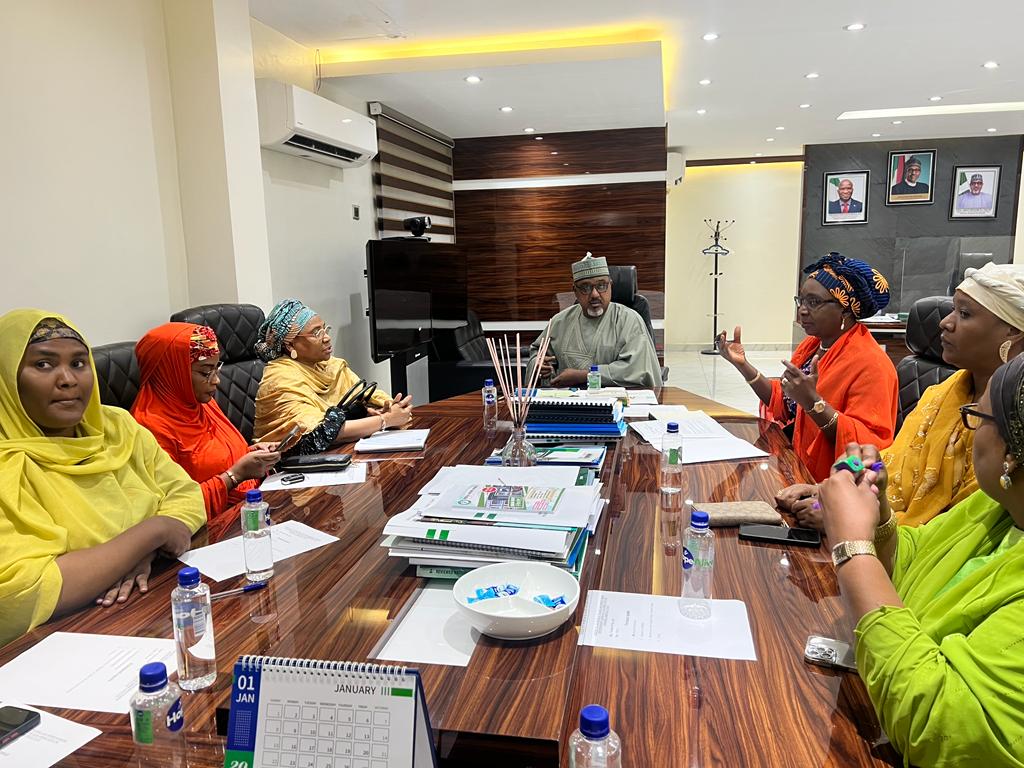
The minister of State for Works and Housing, Umar El-Yakub has disclosed that it is crucial to implement and enforce policies that protect women’s property rights.
This includes legal frameworks that recognize and safeguard women’s ownership and inheritance rights, ensuring that they have equal access to land and property.
According to him, the housing gap for women in Nigeria is multifaceted, stemming from a range of challenges; some are financial constraints, some are discriminatory practices, and in some cultures, women are prevented from owning or accessing land and property.
El-Yakubu made this disclosure yesterday while delivering his closing remarks at a One-Day Workshop on International Women’s Day, 2023, organized by the Girls And Women Enterprenuership Club, (GWINEC) in collaboration with the Federal Ministry of Works and Housing to celebrate the achievements of women and the challenges they face, with the theme: “Bridging the Gender Gap in Housing for Women and Youth,”
The minister noted that a safe and stable environment allows women to flourish, pursue education, engage in economic activities, and contribute to the development of their families and communities.
“By addressing the housing gap, we can create an enabling environment for women to thrive and realize their full potential. Although a female civil servant has every right to own a house just as any male civil servant, due to women’s nature and privileges of having even superpower over their husbands or parents’ properties and houses, many female civil servants intentionally neglect their rights to key into any home schemes.
“Raising awareness and advocating for gender equality in housing is paramount. We must challenge societal norms and perceptions that perpetuate discrimination and limit women’s housing opportunities. Engaging in public discourse, education campaigns, and community mobilization efforts can help shift attitudes, promote inclusivity, and foster a supportive environment for women’s housing rights.
“Furthermore, public-private partnerships are crucial to addressing the housing gap for women. Collaboration between government entities, civil society organizations, and the private sector can yield innovative solutions, secure funding, and create supportive networks to advance women’s access to housing. By leveraging the strengths and resources of different stakeholders, we can accelerate progress and achieve meaningful change.
“Bridging the gender gap in housing for women in Nigeria requires collective action and commitment to support women. In the Federal Ministry of Works and Housing, we are committed to creating more opportunities and more trainings that will enlighten every single woman to know Nigeria is ever ready to accommodate all its citizens equally,” he said.
Earlier, the chairman of Girls And Women Enterprenuership Club, (GWINEC), Dr Hajiya Karima Babangida noted that the poor conditions of the service and low remuneration in the Nigerian Civil Service is a recurring problem in Nigeria.
She stated that from the period Nigeria gained her independence till date, the salaries of the civil servant have been upgraded few times with the last being in 2007. However, the cost of living in the country increases by the year, while the economy of the country has been nose-diving due to several internal and external shocks. Citizens can no longer live comfortably with their take-home pay. What was sold for ₦1 a year ago, is sold for almost five times the price today. Yet, the salaries of civil servants in the country have not been increased.
She said the Girls and Women in Nigeria Entrepreneurship Club (GWINEC) is a registered organization with the Corporate Affairs Commission (CAC) that is designed to improve the livelihood of Nigerian Girls and Women.
According to her, the cooperative is to support both rural and urban, working class, market, and any girls and women from all axes of the country.
She said, one of the main objective of organisation is to collaborate with Federal Ministry of Works and Housing, its parastatal, Shelter Afrique and many more housing developers in making it easier for women to become home owners.
The CEO of Chief Executive Officer of Global Environmental and Climate Conservation Initiative (GECCI), Abdulhamid Tahir Hamid said that adequate housing is a fundamental human right, and it is our responsibility to ensure that all individuals, regardless of gender, have access to safe and secure shelter.
He said, “A safe, secure, affordable and appropriate house and home is a measure of a quality of life that every human being aspires to. Every woman, man and child has a right to adequate housing as a component of the fundamental human right to an adequate standard of living.”
Also, a special assistant to honourable speaker Kaduna State, Hon Hajiyah Ibrahim Arab , said that she is one of the beneficiaries of the first Growing Girls and Women In Nigeria (GWIN) and also served as consultant for/ resource person for the training and employment of GWIN, for both FERMA And FMARD.
She said that the beneficiaries of that programme are always grateful. Adding that we pick up this to training other women.
“So We need to have more women especially in this aspect of gender housing.
“Almost in every culture in this country do not allow women to inherit land and if we can go back to history, we could understand that land actually mostly been inherited.
“The customary laws which do not allow women to inherit land in almost every culture in Nigeria only in the Muslim communities that you can see women inheriting land because Islam allow women to inherit land. So there are many activists who have been fighting to see that the customary laws are over turn.
“If you can see there many cases like that of women are not allow to inherit land but the constitution of Nigeria has already declare the customary laws non and void,” she said.
She said what we all need now is we need the female activists for awareness creation and also some assistance from the government even though they said they have given us 35 affirmative action but how can we achieve it without implementation.
On her part, the Co-Founder and Secretary general of Girls &Women Entrepreneurship Club, Hajiya Habiba Hamza Ahmed, said she has a deep-rooted passion for gender equality and sustainable development.
She said, the club was established as a catalyst for positive change, adding that leadership and vision have paved the way for impactful actions that empower women and improve their access to safe and affordable housing.
She advised women to be proactive, saying that every thing they want if they put themselves down they will do it.
The Bridging the Gender Gap in Housing project which was launched by GWINEC for Nigerian Women & Youth is focusing on working class both private and government workers its mission is to collaborate with Federal Ministry of Works and Housing, its parastatal, Shelter Afrique and many more housing developers in making it easier for women to become home owners in Nigeria.
We’ve got the edge. Get real-time reports, breaking scoops, and exclusive angles delivered straight to your phone. Don’t settle for stale news. Join LEADERSHIP NEWS on WhatsApp for 24/7 updates →
Join Our WhatsApp Channel