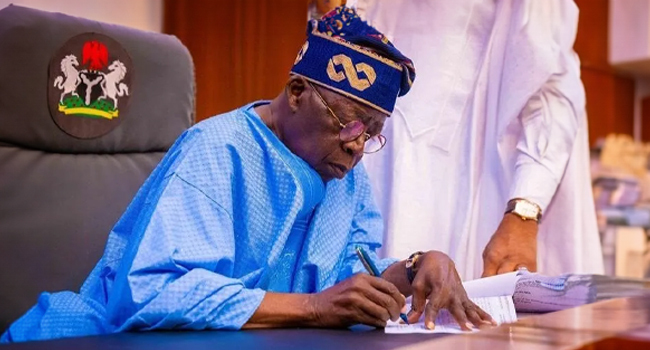
President Bola Tinubu has approved a new investment framework for Nigeria’s deep offshore oil and gas sector, a reform the presidency says could unlock up to $50 billion in fresh investment and revive large-scale offshore projects that have been stalled for decades.
The framework, given legal effect through the Deep Offshore Oil and Gas Projects Incentives (Tax Remission) Order, 2026, replaces the previous approach of negotiating incentives on a project-by-project basis with a transparent, rules-based system built around clear eligibility criteria and defined implementation processes.
According to a statement issued yesterday by the Special Adviser to the President on Information and Strategy, Bayo Onanuga, the reform will kick off with the roughly $10 billion Bonga South West project and will apply across multiple categories of qualifying deep offshore developments going forward.
The policy shift follows engagement between President Tinubu and Shell plc chief executive Wael Sawan, during which the president directed officials to develop new measures to unlock investment in Nigeria’s deep-offshore pipeline. Rather than crafting a solution for a single project, the Federal Government opted to build a broader framework covering the sector.
As part of the approval, NNPC Limited, as the government’s nominated counterparty under existing Production Sharing Contracts, has been cleared to proceed with amending eligible PSCs to give effect to the new framework.
The president’s special adviser on oil and gas, Olu Arowolo-Verheijen, said local content is central to the reform.
“Projects qualifying under the framework will maximise execution within Nigeria wherever commercially and technically feasible, strengthening domestic engineering, fabrication, marine logistics, technical services and project management,” she said. “The objective is not only to increase investment and production, but also to create skilled jobs, deepen local supply chains and position Nigeria as Africa’s regional hub for deep offshore project execution.”
The presidency said the framework was developed through an extensive inter-agency process involving the Federal Ministry of Justice, the Federal Ministry of Finance, the Federal Ministry of Petroleum Resources, the Nigeria Revenue Service, NNPC Limited, the Nigerian Upstream Petroleum Regulatory Commission, the Nigerian Content Development and Monitoring Board, and industry operators.
President Tinubu commended the agencies and stakeholders involved, saying their collaboration, technical expertise and commitment had helped shape the framework.
“The countries that attract long-term investment are not necessarily those with the greatest natural resources. They are the ones that provide the greatest certainty,” Tinubu said. “This reform reflects our determination to build an investment environment defined by clear rules, strong institutions and enduring partnerships. We are creating the conditions for capital to flow, for Nigerian businesses to grow, for our people to prosper and for our natural resources to deliver lasting national value.”
We’ve got the edge. Get real-time reports, breaking scoops, and exclusive angles delivered straight to your phone. Don’t settle for stale news. Join LEADERSHIP NEWS on WhatsApp for 24/7 updates →
Join Our WhatsApp Channel