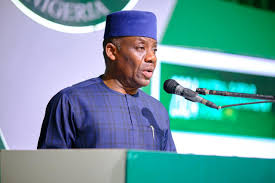
Minister of Education, Maruf Alausa, has disclosed that the Federal Government has returned over one million out-of-school children to classrooms within the last 30 months as part of ongoing reforms aimed at tackling Nigeria’s education crisis.
Alausa also challenged widely quoted figures by UNICEF and UNESCO placing Nigeria’s out-of-school children population at about 18 million, insisting that ongoing government data mapping indicates the actual figure could be far lower.
Speaking on Politics Today on Channels Television, the minister said the Federal Government had already mapped out-of-school children across seven states, including Akwa Ibom, where he said officials found it difficult locating affected children.
“Today, I can tell you that we’ve moved over one million children on the street back to school.
“We’re doing data mapping of out-of-school children as we continue aggressive intervention in moving children back to school,” he said.
According to him, the government’s pilot exercise in Kaduna State revealed significant discrepancies in existing global estimates.
He explained that while UNICEF data estimated Kaduna had 1.8 million out-of-school children, the state-wide mapping exercise conducted by the Federal Government identified about 700,000.
“We’ve mapped the entire out-of-school children in Kaduna State. We only have 700,000, but UNICEF data said 1.8 million,” he stated.
The minister added that preliminary findings from ongoing nationwide sampling suggest Nigeria’s out-of-school population may currently be below eight million, although he admitted the figure remained “too high.”
Alausa said the government was expanding interventions to address the crisis through partnerships with private schools, school feeding programmes and increased collaboration with state governments.
He disclosed that the Federal Government would soon begin paying private schools on a per-child basis to absorb out-of-school children, while plans were underway to roll out a nationwide school feeding programme tied directly to enrolment.
The minister also defended recent education reforms introduced by the administration of President Bola Ahmed Tinubu, including the removal of the UTME requirement for admission into colleges of education and selected non-technology agricultural programmes in polytechnics.
He said the reforms were aimed at expanding access to tertiary education, improving teacher quality and equipping young Nigerians with technical and entrepreneurial skills.
According to him, the Federal Government has already modernised curricula in colleges of education to include courses such as Artificial Intelligence and Education, Computer Science and Education, and Engineering and Education.
Alausa further stated that about 160,000 Nigerians are currently undergoing technical and vocational training in 1,200 centres nationwide under government-supported programmes.
We’ve got the edge. Get real-time reports, breaking scoops, and exclusive angles delivered straight to your phone. Don’t settle for stale news. Join LEADERSHIP NEWS on WhatsApp for 24/7 updates →
Join Our WhatsApp Channel