
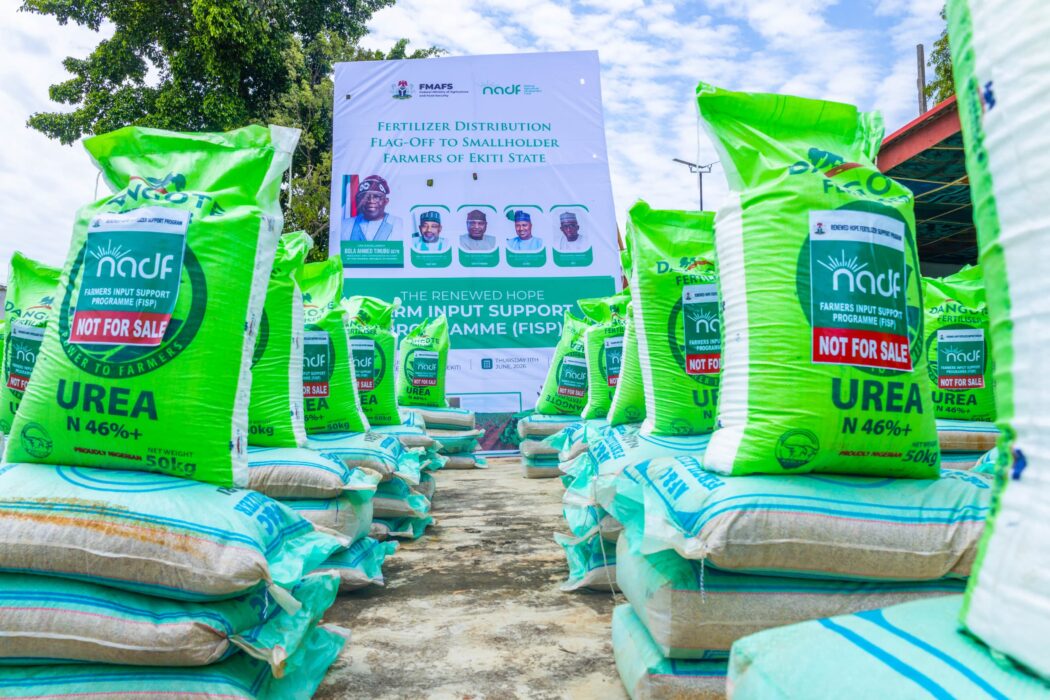
The federal government’s nationwide intervention to provide 515,720 bags of subsidised urea and NPK fertiliser to 128,930 smallholder farmers is expected to strengthen food production in 2026 by addressing one of the most persistent constraints confronting Nigerian farmers: access to affordable and quality farm inputs.
Implemented by the National Agricultural Development Fund (NADF) under the Renewed Hope Farm Input Support Programme (FISP), the intervention covers 25 states and the Federal Capital Territory and is designed around the realities of smallholder agriculture.
According to NADF, each beneficiary is to receive four bags of fertiliser, with the programme targeting farmers cultivating less than 0.5 hectares. At a time when high input costs have constrained production and squeezed farm incomes, the intervention is intended to lower production expenses while helping farmers raise yields.
Vice President Kashim Shettima, who flagged off the national programme in Abuja, said the intervention was part of the Federal Government’s broader effort to improve agricultural productivity, strengthen food security and raise farmers’ livelihoods under President Bola Tinubu’s Renewed Hope Agenda.
The Federal Government’s expectation is that increased production will also help moderate food supply pressures and improve the resilience of rural households.
For farmers, lower input costs can create room for greater investment in cultivation; for consumers, increased output can help ease pressure on food markets.
Shettima who was represented by the Minister of State for Agriculture and Food Security, Aliyu Sabi Abdullahi said the scale of the intervention demonstrated the administration’s commitment to supporting farmers and improving agricultural productivity.
“The provision of 515,720 bags of urea and NPK fertilisers to 128,930 smallholder farmers underscores this administration’s resolve to uplift our farmers and enhance agricultural productivity,” he said.
He also stressed the need for transparency in the distribution process, urging implementing agencies and stakeholders to ensure that the inputs reach their intended beneficiaries, particularly women, youths and vulnerable farmers.
The national rollout also includes 11,210 bags for 2,930 registered farmers in the FCT.
NADF Executive Secretary, Mohammed Abu Ibrahim, said the intervention was being implemented at a critical point in the farming season, with the objective of reducing production costs, increasing yields and strengthening the country’s food supply.
“Food security is not a side issue. It is a national priority. It is central to economic stability, rural prosperity, job creation and the well-being of the Nigerian household.
FISP is not fertiliser distribution for the sake of distribution. It is targeted support designed to get fertiliser to the right farmers, for the right crops, at the right time. Our focus is on increasing productivity, improving farm output and supporting a more stable food market,” he said.
He said the programme was deliberately designed to ensure that support reached genuine farmers cultivating crops considered important to food security and economic growth.
In the North Central, 80,640 bags are being provided to 20,160 farmers in Niger, Benue, Nasarawa and Kwara states.
Ibrahim explained that the intervention was tailored to priority crops, including rice, maize and yam in Niger and rice, yam and soybean in Benue, which he noted that reflected NADF’s strategy of matching inputs with local production potential.
The North-West receives the largest zonal allocation, with 100,800 bags going to 25,200 farmers across Kaduna, Kano, Katsina, Kebbi and Jigawa states.
NADF said it was supporting more than 5,000 ginger farmers affected by blight in Kaduna and assisting flood-affected onion farmers in Kebbi and Sokoto. More than 1,800 extension advisory workers are also expected to be deployed nationwide to provide technical guidance and improve farmers’ application of inputs.
In the South-West, 80,640 bags are being distributed to 20,160 farmers across the participating states, while the South-East is receiving the same quantity for an equal number of beneficiaries in Imo, Enugu, Anambra and Ebonyi.
In the South-South, another 80,640 bags are being provided to 20,160 farmers in Cross River, Akwa Ibom, Delta and Edo. Together, the three southern zones account for 241,920 bags supporting 60,480 farmers.
According to Ibrahim, the geographical spread is significant because Nigeria’s food supply depends heavily on millions of smallholder farmers operating under different climatic, soil and production conditions.
By directing fertiliser to priority food crops and linking each bag to a verified farmer, the programme is expected to improve the likelihood that public input support translates into additional output rather than simply increasing access to subsidised commodities.
NADF has also introduced safeguards intended to reduce diversion. The fertilisers are locally produced, traceable and marked “Not for Sale”, while beneficiaries are subjected to validation, duplication screening and documentation.
The Fund said monitoring and evaluation would be used to assess productivity and yield improvements after the farming season.
In the South-East, NADF specifically linked the programme to indigenous fertiliser production, jobs and wider value-chain development. The approach therefore seeks to connect farm-level support with domestic manufacturing and rural economic activity.
The timing is equally important. The programme is being implemented during the 2026 wet-season farming cycle, when demand for fertiliser is high. Timely access can help farmers apply nutrients during critical stages of crop development, potentially reducing the production losses associated with delayed or inadequate input use.
The Fund has said it intends to track productivity, yields and the wider impact on beneficiaries. It is also finalising a Harmonised Fertilizer Recommendations Manual for Crops in Nigeria to guide farmers on scientifically appropriate application rates.
We’ve got the edge. Get real-time reports, breaking scoops, and exclusive angles delivered straight to your phone. Don’t settle for stale news. Join LEADERSHIP NEWS on WhatsApp for 24/7 updates →
Join Our WhatsApp Channel