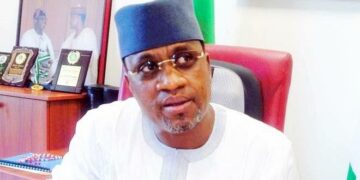

A former Cross River State governor and presidential candidate of the Peoples Redemption Party (PRP), Donald Duke, has faulted Nigeria’s currency management policy.
He argued that floating the naira without strengthening local industries and domestic production is worsening the economic hardship facing Nigerians.
Duke, who spoke with journalists in Abuja on Tuesday, also blamed high interest rates, rising fuel costs and excessive government spending for fuelling inflation.
He warned that Nigeria’s dependence on imported goods was undermining job creation and economic stability.
Duke argued that the government should determine an appropriate exchange rate for the naira and implement policies to achieve and sustain it, rather than allow the currency to depreciate without addressing the structural weaknesses of the economy.
“No country floats its currency. The currency is your economic worth. It is like floating your value. As a human being, what is your worth? Are you going to float your worth? You manage your worth. You manage your currency,” he said.
Duke added that Nigeria must determine a realistic exchange rate and develop the productive capacity required to support it.
“You have to sit down and determine what an exchange rate should be. So, if you say a fair exchange rate for us would be 500, 600 naira to a dollar, fine, how do we achieve that?
“You need foreign currencies to allow you to import your necessities, but you must develop the local industry.
“Now, when you float the currency, you impoverish your people further because they’re not even developing their local industry and so, everybody’s importing one thing or another.
“That’s why I said if the naira becomes one naira to two dollars, everybody will clap. But how can you just keep on importing more?” he asked.
The former governor maintained that Nigeria should focus on reducing its dependence on foreign goods by identifying products that could be manufactured locally, thereby conserving foreign exchange and creating employment opportunities.
According to him, countries deliberately pursue policies to protect their economic interests and sustain their currencies, adding that Nigeria should adopt a similar approach by strengthening domestic production.
“You look at the currency and you look at the value you want to sustain. Everybody does it. The Chinese do it. The Americans do it. They’re not going to allow their currency to fall.
“Then you look at what it is that we ought to do to achieve the value that we think we ought to be.
“So, what are the things that we’re importing that we can do without and make sure that they’re done here in Nigeria? That’s the way we ought to be thinking.
“I mean, doing it in Nigeria, we’ll be creating jobs for our people. And if you’re creating jobs for our people, you’re creating economic stability for your people. As long as you continue importing, you’re creating jobs overseas,” he said.
Duke also lamented what he described as the neglect of balance of trade in economic policy discussions, arguing that Nigeria must pay closer attention to the relationship between its imports, exports and foreign investment.
“Nobody’s even talking about balance of trade anymore. Balance of trade is: I buy so much from you, you buy so much from me. If I have nothing to give you, then you invest in me.
“So you balance what goes out to what comes in,” he said.
On monetary policy, Duke criticised the Central Bank of Nigeria’s high interest rate regime, arguing that the cost of borrowing was discouraging investment and restricting businesses’ access to funds for productive activities.
He said he had discussed the issue with the CBN governor, who, according to him, defended high interest rates as a measure to contain inflation.
Duke, however, argued that the approach failed to adequately address the underlying drivers of rising prices, particularly fuel costs and transportation.
“I will also talk about the interest rate regime. I’ve had this conversation with the governor of the Central Bank.
“They believe that the interest rate is so high because they’re trying to stem inflation.
“I said, well, there’s a misalignment between monetary and fiscal policy. Monetary policy has interest rates and all that.
“But interest rates don’t cause inflation. The price of your fuel causes inflation. The high cost of your fuel causes inflation because everything moves through transportation,” he said.
He added that prevailing interest rates had made borrowing unattractive and increasingly difficult for businesses to sustain.
“But right now, because of your interest rates, no one will borrow money today. They won’t give it because they know you can’t pay for it,” he said.
The former governor also criticised what he described as excessive government expenditure, particularly on imported goods, arguing that public institutions should prioritise locally manufactured products.
“The second thing is the unbridled spending by the governments. If you go to government establishments, literally everything is imported. Vehicles, everything is imported.
“When you learn to start making those things here, and you patronise yourself, you don’t put pressure on the exchange rates because they’re made locally.
“And secondly, you’re creating jobs. But more importantly, you’re localising your expenditure, your growth,” he said.
Duke maintained that directing government expenditure towards domestic industries would help reduce pressure on foreign exchange, stimulate local manufacturing and expand employment opportunities.
On political leadership, he argued that age should not be the primary consideration in assessing the capacity of political officeholders, stressing that competence and the quality of appointments were more important.
“Age doesn’t affect your brain,” he said.
He also expressed concern that political considerations were increasingly influencing government appointments at the expense of effective governance.
“When a government sets up the cabinet, you see the number of politicians that are playing with it. A lot of the appointments are based on politics and not on governance,” he said.
Duke further expressed enthusiasm about the field of presidential aspirants, saying he looked forward to debates that would allow candidates to explain their policies and proposed solutions to Nigeria’s challenges.
He specifically mentioned Adewole Adebayo of the Social Democratic Party (SDP) and Peter Obi of the National Democratic Congress (NDC), expressing hope that the presidential contest would feature substantive discussions on the country’s future.
We’ve got the edge. Get real-time reports, breaking scoops, and exclusive angles delivered straight to your phone. Don’t settle for stale news. Join LEADERSHIP NEWS on WhatsApp for 24/7 updates →
Join Our WhatsApp Channel