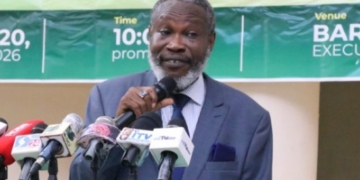

A coalition of tech professionals and educators, under the auspices of VarsityMentor, in collaboration and with support from Gen AI CS in Education, Google Org., and PETGA Initiatives, has held a three-day intensive summit involving 27 universities from across the continent.
The event, which officially opened on Wednesday, 18th February 2026, underscored the importance of modernising curricula to equip students with practical, industry-aligned skills. The world is evolving rapidly, and so is the job market. Graduates are already struggling to find employment, and if action is not taken now, the situation will only worsen,” she warned.
A leading Google technology expert and founder of Varsity Mentor, Obinna Anya, has emphasised that African universities must take control of integrating artificial intelligence (AI) into education.
He cautioned that if the continent merely emulates Western models, it risks falling behind in the global AI race.
Speaking at a high-level summit attended by university lecturers, industry leaders, and government officials, Anya shared insights from his experience in the international tech ecosystem, where AI is already transforming teaching, learning, and assessment.
“AI is revolutionising many industries, and education is among the most impacted. It’s changing how students learn, how teachers teach, and how evaluations are conducted. Africa cannot afford to be left out of this transformation.”Anya stated.
The summit was intentionally designed to go beyond theoretical discussions, creating a platform for educators, policymakers, and industry experts to collectively explore what AI-driven change truly means for African higher education.
While a key focus was on the future of computer science education and ensuring its relevance in the digital age.“Instead of copying what Europe and America are doing, we need to ask: what skills and knowledge should we equip our students with to thrive in the information era? And what unique contributions can Africa make to the global AI dialogue?” Anya explained.
The feedback from participants indicates that momentum is already building with many lecturers expressing excitement about the practical value they could bring back to their institutions.“ The educators are motivated. They see clear, actionable insights they can implement,” Anya noted.
He underscored that the summit is not a one-off event but the beginning of ongoing engagement, with plans to monitor how AI awareness influences curriculum reforms and teaching approaches over time. “We’re committed to tracking progress, how curricula evolve, how teaching methods change and measuring the real impact of this initiative,” he said.
While acknowledging that bridging Africa’s AI education gap is a long-term effort, Anya stressed that raising awareness is a crucial first step.
Addressing concerns about AI’s risks, he warned that the real danger lies in uncritical dependence on technology.
“AI itself isn’t inherently dangerous, but our over-reliance on it can be harmful, “Many people no longer think independently; they scroll social media and assume they’re thinking, when they’re just copying what’s on their feeds.”Anya cautioned.
He called on educators and professionals to teach students to harness AI as a tool for critical thinking, rather than treating it as a substitute.
As AI continues to reshape global education systems, African universities are at a pivotal juncture, either actively shaping the future or passively consuming foreign-developed ideas.
“This awareness marks the beginning of transformation. It’s where meaningful change starts,” he concluded.
With the three-day summit aimed at rethinking computer science education, African universities are taking concrete steps to prevent falling further behind in AI development. Addressing the rising youth unemployment, the decreasing relevance of traditional, theory-heavy computer science programs. The summit focused on equipping lecturers with practical tools and approaches they could implement immediately.
Technical Programme Manager at Google, Valerie Ehimhem, noted “lecturers now have new resources and methods to improve their teaching, and we’re already seeing positive changes,” she said.
She emphasised that government backing is critical to scaling these efforts. Without adequate labs, GPUs, and access to real-world tools, students cannot gain the practical experience needed for today’s digital economy.
The coalition advocates for creating AI and other digital solutions rooted in African contexts, rather than relying solely on imported models.
The summit is intended as the beginning, not a one-time event. Organisers have been working virtually with faculty for over a year and plan to continue collaborating with universities and policymakers.
Ehimhem framed the initiative as a pathway to economic growth and social stability—preparing students to work locally and globally, start businesses, and solve regional problems. “Graduates should be able to work anywhere, earn income, and contribute to national development,” she said.
While urging governments to act swiftly, Ehimhem also called on companies, NGOs, and individuals to invest in infrastructure, internships, and skills development.
She affirmed that Students and Lecturers are ready amd the private sector can help bridge the gap.
Representing a diverse group from Nigeria, Ghana, Ethiopia, Kenya, Malawi, and South Africa, the summit underscores that this is an African-wide challenge—and opportunity.
“This is not just a Nigerian problem. “It’s an African one, and we are committed to leading the change,” Ehimhem said
Site Reliability Engineer at Google, Adekunle Adeyemo, highlighted that outdated curricula no longer reflect the fast-evolving digital landscape. “Africa has often followed behind. Now is the time to catch up, as AI offers us the chance to join the train if we act now”
He added, “AI can help us personalise education at scale. The way we use these tools, whether small tweaks or revolutionary shifts, is up to us”
Adeyemo also addressed fears about AI’s cultural biases, emphasising the importance of African-led AI development.
We can’t afford to be passive consumers of foreign AI systems. Africa must build solutions that reflect our values, cultures, and realities,” he warned.
We’ve got the edge. Get real-time reports, breaking scoops, and exclusive angles delivered straight to your phone. Don’t settle for stale news. Join LEADERSHIP NEWS on WhatsApp for 24/7 updates →
Join Our WhatsApp Channel