One tread that is common in Nigeria’s public university system is the issue of strike, which negatively obstructs academic and partly administrative activities of the Universities.
And this is characterised by prolonged strikes, as a result of funding shortfalls, poor welfare packages and administrative inefficiencies, which often becomes difficult for government to address. And even when platform is created for meaningful discussion, it takes longer than necessary to reach an agreeable conclusion.
In the case of TSU, Jalingo, the strike did not last for more than one month, (February 18 and March 18, 2026), the Union leaders have shown grate sense of understanding, maturity and responsiveness, considering Governor Agbu Kefas‘s huge investment in education.
This was the typical scenario when the Academic Staff Union of University (ASUU), and its Non-academics counterparts of Taraba State University (TSU) chapters embarked on indefinite strike action that lasted for five weeks.
The issues astake which has been the born of contention since 2023, when Governor Kefas assumed office, was intended to cripple the institution and make mess the policy thrust of the governor in education.
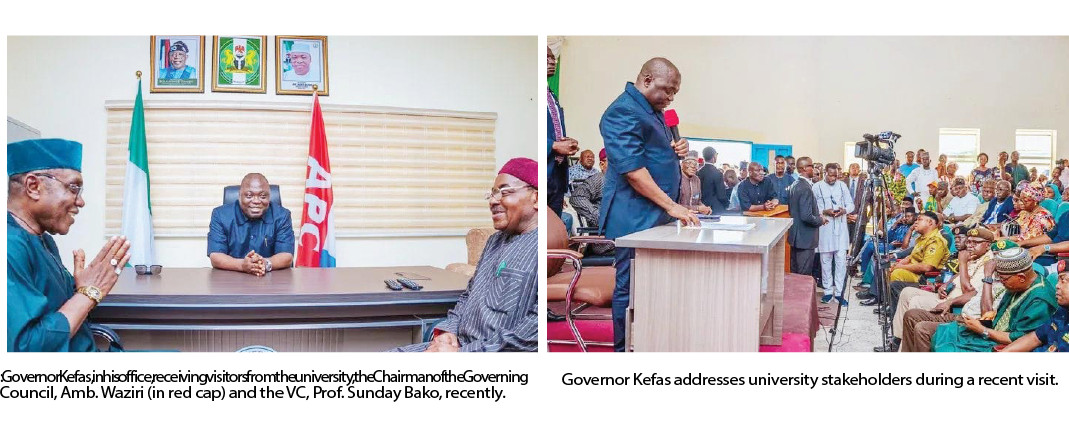
Obviously, the protesters (ASUU) were not given any breathing space since the day they proceeded on the strike, as Governor Kefas, understanding the negative impact on the students and the entire university community, quickly constituted a committee to interface with the union leaders.
Like the proverbial statement, „a child that refuses to let his mother sleep, he will also not sleep“, played out during negotiations with the unions. For both parties, it was a win win thing, whereas, out of the seven demands of the unions, the state government, beyond propaganda and paper documentations, expressly met six of their demands.
Some of the issues included a functional pension scheme for the university, failure to pay of backlog of outstanding salaries owed it members, the inability of the government to settle accumulated Earned Academic Allowances (EAA); and the non-implementation of the newly negotiated ASUU-FGN agreement of 2025, Constitution of governing council among others.
With Governor Kefas ambitious reforms to drive the desired change at TSU, Jalingo, it is save to say that a a different narrative is gradually taking shape, driven by the interventionist approach of the governor, who has placed the institution at the centre of his administration’s education agenda.
It is disturbing to know that, since assumption into office in 2023, Governor Kefas inherited a university burdened by years of accumulated challenges that had stifled its growth and disrupted its academic pattern. Some of which are salary backlogs stretching close to two years, unpaid allowances running into billions, stagnated promotions, weak infrastructure, and the absence of a fully functional governance structure combined to create an atmosphere of uncertainty.
For the students, the situation translated into an unstable academic calendar punctuated by frequent industrial actions, while staff grappled with declining morale, thereby weakening the system.
Faced with this reality he met on ground, the governor moved to stabilise the system, beginning with one of the most critical pressure points, staff welfare. In a significant policy shift, the state government assumed full responsibility for the payment of salaries at the university.
Previously, the institution had relied heavily on internally generated revenue to fund about 70 percent of its wage bill, with the government contributing the balance of 30%. However, following the administration’s decision to slash tuition fees by 50 percent to ease the burden on families, that model became unsustainable, thereby compiling the state government to stepped in and to absorb the full cost, which raised the monthly salary bill from about N308 million to over N637 million.
This intervention, though costly, amidst security challenges confronting the state, has ensured consistency in salary payments, a development that both government officials and union leaders acknowledge has not faltered since the policy was introduced.
Beyond regular salaries, the administration of Governor Kefas has also committed substantial resources to offset inherited liabilities, where as more than N1 billion has been paid towards outstanding salary arrears, while significant sums have been released to address earned academic and administrative allowances owed to the staff.
In a bid to bring a lasting resolution to the lingering disputes with the unions, the government recently approved over N3.1 billion to cover outstanding demands. The disbursement plan, already in motion, includes initial releases of N200 million and an additional N300 million, with provisions for continued monthly payments. These steps reflect a deliberate attempt to restore trust and demonstrate good faith, even as the government contends with fluctuating revenues and competing demands across other sectors.
Parallel to financial interventions, the Kefas administration has embarked on an ambitious programme of infrastructure renewal at the university, which ended years of neglect of student accommodation, poor condition of learning facilities, thereby limiting the institution’s ability to provide a conducive academic environment. One of the most notable projects is the comprehensive renovation of the Zenith Hostel, valued at over N2 billion, which has significantly improved living conditions for students. Closely related is the construction of the Okowa Girls Hostel, a modern facility designed to address the shortage of campus accommodation for female students.
Within the period under review, academic infrastructure has also received needed attention, with the construction of a 700- seater capacity lecture theatre, aimed at enhancing teaching and learning, particularly for large classes. These projects signal a shift from reactive maintenance to deliberate expansion, which positioning the university to better accommodate its growing population and academic needs.
On the physical development at the institution, reforms have been extended into the institutional and academic framework, as the reconstitution of the governing council, has restored a critical layer of oversight, while the delayed staff promotions have resumed, with associated arrears fully settled.
Aside from this, the university has commenced accreditation processes, which previously strained it limited resources, a development which is now being supported by the state, with over N1 billion approved for accreditation exercises across tertiary institutions, including TSU, Jalingo.
For instance, programmes that once struggled to secure accreditation, including those in key faculties, have been regularised, while the broader tertiary education system in the state is witnessing a revival.
Also, institutions that had gone decades without convocation ceremonies are now being repositioned to hold them, marking a return to normal academic traditions and standards. The impact of these measures is gradually becoming evident in each of the tertiary institutions, with TSU receiving the maximum attention.
Central to Kefas’ education policy is the balancing act between expanding access and maintaining institutional sustainability, as the reduction in tuition fees has eased financial pressure on students and families, particularly in a state where many households bear the burden of extended family responsibilities.
The initiative, however, has also reduced the university’s internally generated revenue, which necessitated increased government support.
The governor has on several occasions, consistently argued that universities must evolve beyond dependence on tuition fees, where he advocated for innovation, partnerships and research-driven funding models.
With this, plans are underway to link TSU with international institutions and investors, including the proposals for specialised academies and research collaborations. One of such initiative is the livestock development academy backed by foreign partners, which highlighted the potential for the university to serve as a hub for applied research and economic development.
Despite the scale of these interventions the administration of Governor Kefas in less than three years, industrial unrest has remained a recurring challenge, an unnecessary action orchestrated to frustrate governor Kefas policy on free and compulsory education to indigene of the state.
The persistence of strikes, does not only question the genuineness of the dispute and, it has drawn strong reactions from the governor, who also questioned their timing and impact, particularly in light of ongoing efforts to address longstanding grievances.
While acknowledging the legitimacy of some of the demands by the unions leaders, Governor Kefas has emphasised the need for dialogue instead, and warned against repeated disruptions, which ultimately poses harm on students and undermined the institution’s credibility. The governor‘s approach has combined negotiation with a readiness to enforce structural changes where necessary, with high-level engagements involving union leaders, university management and government officials convened to find common ground, while proposals for staff profiling and systemic overhaul signal a determination to address deeper institutional weaknesses.
In comparison, there are universities, including federal universities are have not done half of what Governor Agbu Kefas has done and is doing at TSU.
These developments at Taraba State University are part of a broader reform agenda, aimed at repositioning the education sector across the state. The administration under review has restructured the sector into distinct segments: basic, secondary and vocational, and tertiary education, to improve focus and efficiency.
At the same time, efforts to eliminate financial leakages at the university underscore a wider commitment to accountability.
While the journey towards full stabilisation is far from complete, the scale and depth of intervention at TSU represent a significant departure from the past. The university, once emblematic of systemic challenges in public higher education, is gradually being repositioned as a focal point of reform and renewal
For students, the most immediate expectation remains a stable academic calendar that allows them to complete their studies without disruption. For staff as well, the priority is the full settlement of outstanding entitlements and a more predictable framework for engagement with government. For the state, the university stands as both a challenge and an opportunity, a test of whether sustained political will can translate into lasting institutional transformation
As these reforms continue to unfold, Governor Agbu Kefas’ imprint on Taraba State University is becoming increasingly evident. What remains to be seen is how enduring these changes will be, and whether they can ultimately redefine the trajectory of higher education in the state.
We’ve got the edge. Get real-time reports, breaking scoops, and exclusive angles delivered straight to your phone. Don’t settle for stale news. Join LEADERSHIP NEWS on WhatsApp for 24/7 updates →
Join Our WhatsApp Channel